OSHA classifies all Cr(VI) compounds as carcinogenic, and its exposure limits under 29 CFR 1910.1026 set an 8-hour permissible exposure limit of just 5 µg/m³. California's 2023 Chrome Plating ATCM now bans new hexavalent chromium facilities outright, with a full functional-plating phaseout scheduled for 2039.
Manufacturers in metal forming, aerospace, and tooling are responding by shifting to PVD coatings, thermal spray, electroless nickel, and nickel-tungsten. These alternatives aren't just safer. Many outperform hard chrome on tool life, cost, and turnaround. This guide breaks down the top providers and helps you pick the right fit for your parts.
TL;DR
- Hard chrome plating faces mounting health, environmental, and regulatory pressure in the US
- PVD, thermal spray, electroless nickel, and nickel-tungsten are the leading replacements
- Match the coating to part size, application, and required hardness
- Compare providers on coating type, turnaround, and industry focus before you commit
Overview of Hard Chrome Plating Alternatives in US Manufacturing
Hard chrome alternatives are coating processes that deliver similar wear resistance and hardness without the hexavalent chromium exposure risk. For metal forming, aerospace, and tooling industries, that distinction now carries real financial weight.
Regulatory pressure is reshaping the market fast. Between OSHA exposure limits and EPA's chromium electroplating NESHAP rules, plus state-level restrictions like California's ATCM, hard chrome shops face rising compliance costs. One NCMS-documented case put a single DoD facility's compliance cost above $14 million over two years.
Common hard chrome alternatives US manufacturers evaluate include:
- PVD coatings (TiN, CrN, AlTiN, TiCN) for cutting tools, dies, and wear components
- Thermal spray (HVOF and similar) for rebuilds and large wear surfaces
- Electroless nickel and composite nickel for corrosion-plus-wear duty
- Nitriding / nitrocarburizing for case hardening without a plated layer
- Trivalent chrome where a chrome-like finish is still required under tighter rules
Below are five providers covering different corners of that US market, from precision tooling to large aerospace components.
Top Alternatives to Hard Chrome Plating for US Manufacturers
When you compare these options, weigh coating performance, certifications, turnaround, and whether the provider can support your plant locations.
Surface Solutions (PVD Coatings)
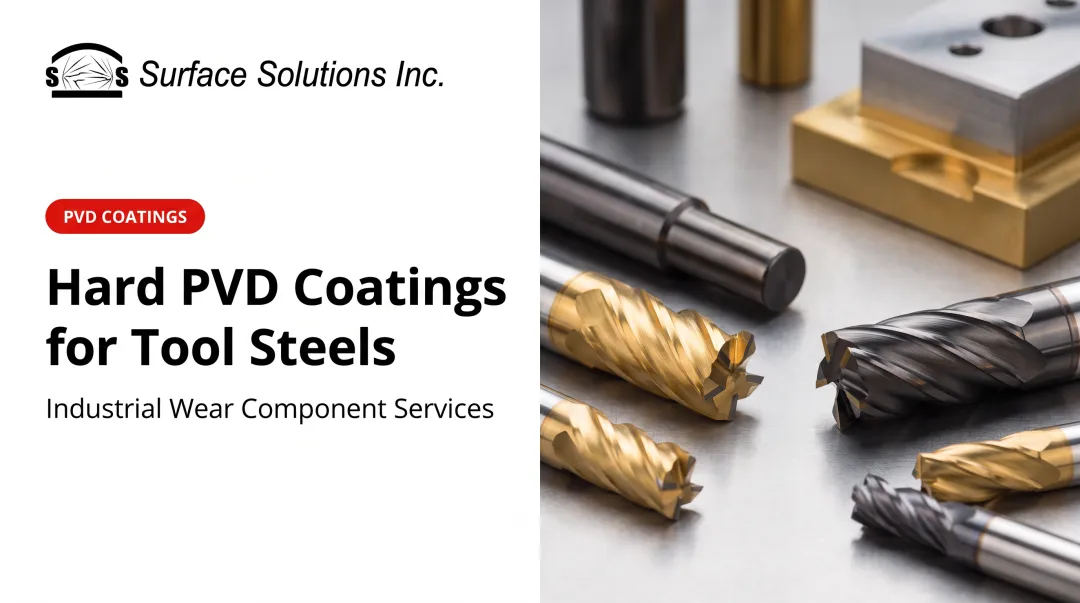
Based in Fridley, Minnesota, Surface Solutions applies PVD coatings for metal forming, punching, cutting tool, and medical device manufacturers nationwide.
Its coatings target a common shop problem: tools that need constant resharpening or replacement.
Documented results include:
- 6x tool life on a three-corner carbide insert with AlTiN machining 304 stainless, with no speed or feed changes
- 500+ parts per run in stainless-steel drawing with CrN, versus 15 parts too hot to touch after switching from Alpha™
| Coating Type | Best For | Key Benefit |
|---|---|---|
| PVD (Alpha, CrN, TiN, AlTiN, TiCN) | Punches, dies, cutting tools, medical device components | Extended tool life, reduced sharpening frequency, better surface finish |

HTS Coatings (Thermal Spray & Electroless Nickel)
HTS Coatings in Madison, Illinois, pairs thermal spray carbide with electroless nickel as hexavalent chrome alternatives and holds ISO 9001:2015 certification.
Thermal spray coatings can be removed and reapplied, unlike hard chrome, and they work across a wide range of substrates and larger parts.
| Coating Type | Best For | Key Benefit |
|---|---|---|
| Thermal spray, electroless nickel | Rolls, hydraulic piston rods, larger parts | Removable/reapplicable coating, high heat resistance |
SIFCO Applied Surface Concepts (Selective Plating / Nickel-Tungsten)
Headquartered in Independence, Ohio, SIFCO serves aerospace, oil and gas, and power generation industries with selective and brush plating.
Its nickel-tungsten coating is free of hexavalent chromium and hardens from 660-690 VHN as-plated to 1,060-1,150 VHN after heat treatment. In Taber testing, SIFCO reports a wear rate 10 times lower than hard chromium.
| Coating Type | Best For | Key Benefit |
|---|---|---|
| Nickel-tungsten via selective/brush plating | Aerospace components, landing gear, gear shafts | Free of hexavalent chromium, high wear resistance |
A&A Thermal Spray Coatings (HVOF Tungsten Carbide)
A&A has applied HVOF tungsten carbide from South Plainfield, New Jersey, since 1944, with a focus on aviation and defense components.
It reports corrosion, fatigue, and impact resistance equal to or better than hard chrome, with coatings at less than 1% porosity. Metco 5803 is qualified to MIL-STD-1687-A for hydraulic rods, compressor rods, and downhole drilling equipment.
| Coating Type | Best For | Key Benefit |
|---|---|---|
| HVOF tungsten carbide | Military and aerospace maintenance applications | High hardness, corrosion resistance, safer application |
GGB (TriboShield Polymer Coatings)
GGB’s TriboShield line covers seven standard polymer coating formulations for aerospace, automotive, and industrial markets.
The coatings skip fine machining. Surface roughness up to 1.6 µm Ra is acceptable as-coated, which cuts polishing and heat treatment out of the process.
| Coating Type | Best For | Key Benefit |
|---|---|---|
| TriboShield polymer coatings | Bearings, fluid power, industrial components | No post-machining required, globally available |

PVD vs. Hard Chrome: Key Differences
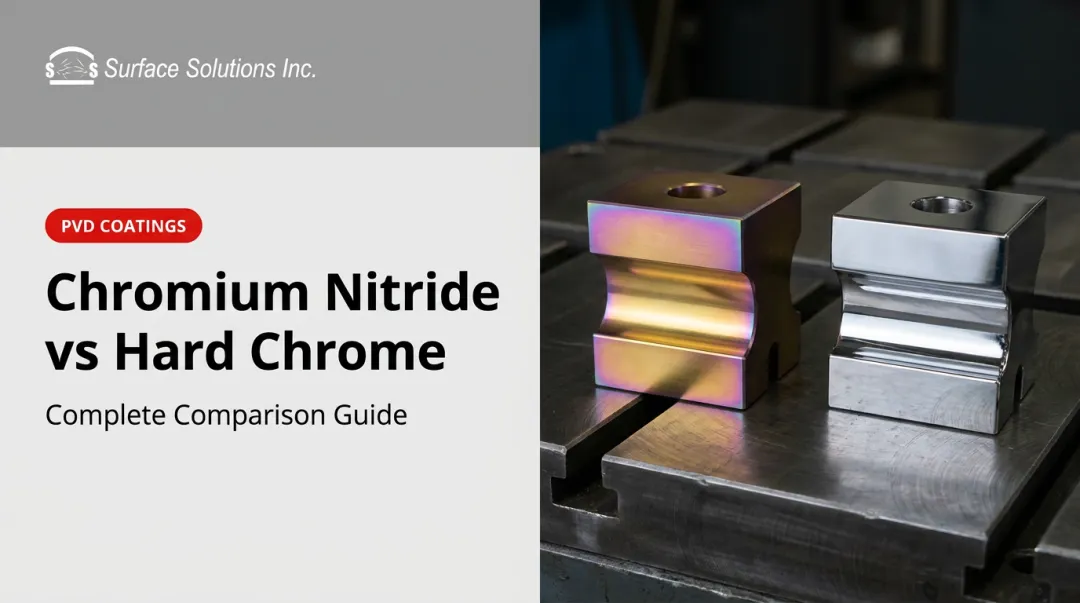
The biggest structural difference is thickness. EPA defines functional hard chrome deposits in the range of 1.3 to 760 microns. PVD coatings like TiN and CrN run 2 to 6 microns, roughly a hundredth the thickness in some cases.
That thinness matters in practice:
- Dissipates heat faster during high-friction operations
- Reduces lubricant needs with a smoother surface finish
- Holds tighter dimensional control without post-coating re-machining
One real limitation: PVD requires a vacuum chamber, so part size is constrained by chamber dimensions. This makes PVD best suited to precision tools, punches, and dies rather than oversized components like large rolls or shafts, where thermal spray or nickel-tungsten fit better.

How We Chose the Best Alternatives
The most common mistake we see is picking a coating based on price alone, without checking part geometry or substrate compatibility. A coating that's cheap per part but wrong for your application costs more in downtime.
We evaluated providers on:
- Industry certifications: ISO standards, military specs (MIL-STD-1687-A), and aerospace qualifications
- Documented hardness and wear data: from technical datasheets, not marketing claims
- Turnaround time: how fast parts get back into production
- Service area coverage: nationwide reach versus regional limitations
Conclusion
There's no single "best" hard chrome alternative. The right choice depends on matching coating properties—thickness, hardness, and process temperature—to your actual operational needs, not just what's trending.
Before committing to a provider, evaluate your part geometry, required hardness range, and the long-term maintenance savings each option offers. A coating that saves you resharpening time but requires a total tooling redesign isn't always a win.
If you're running punches, dies, or cutting tools and want to see how PVD coatings like Alpha™ or CrN could extend tool life, reach out to Surface Solutions for a consultation.
Frequently Asked Questions
What are some alternatives to hard chrome plating?
The main alternatives are PVD coatings, thermal spray, electroless nickel, and nickel-tungsten. Each suits different part sizes: PVD works best for precision tools, while thermal spray and nickel-tungsten handle larger aerospace and industrial components.
Is PVD better than chrome?
PVD offers thinner, more precise coatings with a safer environmental profile than hexavalent chromium plating. Its main limitation is part size, since coating happens inside a vacuum chamber, so it's not suited to oversized components.
Can stainless steel look like chrome?
Yes. Polished stainless steel and certain PVD finishes can closely mimic chrome's bright, reflective appearance without the plating process or its associated hexavalent chromium exposure.
What is the difference between hard chrome and nitriding?
Nitriding diffuses nitrogen into the metal's surface to harden it without adding thickness. Hard chrome instead deposits a separate metal layer on top, which can add anywhere from 1.3 to 760 microns depending on the application.
Why are manufacturers moving away from hard chrome plating?
Hexavalent chromium is classified as carcinogenic by OSHA, and compliance costs are climbing fast, with one documented DoD facility spending over $14 million in two years. State-level restrictions like California's 2023 ATCM are accelerating the shift.
Which coating alternative lasts the longest?
It depends on the application. PVD coatings have shown up to 6x the tool life of uncoated tooling in cutting applications, while SIFCO's nickel-tungsten reports a wear rate 10 times lower than hard chrome in Taber testing.