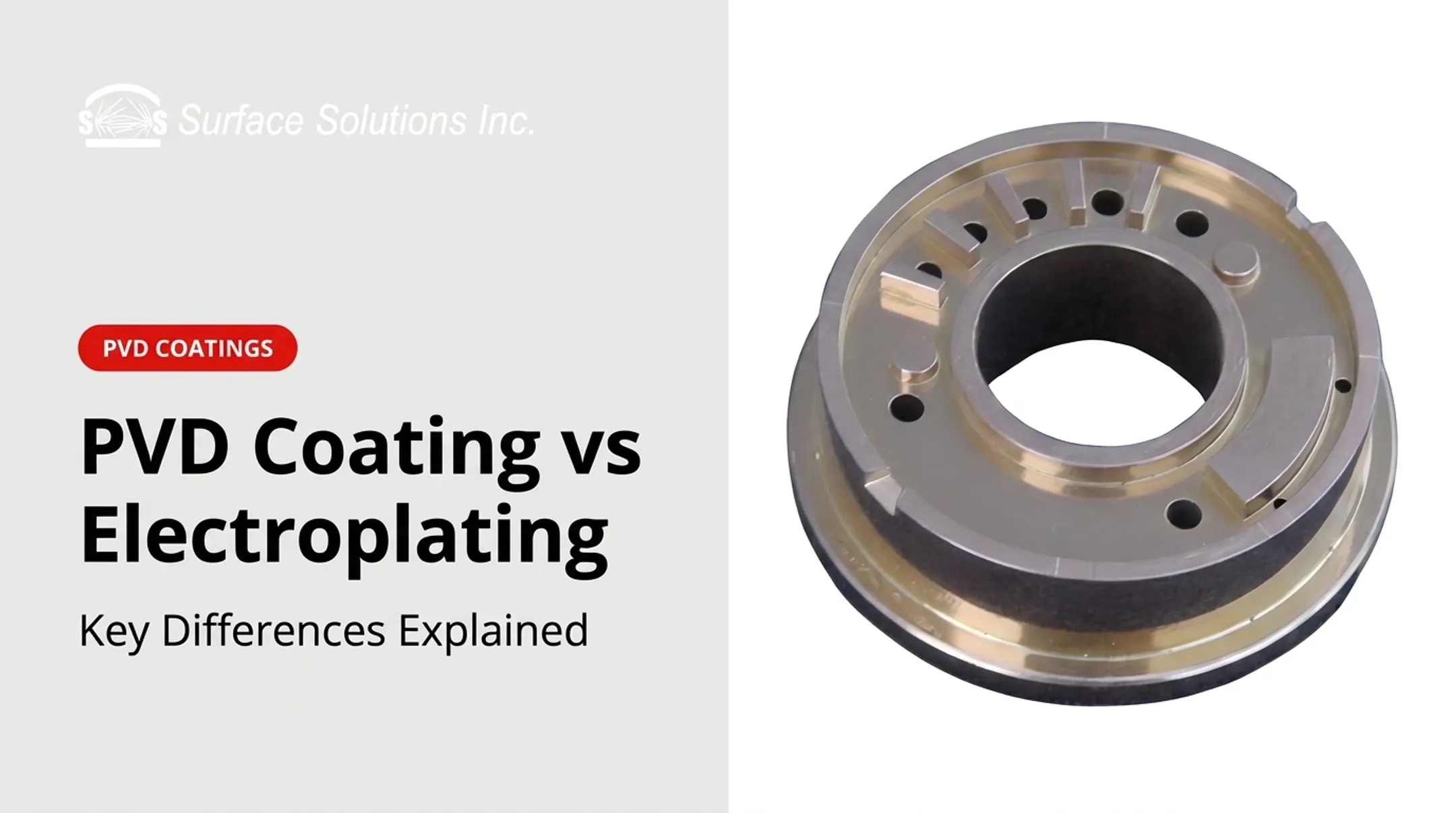
The US surface-finishing industry alone generates $10.7 billion annually, representing 12.4% of the global market. That's a lot of coating decisions being made every day. This guide breaks down how PVD and electroplating actually differ, then helps you figure out which one fits your application.
TL;DR
- PVD builds a dense, hard coating in vacuum; electroplating deposits metal in a liquid bath
- PVD delivers superior wear resistance, longer tool life, and a drier, lower-waste process
- Electroplating costs less upfront and suits thick corrosion barriers or complex geometries
- Choose PVD for high-wear cutting and forming tools; choose electroplating for decorative finishes or heavy corrosion protection
PVD vs Electroplating: Quick Comparison
| Factor | PVD | Electroplating |
|---|---|---|
| Cost | Higher upfront; stronger long-term value | Lower upfront; more frequent replacement |
| Process | Vacuum vapor deposition (TiN, CrN, AlTiN) | Electrochemical deposition from ionic baths |
| Hardness | About 2,300–4,200 HV by coating type | Hard chrome about 900–1,200 HV |
| Environmental profile | Dry vacuum process; no plating bath waste | Wastewater treatment and chemical handling under EPA effluent guidelines |
| Best fit | Cutting tools, punches, dies, high-wear parts | Thick corrosion barriers, complex geometries, decorative finishes |
Those hardness ranges track published coating data:
- TiN: about 2,800 HV
- CrN: about 2,300 HV
- AlTiN: 3,300 HV or higher
- Hard chrome: typically caps near 1,200 HV from a conventional bath
Harder coatings resist abrasive wear longer. That is why cutting and forming tools so often specify PVD.

What is PVD Coating?
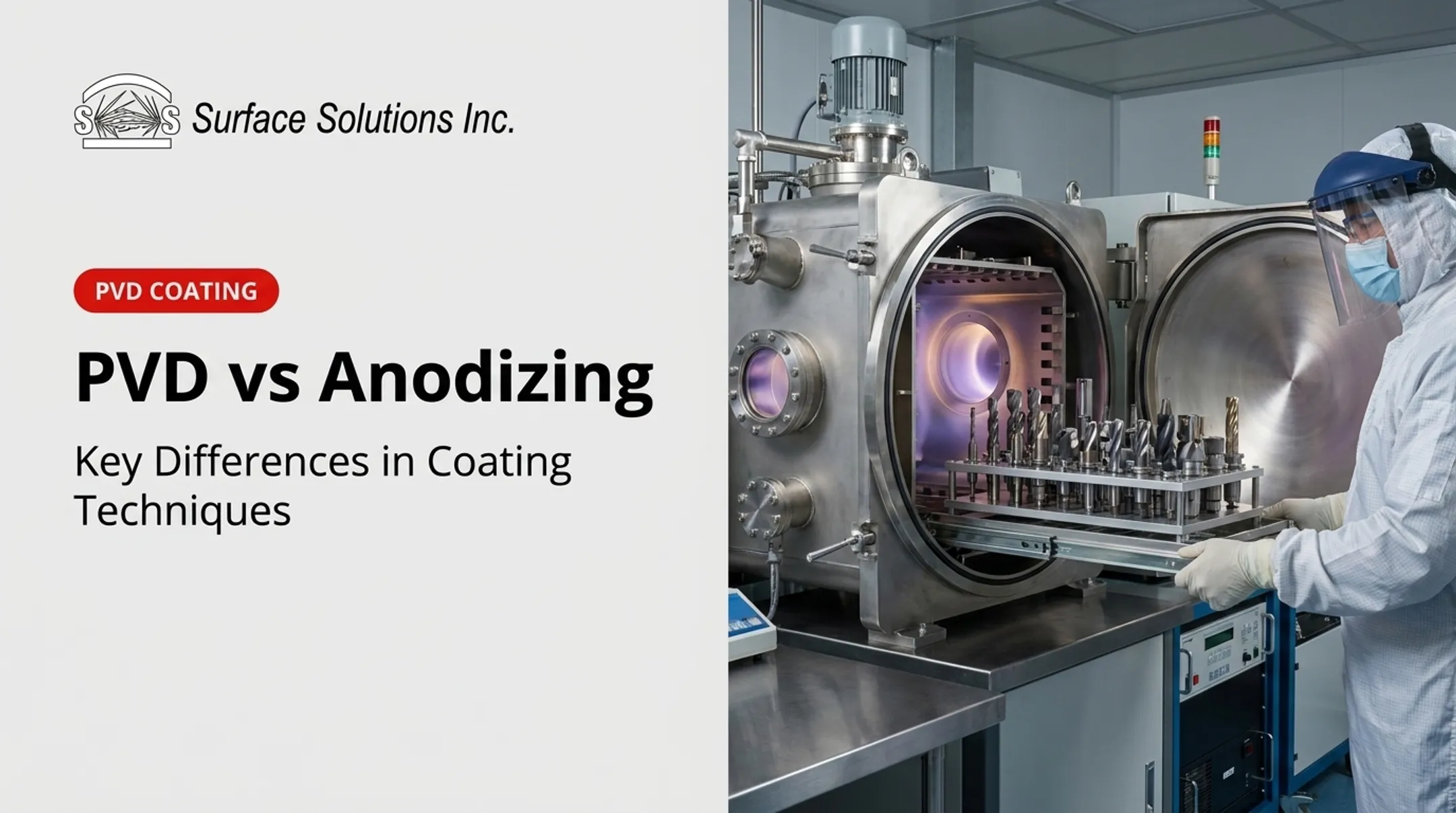
Physical Vapor Deposition (PVD) is a vacuum process that vaporizes a solid coating material (titanium, chromium, or aluminum) and bonds it to a tool's surface at the molecular level. The reaction happens inside a vacuum chamber, often with a reactive gas like nitrogen mixed in to form the final compound coating.
In metal forming, cutting, and tooling, that molecular bond means the coating becomes part of the tool surface instead of sitting on top like a plated layer. Results include:
- Longer runs between sharpenings or replacements
- Less maintenance downtime on production lines
- Higher surface hardness that resists galling and abrasive wear

Common PVD Coating Types for Tooling
Different coatings solve different friction, heat, and wear problems:
- TiN (Titanium Nitride): Standard high-performance coating, solid all-around wear resistance
- CrN (Chromium Nitride): Corrosion-resistant, handles thermal management well in demanding draws
- AlTiN (Aluminum Titanium Nitride): Built for high-heat, high-speed cutting—rated to withstand 800–900°C
- TiCN (Titanium Carbo-Nitride): Adds carbon for enhanced toughness
- Alpha™: Surface Solutions' proprietary formulation, engineered for sheet-metal forming and cutting tools where sharpening delays and reduced galling matter most
Surface Solutions applies Alpha and CrN on industrial tooling when the goal is longer sharpening intervals and less galling on the line.
Use Cases of PVD in Manufacturing
PVD coatings are typically applied to finished tools and dies before they return to production: punches, drawing dies, cutting inserts, and molds. Industries that rely heavily on PVD include:
- Metal stamping and sheet metal forming
- Drawing applications (including stainless steel)
- Cutting tool manufacturing
- Medical device production
The numbers back this up. One Surface Solutions customer, Don Richardson, ran a full 60,000-part order without resharpening after switching to Alpha™ coating—compared to a previous resharpening requirement every 10,000 parts. That's 6x more parts before maintenance, and since removing and resharpening a tool takes roughly 8 hours, skipping six cycles saved 48 labor hours on that run alone.
Coating choice also changes thermal behavior. A separate sheet-metal forming customer tested Alpha versus CrN on a stainless steel drawing operation. Alpha-coated tooling produced just 15 parts before running too hot to touch.
After switching to CrN, the same tooling produced over 500 parts and stayed only warm to the touch—clear gains in heat control and throughput from one coating change.

What is Electroplating?
Electroplating is an electrochemical process: an electric current runs through a liquid bath, depositing metal ions onto a substrate. The EPA defines electroplating as a method for corrosion protection, wear resistance, or anti-friction properties, commonly using nickel, chromium, zinc, copper, or tin.
It's been a manufacturing staple for decades because it's:
- Cost-efficient for large production runs
- Capable of thick protective layers, sometimes up to 0.025 inches with hard chrome
- Flexible across a wide range of base metals
Common Electroplating Variations
- Nickel plating: Engineering-grade buildup for worn or mismachined parts (per ASTM B689)
- Chrome plating: Corrosion resistance and moderate wear protection on shafts, molds, cutting surfaces
- Zinc plating: Primarily corrosion protection on iron and steel, not a high-hardness tooling option
Use Cases of Electroplating in Manufacturing
Electroplating fits well where corrosion resistance, decorative appearance, or base-layer prep is the priority rather than extreme wear resistance. Typical applications:
- Automotive components and fasteners
- General hardware
- Plumbing fixtures
- Base-layer prep before other surface treatments
Hard chrome plating typically runs 900–1,200 HV with layers up to 0.025 inches. Industry sources say it can extend base-material wear life by 2–10 times, though that figure is not a controlled benchmark.
PVD tooling coatings take a different path: just 2–5 microns thick, with hardness levels of 2,300–4,200 HV. That thinner, harder layer is built for precision wear resistance rather than bulk buildup.

PVD vs Electroplating: What's Better for Your Application?
There's no universal winner here. The right call depends on:
- Production volume — high-volume tooling runs benefit more from PVD's longer intervals between maintenance
- Part geometry — PVD is line-of-sight, so parts with pressed-in components, plastic inserts, or assemblies usually aren't candidates
- Wear and heat exposure — high-friction, high-heat cutting or forming favors PVD's hardness
- Budget — electroplating wins on lower upfront cost
- Expected tool lifespan — PVD typically pays back through fewer sharpening cycles and less downtime
Choose PVD if your priority is fewer resharpenings and longer tool life in high-wear forming or cutting.
Choose electroplating if low upfront cost or thick corrosion barriers on simple geometries matter more than extended wear life.
Real-World Example: PVD Coating in Tool Manufacturing
A metal-forming and punching customer, Chris, faced a common problem: abrasive laser dust and slag were chewing through tooling, and operators had to stop mid-run to polish blocks just to keep production moving. That's lost time, inconsistent output, and added labor cost stacking up on every shift.
After switching to Alpha™ coating, the results held up over time:
- Coated blocks stayed in good condition after more than one year in service
- Tooling resisted picking up base metal during forming
- Operators formed 3/8-inch-thick Grade 80 hot-rolled steel into a tight channel using minimal lubricant
- No mid-run polishing required
- Better-looking finished product with less lubricant overall
The same durability gains show up in cutting tools. On a three-corner carbide insert machining 304 stainless steel, Alpha™ delivered 2x the life of TiN. AlTiN extended that further to 3x Alpha™ (about 6x TiN) at a coating cost of just $2.50–$4.00 per tool. Speeds and feeds did not need adjustment.

For high-volume tooling operations, that investment pays back quickly through less downtime and fewer maintenance stops. If you're matching a coating to a specific tooling application, Surface Solutions can help select the right PVD formulation (Alpha™, CrN, TiN, AlTiN, or TiCN) for your production needs.
Conclusion
Neither PVD nor electroplating is universally "better." The right choice comes down to what your application demands: maximum wear resistance and tool longevity favor PVD, while cost-effective, thick protective plating favors electroplating.
For manufacturers in metal forming, cutting, and tool resharpening industries, PVD coatings typically deliver stronger long-term ROI. Applied at roughly 0.0001–0.0002 inches thick and processed at 700–800°F, these coatings extend part life and lighten the maintenance workload.
Frequently Asked Questions
Is electroplating the same as PVD?
No. Electroplating uses electric current in a liquid bath to deposit metal ions; PVD uses vacuum vapor deposition to bond coating material at the molecular level, yielding different durability and finish characteristics.
Does PVD last longer than gold plating?
PVD coatings generally outlast traditional gold electroplating because of their denser molecular bond and higher hardness, particularly under repeated wear. Gold plating is prized more for appearance and conductivity than wear resistance.
What industries benefit most from PVD coating?
Metal forming, cutting tools, punching and stamping, and medical device manufacturing see the biggest gains, thanks to PVD's high hardness and wear resistance in demanding, repetitive applications.
Can PVD coatings be applied to existing tools?
Often, yes. Existing tools can be stripped and recoated to restore or extend performance, subject to inspection. Surface condition and prior treatments need review before recoating.
Is PVD more expensive than electroplating?
Upfront costs run higher for PVD, but total cost of ownership is often lower thanks to extended tool life and reduced maintenance. The right comparison depends on your specific production volume and wear conditions.
How do I know which coating is right for my application?
Consult a coating specialist to evaluate part geometry, wear conditions, and production volume. Surface Solutions can help match the right PVD coating to your tooling needs. Call 763-785-9436 or email info@tincoat.net.