For manufacturers in metal forming, stamping, and punching operations, the DLC vs. TiN question comes up constantly. Both extend tool life beyond uncoated steel. But they behave very differently under sustained mechanical stress, and choosing the wrong one for your application is a real cost — measured in resharpening cycles, galvanic build-up, and production downtime.
This article breaks down how each coating performs, where each one earns its cost, and how to match the right option to your actual operation.
Key Takeaways
- DLC delivers superior hardness and dramatically lower friction, making it the stronger performer in high-cycle and galvanized steel applications
- TiN offers reliable wear protection at a lower upfront cost — well-suited to moderate-volume shops managing in-house tool reconditioning
- Galvanic build-up on TiN-coated tools is a documented issue; DLC-type coatings show near-zero zinc adhesion under identical conditions
- Surface Solutions' Alpha™ coating has helped manufacturers run 6x more parts before resharpening is required
- Evaluate total cost-per-part, not upfront coating price, when choosing between these options
DLC vs. TiN Coatings: Quick Comparison
| Factor | DLC | TiN |
|---|---|---|
| Hardness | ~2,500–5,000 HV | ~2,300–2,800 HV |
| Friction coefficient | ~0.05–0.10 | ~0.55–0.60 |
| Coating thickness | 0.5–4 microns | 1–4 microns |
| Upfront cost | Higher | Lower |
| Galvanic build-up | Near zero | Significantly more |
| In-house resharpening | Requires care; professional recoating preferred | More forgiving for in-house workflows |
| Best fit | High-cycle, galvanized steel, precision runs | Moderate-volume, general fabrication, cost-sensitive ops |
The friction coefficient gap has the most direct impact on punch force and galvanic build-up. A 2011 micro-deep-drawing study measured punch forces of 41–46 N with DLC versus 53–63 N with TiN — showing how TiN's higher friction directly increases forming resistance at each cycle.

What Is DLC Coating?
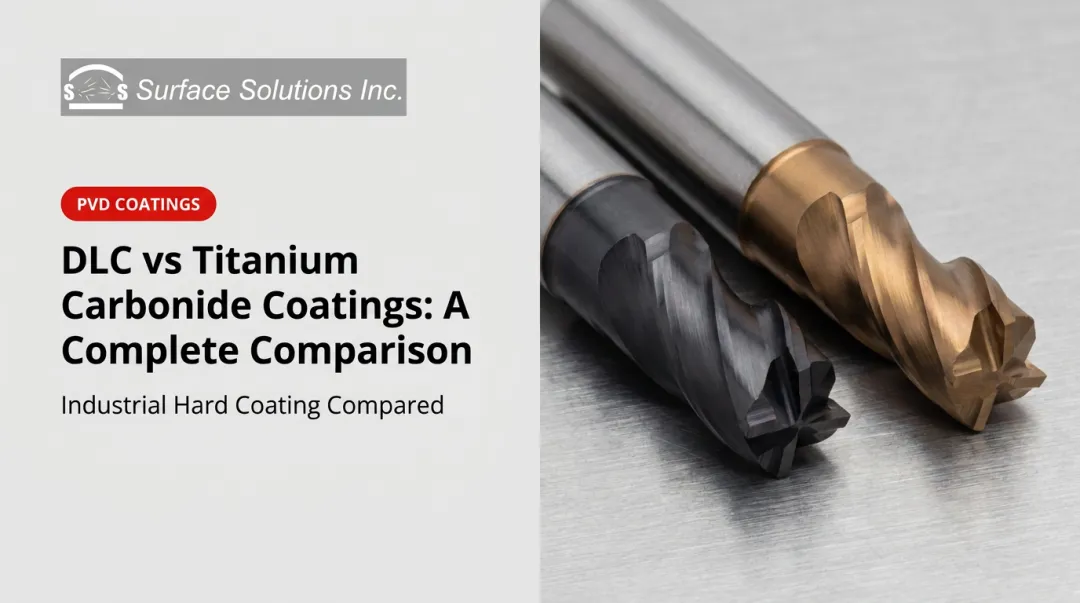
DLC (Diamond-Like Carbon) is a thin-film, amorphous carbon coating that mimics diamond's hardness and chemical inertness. Applied via PVD or PACVD plasma deposition at thicknesses ranging from roughly 0.5 to 4 microns, it produces a dark gray to black finish on the coated tool.
Core Physical Properties
Four properties define DLC's performance in shear pin applications:
- Extreme hardness — forming-grade DLC products range from approximately 2,500 HV (Ionbond 40) to 5,000 HV (hydrogen-free ta-C variants), placing them among the hardest industrial coatings available
- Ultra-low friction — dry friction against steel of 0.05–0.10, meaning far less material sticks to the pin face during shearing cycles
- Chemical inertness — resistant to corrosion from lubricants, metal oxides, and zinc compounds common in galvanized steel forming
- Temperature stability — service temperatures up to approximately 350°C (660°F) for standard hydrogenated DLC; higher for ta-C variants
Operational Benefits in Forming Environments
The low friction coefficient has a compounding effect in production: less zinc and metallic material adheres to the pin face, which maintains dimensional accuracy at the tip far longer. Cleaner tip geometry means more consistent part edges throughout the run, less lubricant consumption, and fewer unplanned stoppages for polishing or cleaning.
Limitations Worth Knowing
DLC does carry real trade-offs to weigh:
- Higher per-tool coating cost than TiN
- Opt for professional recoating — aggressive in-house grinding risks delamination
- Research on blanking and piercing tools has documented small radial fractures and DLC delamination under certain impact conditions — relevant in operations with inconsistent feed or material irregularities
Where DLC Delivers the Most Value
Given those trade-offs, DLC makes the most sense in environments where tip geometry and cycle count justify the cost:
- High-volume automated punching and stamping lines
- Forming operations involving galvanized or coated steels
- Precision shearing where tip geometry must hold across thousands of cycles
- Applications where each resharpening event costs significant labor and lost production time

What Is TiN Coating?
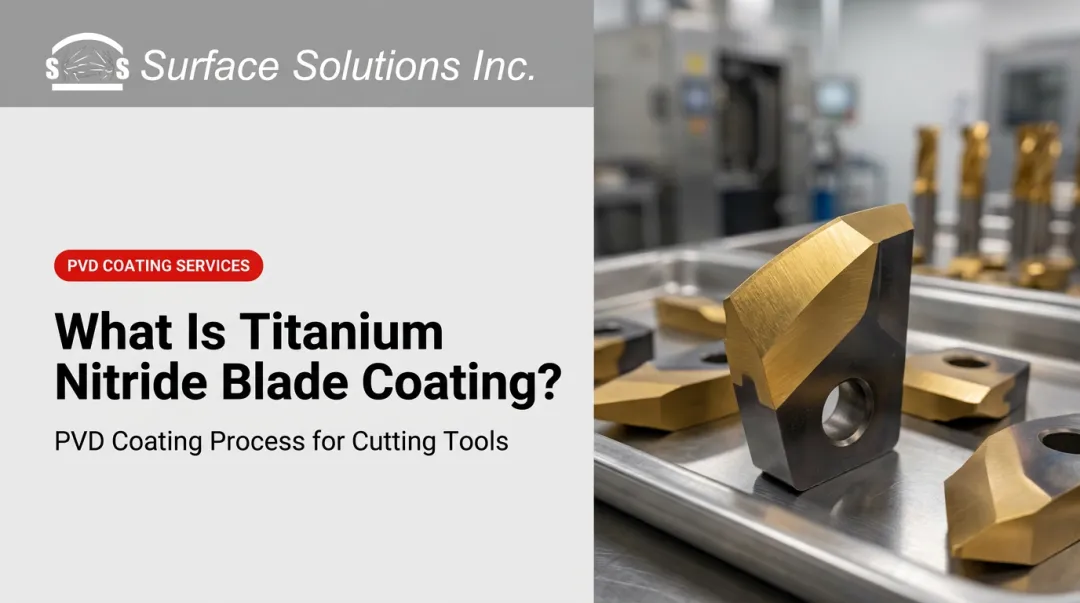
TiN (Titanium Nitride) is a hard ceramic compound applied as a thin film via PVD. Its distinctive gold or bronze color makes it one of the most recognizable industrial coatings — and for good reason. TiN has been the standard coating for cutting tools, forming dies, and shear pins in production manufacturing for over 40 years.
Core Physical Properties
Current forming-grade TiN products from manufacturers like Ionbond and voestalpine document:
- Hardness of 2,300–2,800 HV — comparable to many carbide substrates and sufficient for most cold forming loads
- Friction coefficient of 0.55–0.60 against steel — roughly 25–30% lower than uncoated tool steel, though noticeably higher than DLC
- Coating thickness of 1–4 microns with excellent adhesion to both tool steel and carbide substrates
- Operating temperature up to 500°C (930°F) — within range for cold forming, though it degrades faster in sustained heat above that threshold
Practical Benefits for Shear Pin Applications
TiN's real advantage is accessibility. It:
- Extends tool life significantly — manufacturers commonly report 3–6x more parts before resharpening
- Is compatible with in-house face-sharpening workflows — when a TiN-coated punch is face-ground, the coating remains on the punch sides and continues providing flank protection
- Requires less specialist dependency for reconditioning
- Offers solid protection against mechanical fatigue and gradual wear in moderate-duty production
For manufacturers looking to apply TiN to shear pins or forming tools, Surface Solutions offers PVD TiN coating services for batch production parts across the US, Canada, and Mexico.
Where TiN Falls Short
In high-cycle environments, TiN's friction coefficient becomes a liability:
- More zinc and metallic material adheres to the pin face during galvanized steel forming
- Faster wear in continuous automated lines running hundreds of thousands of cycles
- More frequent resharpening intervals compared to DLC or advanced proprietary coatings
DLC vs. TiN for Shear Pins: Which Is Better?
The answer depends on four variables specific to your operation:
- Production volume and cycle rate — total shearing cycles per shift and sustained line speed
- Material being processed — galvanized, zinc-coated, or abrasive stock accelerates adhesion and wear differently
- Dimensional precision requirements (tighter tolerances demand a coating that holds tip geometry longer)
- Total cost-per-part (not the upfront coating price, but the math across the full tool life cycle)
The Galvanic Build-Up Problem
Galvanic build-up is where the performance gap between advanced DLC-type coatings and standard TiN becomes most visible on the production floor.
Surface Solutions offers a proprietary PVD coating called Alpha™ — formulated specifically for forming and stamping applications above the performance tier of standard TiN. In a documented field comparison, a customer punching 0.057" galvanized steel at one stroke per second ran one Alpha™-coated round punch and one TiN-coated round punch side by side under identical conditions.
The result was clear: "The Alpha does have almost no galvanized build-up and the TIN has much more."
This isn't a lab result — it's a production-floor observation under real operating conditions. The practical consequence is fewer die removals, less polishing between runs, and longer uninterrupted production.
Situational Recommendations
That field evidence maps directly to two distinct operating profiles. Choose DLC (or a DLC-type advanced PVD coating like Alpha™) when:
- Running high-volume automated lines at sustained cycle rates
- Forming galvanized, zinc-coated, or other coated steel grades
- Prioritizing total run length over per-tool upfront cost
- Every resharpening event represents significant lost production time
Choose TiN when:
- Operating at moderate volumes with mixed material applications
- Managing tighter per-tool budgets with predictable reconditioning cycles
- In-house resharpening capability is a priority
- General fabrication with non-galvanized mild steel is the primary use case
Real-World Performance: What Manufacturers Have Found
Surface Solutions' customer data shows consistent, measurable gains — not marginal improvements.
Case 1: 6x Run Length on Alpha™-Coated Tooling
One customer — Don Richardson — documented a direct before-and-after comparison using Alpha™-coated tooling. His baseline: resharpening required after every 10,000 parts. After coating with Alpha™, the same tooling ran a full order of 60,000 parts without needing resharpening — six times the previous interval.
The labor math compounds fast. At 8 hours per resharpening cycle, six avoided events equals 48 hours of saved labor per tool life cycle.
Case 2: 15 Million Parts, 15 Months Between Sharpenings
Richardson's results held up at higher volume too. A separate stamping operation running M4 punches through 0.057" galvanized steel at one stroke per second — 8 to 16 hours per day — reported that Alpha™-coated punches lasted over 15 months and approximately 15 million parts before resharpening was required. Their previous uncoated D2 punches needed sharpening every three weeks.
Beyond resharpening frequency, the operational benefits compounded:
- Reduced punch chipping
- Near-zero galvanized material build-up (versus significant accumulation on TiN)
- Less lubricant required
- Extended die life due to sharper punches exerting more controlled force
- Better-quality part edges throughout the run

When resharpening intervals shrink from months to weeks, the coating decision directly drives your downtime — not just your tooling cost.
Manufacturers dealing with rapid shear pin wear, galvanic build-up, or frequent resharpening downtime can contact Surface Solutions Inc. at 763-785-9436 or info@tincoat.net to discuss which coating — TiN, Alpha™, CrN, or AlTiN — fits their specific application and materials.
Conclusion
DLC is the stronger performer in demanding, high-cycle shear pin applications — particularly where galvanized or abrasive materials are involved. TiN remains a practical, cost-effective choice for moderate-volume operations where in-house tool management and lower upfront cost are genuine priorities.
The right coating does more than protect the pin. It cuts unplanned stoppages, lowers per-part cost over the tool's full life, and holds output quality steady through high-volume runs. If you're evaluating TiN coating for shear pins or other metal forming tools, Surface Solutions provides batch PVD coating services with turnaround times built for production schedules — not lab timelines.
Frequently Asked Questions
Can a coated shear pin be resharpened and recoated?
Yes. Both TiN and DLC-type coatings can generally be removed, the tool resharpened, and the coating reapplied. TiN is more forgiving for in-house face-grinding workflows, while DLC and advanced PVD coatings like Alpha™ benefit from professional handling to avoid delamination during grinding. Surface Solutions accepts resharpened tools for recoating; contact them to confirm the process for your specific parts.
Does DLC coating significantly change the dimensions of a shear pin?
No — DLC coatings are applied in very thin layers (typically 0.5–4 microns, or roughly 0.0001"–0.0002"), so dimensional change is minimal. Most shear pin applications fall well within tolerance after coating, though precision-critical components should be measured after coating to confirm fit.
Which coating performs better when forming galvanized steel?
DLC and DLC-type advanced PVD coatings are clearly preferred for galvanized steel forming. Their ultra-low friction coefficient dramatically reduces zinc adhesion to the pin face. A documented field comparison at Surface Solutions showed Alpha™-coated tooling with near-zero galvanized build-up versus significantly more accumulation on TiN under identical production conditions.
How much longer does a DLC-coated shear pin last than a TiN-coated one?
It varies by application, but the gap is substantial in high-cycle environments. Surface Solutions has documented Alpha™-coated tooling producing 6x more parts before resharpening versus uncoated tools; one stamping customer reached 15 million parts over 15 months before needing to resharpen. TiN tools in the same application showed notably more build-up and faster wear.
Is TiN coating a good choice for lower-volume or general fabrication shops?
Yes. TiN is well-suited for moderate-volume operations, offers reliable improvement in tool life over uncoated steel, and is accessible for shops that handle their own tool reconditioning. It's a practical entry point into coated shear pin tooling where maximizing run length isn't the primary driver.
What other coatings besides DLC and TiN are available for shear pins?
Surface Solutions also offers CrN (chromium nitride), AlTiN (aluminum titanium nitride), TiCN (titanium carbo-nitride), and the proprietary Alpha™ coating. CrN is particularly well-suited for stainless steel drawing and non-ferrous forming; AlTiN offers extreme hardness for high-demand cutting applications. Contact Surface Solutions to get a coating recommendation matched to your materials, volumes, and tooling geometry.