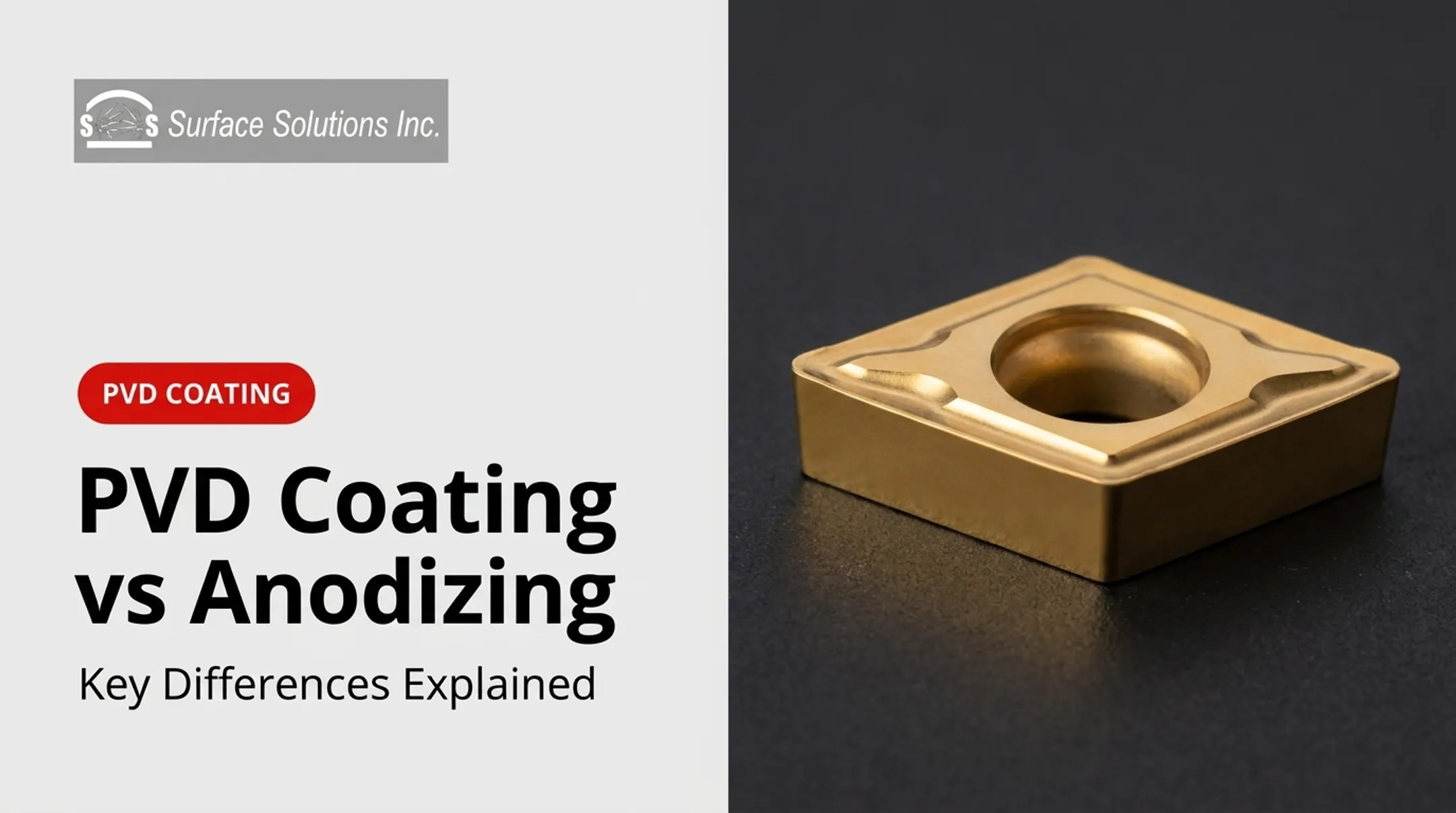
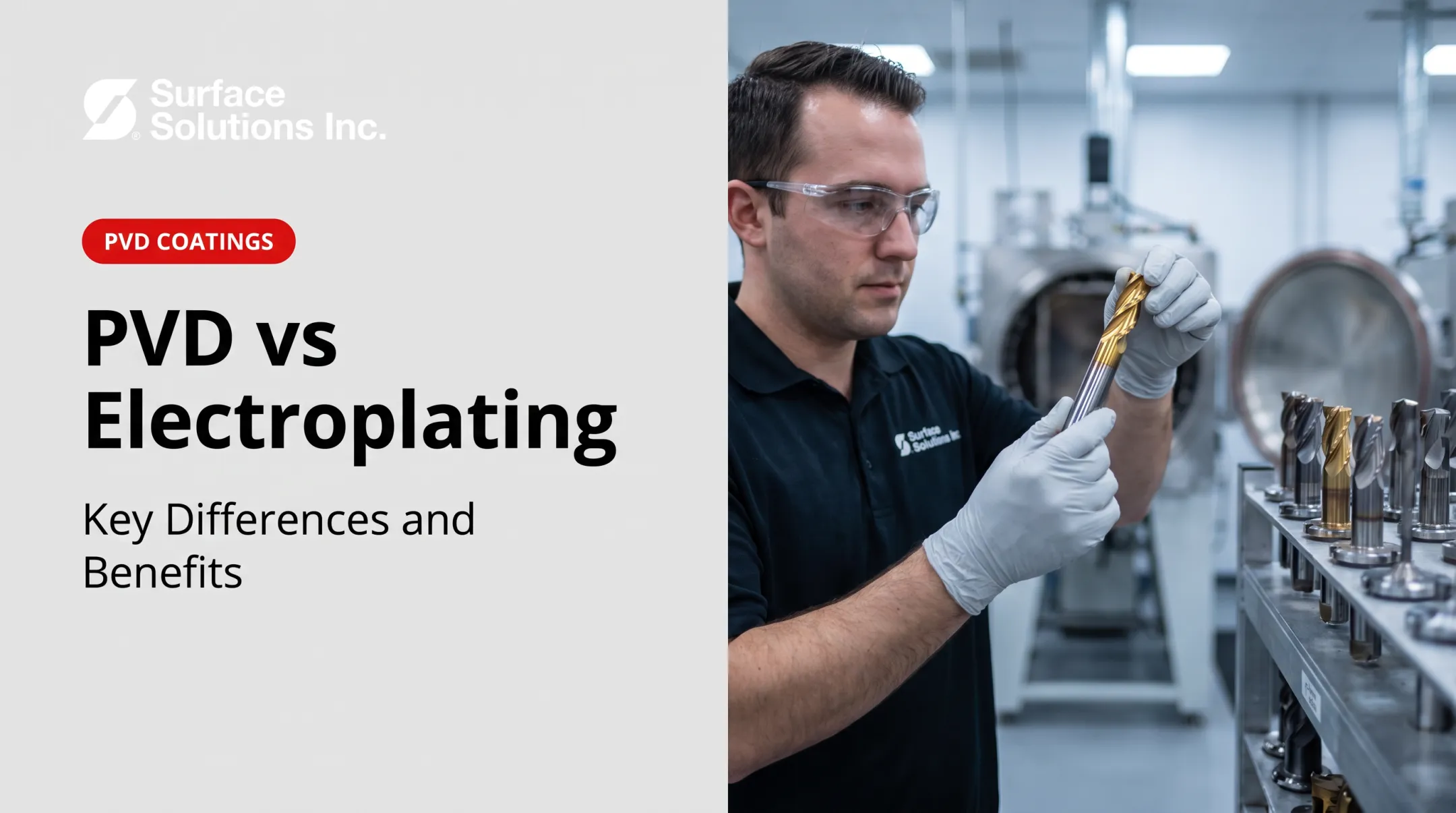
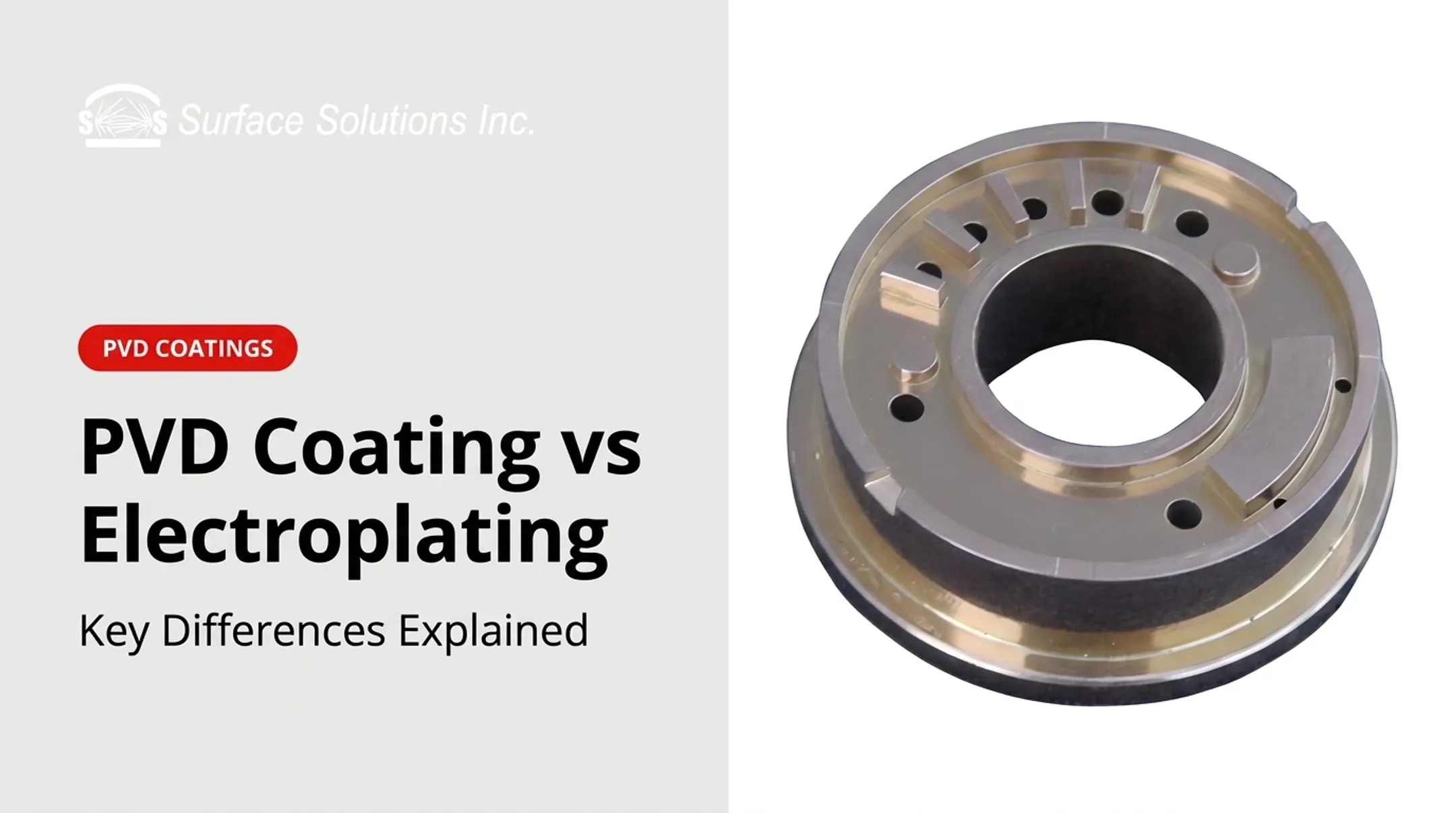
The choice affects more than just upfront cost. It shapes tool life, unplanned downtime, and how your parts perform under heat, friction, and repeated cycles. Pick the wrong process, and you're paying for it in sharpening labor or scrapped parts down the line.
This guide breaks down how PVD and anodizing actually work, where each one wins, and how to decide which fits your application.
TL;DR
- PVD deposits a thin, hard metallic or ceramic layer onto a part in a vacuum chamber
- Anodizing electrochemically converts aluminum's own surface into a protective oxide layer
- PVD delivers higher hardness across more substrates; anodizing costs less for high-volume aluminum
- Use PVD for cutting tools, dies, and wear parts; use anodizing for aerospace and architectural aluminum
- Pick based on substrate, wear demands, budget, and production volume
PVD vs Anodizing: Quick Comparison
Cost
PVD carries a higher upfront cost per batch, driven largely by vacuum system requirements, chamber size, and power supplies needed for deposition. That cost gets offset by extended tool life and fewer production interruptions.
Anodizing costs less per piece, especially at scale. Bulk processing lets manufacturers immerse many parts together, which cuts per-unit loading and labor costs. That advantage is a major reason it dominates high-volume aluminum production.
Composition and Process
The two processes work in fundamentally different ways:
| Process | Mechanism |
|---|---|
| PVD | Vaporizes a solid metal target in a vacuum, then condenses it as a thin film on the part's surface |
| Anodizing | Uses an electrochemical bath to convert the substrate's own surface into an oxide layer |
PVD adds a new layer; anodizing transforms what's already there.
Hardness and Durability
Published hardness figures vary by coating and testing method, but they illustrate a real gap:
- TiN: around 2,300–2,800 HV
- CrN: 2,200–2,700 HV
- TiCN: 2,800–3,000 HV
- AlTiN: 4,000–4,500 HV
Hard anodizing (Type III) hardness depends on the aluminum alloy class. ISO 10074 sets minimums ranging from 250 HV to 400 HV depending on the alloy. Standard Type II anodizing isn't typically rated by microhardness at all; it's evaluated through abrasion testing instead.
PVD coatings generally outperform anodized layers in raw hardness, which is why they dominate high-wear tooling applications.

Material Compatibility
PVD works on steel, titanium, carbide, and various alloys, though substrate limits vary by shop. Surface Solutions coats most metals except aluminum and zinc-containing alloys, and only accepts conductive, single-piece metal components.
Anodizing is effectively limited to aluminum and titanium. MIL-A-8625F covers aluminum and aluminum alloys specifically; steel cannot form the stable oxide layer the process depends on.
Best-Fit Applications
- PVD: Cutting tools, punches, dies, medical devices, high-wear industrial components
- Anodizing: Aerospace panels, architectural aluminum, consumer electronics housings
What is PVD Coating?
Physical Vapor Deposition (PVD) is a vacuum-based process where a solid metal target is vaporized and bonded to a substrate at the molecular level. The result is a thin, extremely hard film — typically just 0.0001–0.0002 inches (2–5 microns) — applied at deposition temperatures around 700–800°F.
That thinness matters. PVD doesn't add bulk or change part dimensions in any meaningful way, which is why it works so well on precision tooling.
Core operational benefits include:
- Extended tool life between sharpenings
- Reduced lubricant requirements during forming or cutting
- Better surface finish, sometimes eliminating polishing steps entirely
- Less frequent maintenance downtime
Common PVD Coating Variants
- TiN — a standard, general-purpose coating with reliable hardness and wear resistance
- AlTiN — built for demanding, high-heat applications; delivers 2–7 times the tool life of uncoated tools with hardness around 4,000–4,200 HV
- CrN — corrosion-resistant, well suited to medical and food-processing environments
- TiCN — a titanium-carbon hybrid offering strong hardness for wear-heavy jobs
- Alpha™ — Surface Solutions' proprietary coating engineered specifically for punches, dies, and cutting tools facing repetitive high-cycle abuse

Use Cases of PVD
PVD is typically applied as a final step, after a tool is machined, sharpened, or resharpened, right before it returns to production. It's common in:
- Metal forming and sheet metal drawing
- Punching and stamping
- Medical device manufacturing
- Cutting tool production
In one documented case, an Alpha™-coated M4 punch ran for more than 15 months and produced an estimated 15 million parts stamping galvanized steel. Previously, uncoated D2 punches needed sharpening every three weeks.
The coated punch also showed almost no galvanized buildup compared to a TiN-coated punch, reducing chipping and extending die life.

What is Anodizing?
Anodizing is an electrochemical process that thickens aluminum's natural oxide layer, turning it into a durable, corrosion-resistant finish. Unlike PVD, it doesn't add a separate material. It transforms the surface that's already there.
Core benefits include:
- Strong corrosion resistance
- Color and aesthetic finishing options
- Mild wear protection
- Minimal added weight, ideal for aerospace components
Type II vs Type III Anodizing
- Type II (conventional): Thickness typically 0.00007–0.0010 in, per MIL-A-8625F. Good general corrosion protection and coloring.
- Type III (hard anodizing): Thickness ranges from 0.0005–0.0045 in, delivering greater wear resistance and durability for structural or high-contact applications.
Use Cases of Anodizing
Anodizing is almost always a finishing step applied to completed aluminum components before assembly. It shows up heavily in:
- Aerospace panels and structural components
- Architectural fixtures and extrusions
- Consumer electronics housings
- Lighting reflectors
Anodizing's economics get stronger at scale. The Aluminum Anodizers Council notes that anodized products require minimal upkeep, with routine cleaning limited to mild soap and water. That low-maintenance profile cuts operating cost over the product's lifespan.
Suppliers running bulk lines can process millions of small aluminum parts economically. Batch-oriented aluminum manufacturers rely on that scale advantage.

PVD vs Anodizing: Which Is Better for Your Application?
There's no universal winner. The right call depends on a handful of factors:
- Substrate material — steel, titanium, or carbide points to PVD; aluminum points to anodizing
- Wear and heat demands — heavy friction, abrasion, or cutting loads favor PVD's superior hardness
- Production volume — high-volume aluminum runs often favor anodizing's per-unit economics
- Budget — anodizing costs less upfront; PVD pays back through longer tool life and less downtime
- Desired finish — anodizing offers color options; PVD offers a harder, wear-resistant finish for high-contact tools and parts

Rule of thumb:
- Choose PVD for tools and parts facing heavy friction, abrasion, or heat—cutting inserts, punches, and forming dies.
- Choose anodizing for aluminum components when corrosion resistance, appearance, and cost efficiency at scale matter most.
Real-World Example: PVD Coating in Action
Manufacturers switching to PVD often do so after hitting a wall with resharpening frequency and maintenance downtime. Surface Solutions has worked with companies like Special Tools, Inc. and K&C Manufacturing, both of which reported major operational improvements after adopting PVD coatings.
At Special Tools, Inc., owner Tony Deschenes described a customer who wasn't previously using coatings. After trying PVD, the customer wanted every tool coated — calling the difference "night and day," with tools "working better than new."
At K&C Manufacturing, CFO Angela Naasz reported that Alpha™ cutters appeared to eliminate an entire manufacturing process, saving significant time.
In other documented cases, Surface Solutions coatings have delivered up to 6x more parts produced before resharpening and 48 hours of labor saved from less frequent sharpening.
PVD coating pays off most in high-cycle, high-wear tooling applications, where less maintenance means more throughput.
If tool wear or resharpening downtime is eating into your production schedule, contact Surface Solutions to see whether PVD coating fits your parts.
Conclusion
Neither PVD nor anodizing is universally better. The right process depends on your substrate, wear demands, and production priorities. Trying to force one process onto the wrong job usually costs more than it saves.
PVD fits high-wear tooling and cutting applications where longer part life and less downtime matter most. Anodizing is the better match for aluminum components that need corrosion resistance and cost-effective finishing at volume.
Start with your substrate and production goals. Those two factors usually decide which process belongs on the part.
Frequently Asked Questions
Is PVD the same as anodizing?
No. PVD adds a separate coating layer through vapor deposition, while anodizing converts the substrate's own surface into an oxide layer. They are different processes with different substrate requirements.
Is PVD coating the best?
PVD offers superior hardness and wear resistance for many industrial applications, but "best" depends on your substrate, budget, and use case. Aluminum parts needing corrosion resistance are often better served by anodizing.
Can PVD be applied to aluminum?
PVD can technically be applied to aluminum, but many providers, including Surface Solutions, exclude aluminum and zinc-containing alloys from their coating scope. Check with your provider on substrate compatibility before sending parts.
Can anodizing be applied to steel, or only aluminum?
Anodizing works on aluminum and titanium but isn't effective on steel. Steel forms iron-oxide rust rather than the stable, adherent oxide layer that anodizing depends on.
Which process is more environmentally friendly?
PVD is a dry, vacuum-based process with no aqueous electrolyte bath. Anodizing uses water-based chemistry and generates wastewater and sludge that require management. Each carries different environmental tradeoffs—neither is universally cleaner.
How do I know which coating is right for my parts?
Evaluate your substrate material, wear conditions, and production goals first. For tooling and wear-heavy applications, consult a PVD specialist like Surface Solutions for application-specific guidance.