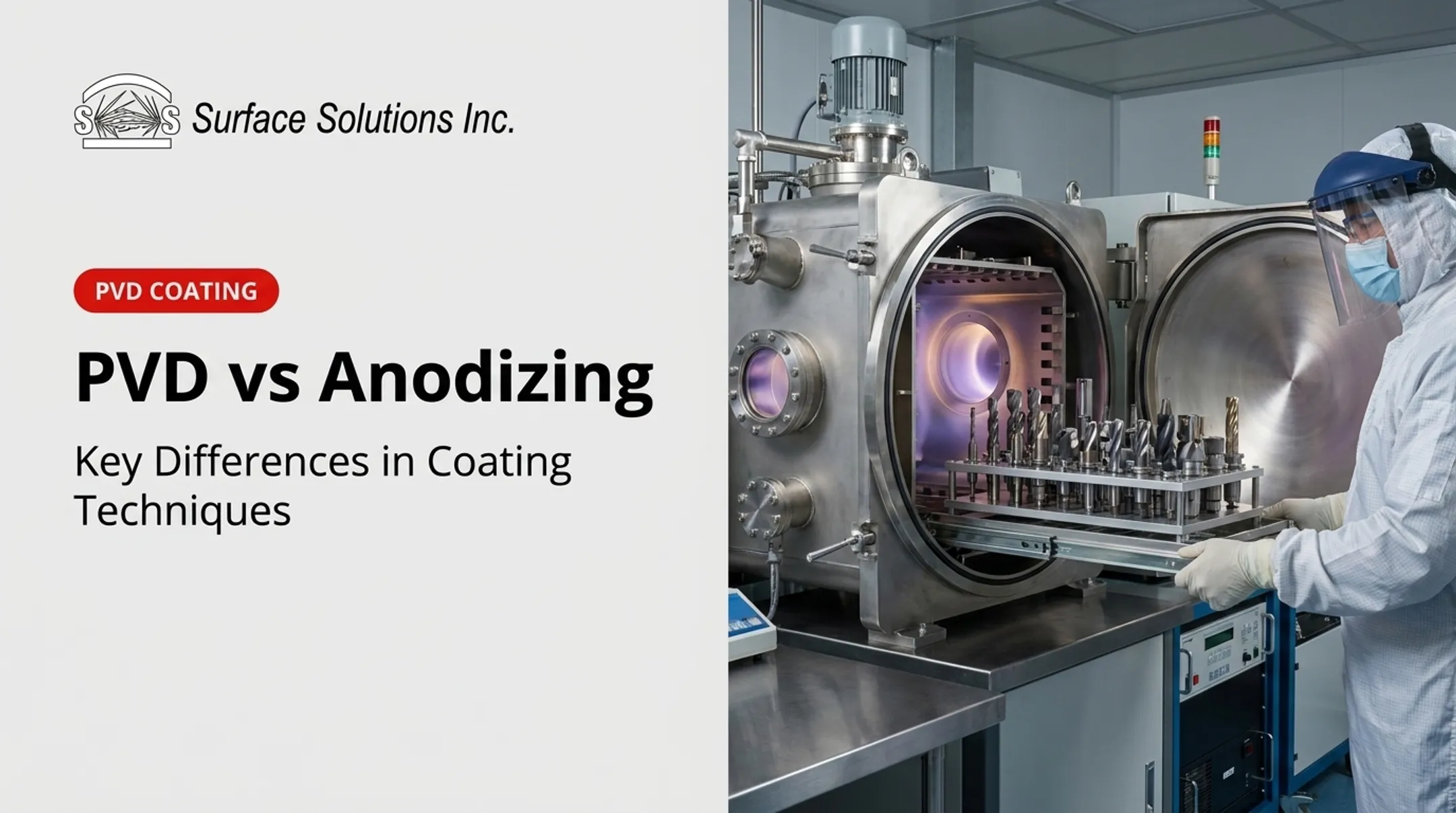
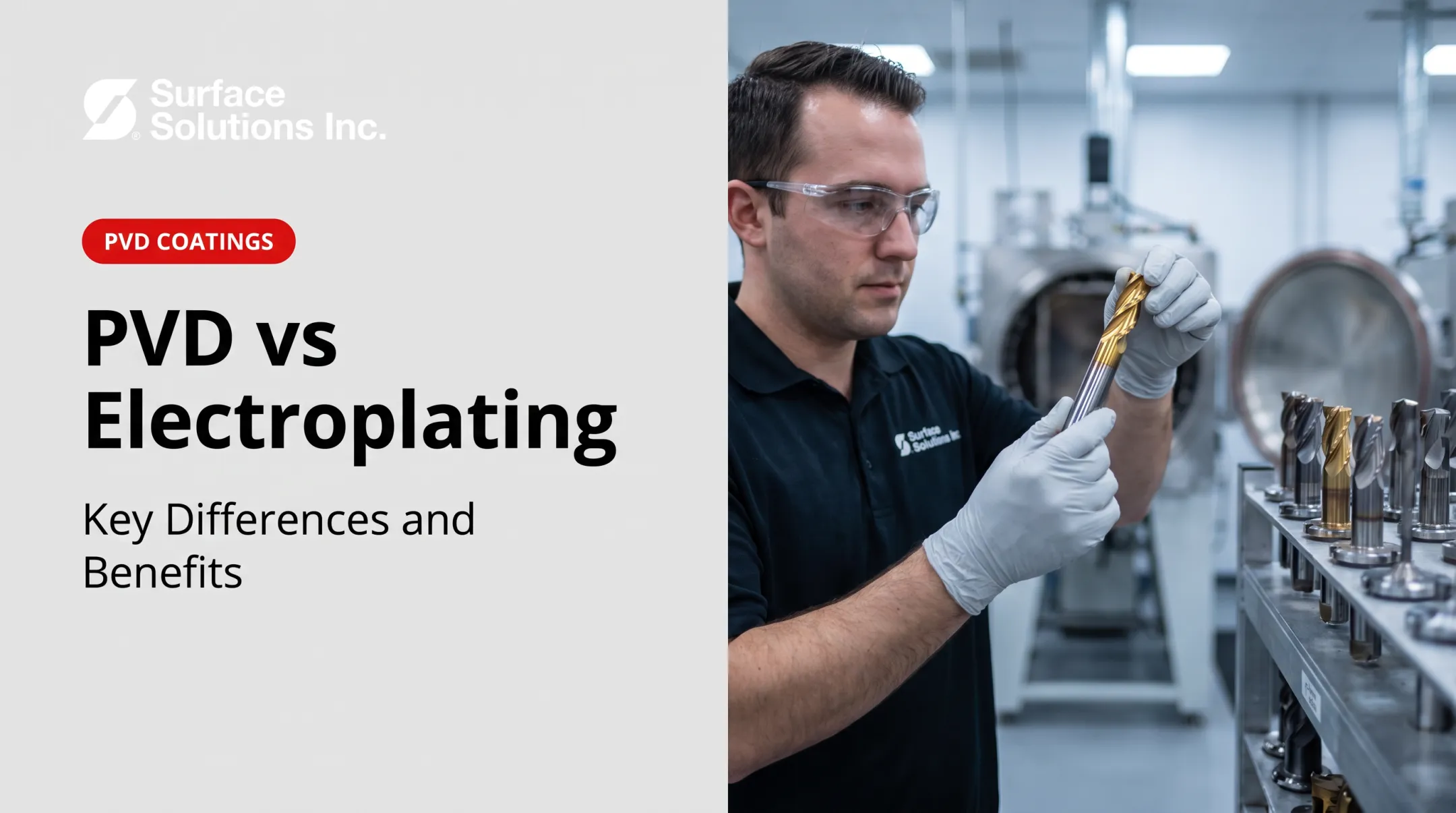
The global PVD coating market is projected to grow from $3.4 billion in 2025 to $6.1 billion by 2033, according to Grand View Research — a signal that more manufacturers are moving toward vacuum-based coatings for wear-critical applications. This article breaks down how PVD coating and electroplating actually differ, and which one fits your production goals.
TL;DR
- PVD vaporizes metal in a vacuum and bonds a thin, hard film to the tool at the molecular level.
- Electroplating uses electric current in a liquid bath to deposit thicker metal layers onto the surface.
- PVD wins on hardness and wear life; electroplating wins on upfront cost and coating thickness.
- Choose PVD for high-wear cutting, forming, and stamping tools; choose electroplating for decorative finishes and general corrosion protection.
- The right choice cuts resharpening frequency, trims maintenance downtime, and lifts production throughput.
PVD Coating vs Electroplating: Quick Comparison
Cost
- PVD: Higher upfront cost per batch, but stronger ROI in volume production because tools need resharpening far less often
- Electroplating: Lower initial cost, though savings can erode with more frequent tool replacement and maintenance
Process & Composition
- PVD: Metal is vaporized in a vacuum chamber and bonded to the substrate at the molecular level, forming coatings like TiN, CrN, AlTiN, or proprietary blends such as Alpha™
- Electroplating: An electric current drives metal ions out of a liquid bath and onto a conductive substrate
Durability & Hardness
Hardness testing shows a clear gap between the two processes:
- PVD TiN: ~2,500 HV (some Ionbond products reach 2,800 HV)
- PVD CrN: ~2,350 HV
- Hard chrome electroplating: 900–1,200 HV
- Bright nickel plating: ~300 HV
That gap is why PVD-coated tools hold an edge longer before they dull, per a 2015 academic hardness study.

Coating Thickness
- PVD: Typically 2–5 microns — thin but extremely dense
- Electroplating: Ranges from 20 microns to over 100 microns for extreme-wear hard chrome applications, but the layer is less dense and can require multiple passes
Environmental Impact
- PVD: Dry, vacuum-based process with minimal wastewater output
- Electroplating: Chemical baths under EPA wastewater rules (40 CFR Parts 413 and 433); the EPA reports 78% of metal-finishing facilities discharge wastewater indirectly through treatment plants

What Is PVD Coating?
Physical Vapor Deposition (PVD) is a vacuum-based process that vaporizes metal and bonds it to a tool's surface at the molecular level. The result is a dense, extremely hard layer that resists wear far better than the base metal alone.
For manufacturers, that translates into fewer maintenance cycles, less lubricant use, and reduced scrap. Tools coated with PVD often need less polishing and hold their edge across longer production runs.
Common PVD Coating Types
- TiN (Titanium Nitride): Standard high-performance coating with strong hardness and wear resistance
- CrN (Chromium Nitride): Corrosion-resistant, well-suited to medical and food-processing tooling
- AlTiN (Aluminum Titanium Nitride): Reported hardness of 4,000–4,200 HV, with superior thermal stability
- TiCN (Titanium Carbo-Nitride): Combines titanium and carbon for added toughness
- Alpha™: A proprietary formulation from Surface Solutions built for high-wear forming and punching applications
Use Cases of PVD Coating
PVD coatings are applied to punches, dies, cutting tools, and molds used in production. Common applications include:
- Metal forming and sheet metal drawing
- Punching and stamping
- Cutting tools
- Medical device manufacturing
One documented case: a customer running Alpha™-coated M4 punches kept them in service for over 15 months, producing an estimated 15 million parts. The same shop's uncoated D2 punches previously needed sharpening every three weeks.

What Is Electroplating?
Electroplating is an electrochemical process that uses electric current to deposit metal ions from a liquid bath onto a conductive substrate. The EPA describes it as a finishing operation designed to make parts stronger, shinier, and more corrosion-resistant.
Its practical advantages are straightforward: it works across many base metals, shops are widely available, and setup typically costs less than vacuum deposition.
Common variations include:
- Hard chrome plating — used on hydraulic pistons, gears, dies, and extrusion screws
- Nickel plating — improves appearance and corrosion resistance
- Zinc-nickel plating — favored for automotive fastener corrosion protection
- Rhodium plating — mostly used in catalytic converter manufacturing
Use Cases of Electroplating
Electroplating fits fasteners, decorative hardware, and components that need corrosion protection more than extreme wear resistance. Automotive trim, general hardware, and lower-stress industrial parts are common applications.
The Nickel Institute points to zinc-nickel-plated automotive bolts as a strong example valued for salt-spray corrosion resistance on high-demand automotive fasteners.
PVD Coating vs Electroplating: Which Is Better for Your Application?
The right answer depends on what your tooling actually experiences day to day. Weigh these factors:
- Expected wear and friction: High-friction, high-cycle tooling wears out electroplated finishes faster than dense PVD layers
- Production volume: Higher volume production magnifies the cost of frequent resharpening or replating
- Precision requirements: Thin PVD layers preserve tight tolerances better than thicker plated layers
- Budget constraints: Electroplating wins on lower upfront spend
- Environmental compliance: PVD's dry process avoids wastewater treatment requirements tied to plating baths
Choose PVD if tool longevity, reduced downtime, and performance in high-wear cutting or forming applications matter most.
Choose electroplating if your priority is lower initial cost or decorative or corrosion-focused finishing on lower-stress components.
For tooling specifically (punches, dies, cutting tools), PVD coatings tend to deliver stronger long-term value through reduced resharpening and labor savings.
Real-World Example: PVD Coating in Metal Forming Applications
Manufacturers running standard tooling or electroplated finishes often deal with frequent resharpening, high labor hours, and inconsistent part quality between maintenance cycles. That's the operational challenge Alpha™ coating from Surface Solutions was built to solve.
One customer, Don Richardson, ran a full production order of 60,000 parts without resharpening — compared to the usual 10,000-part limit before Alpha™ coating. That's 6x more parts per sharpening cycle.
Here's what that meant in labor hours:
- Each resharpening cycle required roughly 8 hours (removal, sharpening, reinstallation)
- Avoiding six sharpening cycles saved approximately 48 hours of labor
- The die ran longer without basic maintenance, freeing up the crew for other work

Labor savings are only half the story—run life tells the rest. Another shop switched punch material from D2 to M4 and applied Alpha™ coating. The uncoated D2 punches had needed sharpening every three weeks. The Alpha™-coated M4 parts stayed in service for over 15 months, producing an estimated 15 million parts.
Manufacturers running high-volume punching, forming, or cutting operations see measurable savings once they upgrade from uncoated or electroplated tooling to PVD.
If downtime and resharpening cycles are cutting into your output, contact Surface Solutions to evaluate whether PVD coating fits your production goals.
Conclusion
Neither method wins in every scenario. PVD coating suits high-wear, precision tooling where tool life and reduced downtime directly affect production economics. Electroplating remains a solid choice for cost-sensitive projects or applications where decorative finish and corrosion protection matter more than extreme wear resistance.
For manufacturers focused on tool life, reduced downtime, and production efficiency, PVD coatings typically deliver stronger long-term value: fewer resharpening cycles, less labor spent on maintenance, and more consistent part quality across a production run.
Surface Solutions applies TiN, AlTiN, CrN, TiCN, and Alpha hard coatings for manufacturers coating cutting tools, dies, and industrial wear components.
Frequently Asked Questions
Is PVD coating better than electroplating?
PVD generally offers superior hardness and wear resistance, making it the stronger choice for high-wear tooling. Electroplating can still be more cost-effective for lower-stress or decorative applications.
What is the main difference between PVD and electroplating?
PVD uses vacuum deposition to vaporize metal and bond it to a surface at the molecular level. Electroplating uses an electric current to deposit metal ions from a liquid bath onto a conductive substrate.
Does PVD coating last longer than electroplating?
Yes, in most tooling and high-friction applications. PVD's density and hardness (often 2,000+ HV versus 900–1,200 HV for hard chrome) typically translate into longer service life.
Is PVD coating more expensive than electroplating?
PVD usually costs more upfront. However, it often delivers better long-term ROI through fewer resharpening cycles and less downtime from wear-related failures.
Can PVD coating be applied to any metal?
PVD works well on steel, stainless steel, and titanium substrates. It's not suited for aluminum or zinc alloys, non-conductive materials, or parts with surface oxides that haven't been pre-treated.
Which is more environmentally friendly, PVD or electroplating?
PVD's dry vacuum process produces minimal wastewater and hazardous byproducts. Electroplating relies on chemical baths that require wastewater treatment under EPA regulations.