Introduction
Chromium plating shows up almost everywhere in manufacturing. It's on car bumpers, hydraulic piston rods, firearm barrels, and the dies stamping out sheet metal parts by the millions.
That widespread use breeds confusion around terminology. Is "chrome" different from "chromium"? What separates hard chrome from decorative chrome or thin dense chrome? And with hexavalent chromium capped at 5 micrograms per cubic meter under OSHA's exposure limit, which process should you specify?
This guide breaks down how chromium plating works, the main types available, the hexavalent vs. trivalent safety debate, and where PVD chromium-based coatings now outperform traditional electroplating for demanding tooling applications.
Key Takeaways
- "Chromium plating" and "chrome plating" describe the exact same electroplating process
- Hard, decorative, and thin dense chrome differ in thickness and use, not chemistry
- Trivalent chromium is gaining ground as regulators restrict hexavalent chromium's toxicity risks
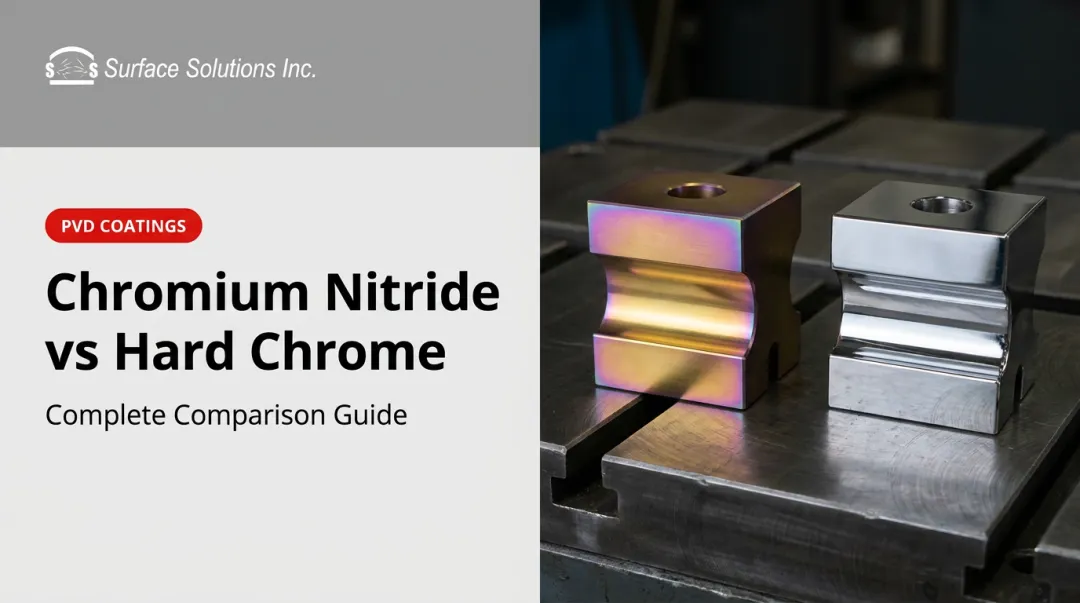
- CrN (PVD chromium nitride) coatings often outperform hard chrome in wear resistance for tooling
What Is Chromium Plating and How Does It Work?
Chromium plating is the process of electrodepositing a thin layer of chromium metal onto a substrate. The goal depends on what you're building: a mirror-bright finish for consumer goods, or a hard, wear-resistant surface for industrial parts that take a beating.
Layer thickness and bath chemistry determine which outcome you get. A decorative bumper trim piece might carry a fraction of a micron of chromium. A hydraulic cylinder rod, on the other hand, could need several thousandths of an inch to survive years of friction and pressure.
Is Chromium Plating the Same as Chrome Plating?
Yes. "Chrome plating" is just the informal name for chromium electroplating — there's no separate industrial process hiding behind the shorter term. Trade publications and technical specifications use "chromium plating," "chrome plating," and "hard chrome" interchangeably to describe the same electrodeposition technique.
How the Chromium Plating Process Works
The process follows a consistent sequence regardless of the final application:
- Clean and degrease the part to remove oils, dirt, and residue
- Activate the surface with an acid dip (often 10-30% concentration) to strip oxide layers and prepare the metal for bonding
- Immerse in the plating bath, where the part becomes the cathode and a chromium anode supplies the metal ions
- Apply DC current, which drives chromium ions onto the part's surface
- Rinse thoroughly to prevent bath chemicals from carrying over onto the finished piece

Plating rate, hardness, and finish quality all hinge on bath temperature, current density, and chemical composition. That's why quality-focused shops work to recognized standards like ASTM B650 for engineering chromium coatings, AMS2406 for hard chrome plating, or MIL-STD-1501 for low-embrittlement chrome on high-strength steel. These specs define everything from thickness tolerances to adhesion testing methods.
Types of Chromium Plating Explained
Chromium plating isn't one-size-fits-all. The three main categories differ primarily in thickness and purpose rather than the underlying chemistry.
Hard Chrome (Industrial/Engineered Chrome)
Hard chrome, sometimes called engineering chrome, is built for punishment. It's typically deposited at 0.5 to 10 mils thick, with hardness ratings between 800 and 1,200 HV (Vickers hardness) depending on the bath formulation.
Common applications include:
- Hydraulic cylinders and piston rods
- Press tooling and dies
- Industrial rolls and rotors
- Engine components requiring dimensional restoration
The thickness isn't just for looks. It provides genuine wear resistance and can even rebuild undersized worn parts back to spec.
Decorative Chrome Plating
Decorative chrome is the finish most people picture when they hear "chrome" — that bright, mirror-like shine on car trim, faucets, and appliance hardware. It's applied as a thin topcoat, usually 0.25 to 0.8 micrometers, over a layer of bright nickel.
The nickel underlayer does most of the corrosion-protection work here. The chromium topcoat adds shine and tarnish resistance, not structural durability. That's fine for its purpose, since decorative applications prioritize appearance over withstanding heavy mechanical wear.
Thin Dense Chrome (TDC)
TDC solves a specific problem with conventional hard chrome: microcracking. Standard hard chrome deposits develop a network of tiny cracks as thickness increases, which can trap contaminants or initiate corrosion.
TDC processes deposit chromium at 1 to 17 micrometers in a denser, more crack-resistant structure. This makes it attractive for precision components where surface integrity matters as much as hardness, without adding bulk thickness that would require extra machining afterward.

Hexavalent vs. Trivalent Chromium Plating: Which Is Safer and Better?
This is where chromium plating gets genuinely complicated, and where regulatory pressure is reshaping the industry.
Hexavalent chromium baths use chromium trioxide dissolved in sulfuric acid, typically at concentrations of 180-500 g/L. It produces excellent hardness and corrosion resistance, and it's been the industry workhorse for decades. But it comes with serious health baggage.
- OSHA classifies all hexavalent chromium compounds as carcinogenic to workers, with elevated risk of lung, nasal, and sinus cancers
- The EPA regulates chromium electroplating operations as a source of hazardous air pollutants under the Clean Air Act
- The International Agency for Research on Cancer (IARC) classifies hexavalent chromium as carcinogenic to humans
- Chromium trioxide sits on the EU's REACH Authorization List, restricting its use across Europe
Trivalent chromium, using chromium sulfate or chloride baths, sidesteps most of that risk profile. Here's how the two compare:
| Factor | Hexavalent Chromium | Trivalent Chromium |
|---|---|---|
| Plating efficiency | 10-20% | 20-25% |
| Deposit distribution | Poor throwing power | Better coverage, less sensitive to current interruption |
| Achievable thickness | Up to 30 mils | Typically 0.005-1.0 mil |
| Wastewater treatment | Two-stage (reduce then precipitate) | Simpler, already reduced |
| Best fit | Thick functional hard chrome | Decorative and thinner functional coatings |
Trivalent chromium generally can't yet match hexavalent's thick, heavy-duty deposits, which is why hard chrome operations haven't fully abandoned Cr(VI). But for decorative work and many qualified functional applications, trivalent is increasingly the default choice.
Trivalent conversions also simplify wastewater treatment and improve deposit uniformity. The National Association for Surface Finishing (NASF) has tracked this broader shift away from hazardous chemistries as more shops qualify trivalent processes for functional applications.
Benefits and Common Applications of Chromium Plating
Chromium plating earns its place in manufacturing through four core properties: corrosion resistance, hardness, low friction, and easy cleaning. A hydraulic piston rod plated with 0.04-0.06mm of hard chrome, for instance, can resist wear and corrosion in cyclical, high-pressure use for years before requiring service.
Different industries lean on chromium plating for different reasons:
- Automotive trim — appearance and tarnish resistance
- Hydraulics — low friction and wear resistance under constant motion
- Tooling and dies — hardness and dimensional stability under repeated impact
- Firearms — corrosion resistance and smooth bore surfaces
- Medical instruments — cleanability and corrosion resistance in sterile environments
One well-documented example: according to The Fabricator, chromium-plated cast-iron and cast-steel stamping die surfaces have run up to 600,000 hits in production before needing rework. Results like that depend heavily on substrate prep, grinding tolerances, and the operating environment, but they show what properly applied hard chrome can achieve.
Beyond Traditional Plating: PVD Chromium Coatings for Tooling and Manufacturing
Hard chrome plating has real limitations once you get into cutting, punching, and forming tools:
- Deposits build up unevenly, thicker at edges and corners, forcing extra grinding
- Post-plating machining adds time and cost to every batch
- Hexavalent baths generate hazardous waste that requires careful handling and disposal
PVD (physical vapor deposition) chromium-based coatings, like chromium nitride (CrN), offer a functional alternative without the electroplating bath. Rather than depositing metal from an aqueous solution, PVD applies a coating in a vacuum chamber at high temperature, typically around 700-800°F.
One peer-reviewed reciprocating-wear study found that arc-PVD CrN measured roughly twice the hardness of electrolytic hard chrome. At elevated load and temperature, the CrN coating showed no detectable wear where hard chrome had measurable wear depth.

At Surface Solutions, this shows up directly in customer results:
| Application | Coating | Result |
|---|---|---|
| Stainless steel drawing | Alpha™ | 15 parts before the tool ran too hot to touch |
| Stainless steel drawing | CrN | 500+ parts, tool stayed only warm |
| High-volume stamping (M4 punches) | Alpha™ | 15 months and ~15 million parts, versus a 3-week resharpening cycle on uncoated D2 punches |
In both cases, the coating switch translated directly into fewer tool changes and less downtime on the shop floor.
If you're weighing tool life against maintenance costs, it's worth talking to a PVD coating specialist alongside your usual chrome plater. The right coating choice often comes down to the specific tool geometry, material, and production volume rather than a blanket rule.
Frequently Asked Questions
Is chromium the same as chrome plating?
Yes. Both terms refer to the identical electroplating process that deposits chromium onto a metal surface. "Chrome" is simply the everyday shorthand used in casual and trade conversation.
What is the difference between hard chrome and decorative chrome plating?
Hard chrome is thick (0.5-10 mils) and built for wear resistance on industrial parts like hydraulic rods and dies. Decorative chrome is a thin topcoat (0.25-0.8 microns) over nickel, prioritizing shine over toughness.
Is chromium plating environmentally safe?
It depends on the chemistry. Hexavalent chromium is classified as carcinogenic and faces tightening regulation, while trivalent chromium carries a far lower toxicity and environmental footprint.
How long does chromium plating typically last?
Lifespan depends on plating type, thickness, and operating conditions. Hard chrome on stamping dies can last for hundreds of thousands of cycles, while thin decorative coatings wear faster under mechanical stress.
Can chromium plating be applied to plastic or aluminum parts?
Decorative chrome can go onto plastic or aluminum substrates using appropriate conductive undercoats and nickel layers. Functional hard chrome, however, is generally limited to metal substrates suited to heavier deposits.
What is the difference between chrome plating and PVD coating?
Chrome plating uses an electrolytic bath at relatively low temperatures. PVD coatings like CrN apply in a vacuum chamber near 700-800°F, producing thinner, harder, more uniform coverage for tooling.