The problem is that antimicrobial coatings often get discussed in lab-speak: log reductions, biofilm assays, contact angles. What actually matters to a manufacturer or hospital procurement team is different. Does the coating survive sterilization cycles? Does it extend instrument life? Does it hold up under FDA review?
This article covers the practical side: real benefits, real applications, and what to look for in a coating partner.
TL;DR
- Antimicrobial coatings inhibit bacterial adherence on device surfaces, lowering infection risk when properly validated
- Validated coatings support easier sterilization, longer device lifespan, and stronger regulatory positioning
- Primary applications include implants, surgical instruments, catheters, and wearable diagnostics
- Choose coatings based on biocompatibility testing, application consistency, and ISO 10993/FDA compliance
What Is Antimicrobial Coating (Brief Context)
An antimicrobial coating is a surface treatment applied to a medical device to inhibit microbial colonization and growth on that surface.
You'll typically find these coatings on:
- Orthopedic and cardiovascular implants
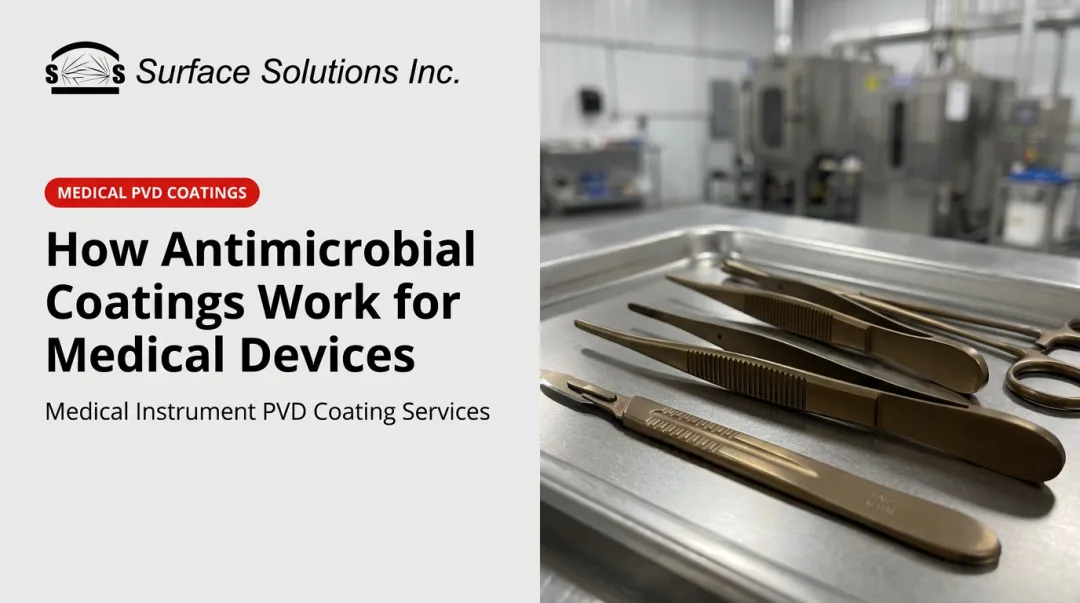
- Surgical tools and instrument sets
- Catheters, stents, and guidewires
- Endoscopes and reprocessed diagnostic equipment
- Wearable and skin-contact devices
Antimicrobial coating supports infection control. It doesn't replace sterilization protocols. FDA reprocessing guidance is explicit that cleaning must precede sterilization. A coated surface still requires validated cleaning and sterilization cycles to be safe for reuse.
Key Advantages of Antimicrobial Coatings for Medical Devices
These advantages tie directly to metrics manufacturers and hospitals already track: infection rates, sterilization costs, device lifespan, and compliance risk. These are numbers that show up on a P&L or an audit report.
Reduced Risk of Healthcare-Associated Infections
Coatings work by limiting bacterial adherence and biofilm formation on a device surface. On implants and catheters, this matters most at the insertion site and throughout dwell time, when bacteria have the longest window to colonize.
Why this matters financially: a 2023 peer-reviewed model projected 77,653 complex surgical site infections following hip and knee arthroplasty in the US between 2020 and 2030. Of those, 23,297 would be preventable if SSI rates dropped by 30%. A separate 2024 cost study found the mean direct hospital cost for a single hip periprosthetic joint infection procedure runs $28,904.

KPIs impacted:
- Infection rate and readmission rate
- Cost per procedure
- Patient satisfaction scores
This advantage matters most for long-dwell implants, immunocompromised patients, and high-volume surgical centers, where even a small infection rate reduction compounds across thousands of procedures.
Improved Durability Through Sterilization Cycles
Repeated autoclave and chemical sterilization cycles degrade uncoated surfaces over time. A 2015 scanning electron microscopy study on scaling curettes found carbon-steel instruments showed visible oxidation and edge deterioration after just 10 sterilization cycles, while stainless-steel instruments held up with little change.
PVD-coated instruments perform even better. Internal data from Surface Solutions shows PVD-coated tools can achieve up to 10x the lifespan of uncoated instruments in demanding applications. That gap adds up fast in high-throughput surgical settings running dozens of sterilization cycles weekly.

KPIs impacted:
- Instrument lifespan and replacement frequency
- Sterilization compliance rate
- Total cost of ownership for reusable tool sets
Enhanced Corrosion and Contamination Resistance
Corrosion isn't just cosmetic. FDA's reprocessing guidance flags corrosion, discoloration, and pitting as deterioration requiring formal acceptance or failure criteria before a device returns to use. Micro-pitting creates hiding spots for bacteria that survive even thorough cleaning.
PVD-based coatings, like the TiN, CrN, and AlTiN coatings applied by Surface Solutions, create a dense, non-porous barrier that resists this kind of surface breakdown. CrN in particular is formulated for superior corrosion resistance, making it a common choice where both antimicrobial performance and wear resistance are required.
Fewer corrosion-related failures mean fewer recalls and cleaner regulatory audit outcomes. That difference shows up when FDA inspectors review your reprocessing validation records.
KPIs impacted:
- Corrosion incidence and surface defect rate
- Regulatory compliance pass rate
This matters most for devices exposed to bodily fluids, moisture, and repeated harsh cleaning chemicals — think surgical instruments and long-dwell implants.
Common Applications of Antimicrobial Coatings in Medical Devices
Coating choice depends heavily on device type and how long it contacts the body. A long-dwell implant has different priorities than a single-use surgical blade.
- Orthopedic implants — prioritize long-term biocompatibility and wear resistance over decades of use
- Catheters and stents — need coatings that resist biofilm without compromising lubricity or flexibility
- Surgical instruments — prioritize durability through repeated sterilization cycles and cutting edge retention
- Endoscopes — face unique reprocessing challenges due to complex internal channels
- Wearable/skin-contact devices — require coatings tolerant of prolonged skin contact and moisture

Beyond biofilm control, PVD-coated instruments also gain lower friction, which supports smoother, more precise movement during procedures. Robotic surgery components that once galled and froze under repeated use often run seizure-free for extended periods once coated.
What Happens When Antimicrobial Coating Is Missing or Ignored
Skip antimicrobial coating and the gap is not theoretical. Consequences show up quickly in operations and cost:
- Higher rates of surgical site and implant infections
- Faster instrument degradation, driving replacement well ahead of schedule
- Increased sterilization failures and biofilm buildup on hard-to-clean surfaces
- Rising liability exposure and compliance risk during FDA audits
- Reduced confidence from surgeons, hospital procurement teams, and patients
Given that coated instruments can last up to 10x longer than uncoated ones, skipping coating only defers cost. That expense returns later as replacement, downtime, or a failed audit.
How to Choose the Right Antimicrobial Coating Partner
Coating effectiveness comes down to three things:
- Proven biocompatibility testing: The coating and finished device should meet ISO 10993 requirements, evaluated as a whole finished product, not just the raw coating material
- Consistent, even application: Complex geometries (cannulated instruments, threaded components, internal lumens) need a process that doesn't leave thin spots or gaps
- Medical-grade PVD experience: A provider that understands both the coating chemistry and the regulatory documentation the FDA expects

Surface Solutions serves medical device manufacturers nationwide, applying durable PVD coatings including TiN, AlTiN, CrN, and TiCN to instruments and components at scale.
That differs from consumer-grade or single-part coating shops. Medical device manufacturers need a partner built for batch production and consistent documentation.
Conclusion
Antimicrobial and PVD coatings reduce infection risk, extend device life, and support the kind of documentation FDA reviewers want to see. None of these benefits are one-time wins — they compound when coatings are applied consistently and paired with proper sterilization protocols throughout a device's service life.
Coating selection deserves the same strategic attention as material selection or sterilization validation. Treat it as an afterthought, and you'll pay for it later in replacement costs, audit findings, or worse.
Frequently Asked Questions
What is an antimicrobial coating for medical devices?
It's a surface treatment designed to inhibit microbial growth and reduce infection risk on a device's exposed surfaces. It works alongside, not instead of, standard sterilization protocols.
Are antimicrobial coatings safe for medical devices?
Properly tested coatings meeting ISO 10993 biocompatibility standards are considered safe for medical use. Safety depends on coating chemistry and application consistency on the finished device.
What are common antimicrobial coatings used on medical devices?
Common options include silver-ion coatings, antimicrobial polymers, and metal-based coatings like chromium or copper alloys. PVD coatings such as TiN and CrN add corrosion and wear resistance alongside these.
Is PVD coating considered medical grade?
PVD coatings can meet medical-grade standards when they pass biocompatibility and regulatory testing. They're widely used on surgical tools and implants for durability and surface performance.
How long do antimicrobial coatings last on medical devices?
Longevity varies by coating type, device use, and sterilization frequency. Some coatings, particularly PVD hard coatings, can last the device's full service life with proper care.
Do antimicrobial coatings affect device performance or functionality?
Properly engineered coatings do not compromise functionality. PVD coatings often improve performance by reducing friction and increasing wear resistance on moving components.