That's galling, and it's one of the most frustrating failures in metalworking because it feels random but isn't. Fastenal, which deals with this constantly across its industrial customer base, describes thread galling as essentially a cold-welding process: heavy pressure between mating surfaces causes them to fuse together under friction and heat.
Once you understand what triggers galling, you can stop it before it costs you a tool, a fastener, or a production run. This article covers the causes, the early warning signs, and the prevention strategies — including anti-galling coatings — that actually work.
TL;DR
- Galling is adhesive wear: surfaces fuse when oxide layers break under friction and pressure
- Main causes: similar/soft metal pairings, high friction and speed, poor lubrication, damaged surfaces
- Ignoring it risks seized fasteners, ruined tooling, and unplanned downtime
- Prevention combines coatings, lubrication, smart material pairing, and controlled installation
- Long-term control needs routine inspection, trained operators, and recoating high-wear tools
Common Causes of Galling in Stainless Steel
What Is Galling?
Galling is adhesive wear that happens when two metal surfaces slide against each other under pressure. The contact breaks down their protective oxide films and transfers material back and forth, micro-welding the surfaces together. It rarely comes from one single factor. Usually it's a combination of the causes below stacking up at once.
Similar or Soft Metal Pairings
Stainless-on-stainless contact is the worst-case scenario. Fastenal notes that mating parts made of the same alloy have a greater tendency to gall than dissimilar alloys. The identical, ductile surfaces adhere to each other more readily than a stainless part paired with something harder or chemically different. Typical scenario: A stainless bolt and nut of the same grade, tightened together with no differentiation between the two surfaces.
High Friction, Pressure, and Speed
Heavy thread pressure gets galling started. Installation speed makes it worse. Faster tightening or faster sliding generates more friction and heat, which destroys the protective oxide film quicker. Typical scenario: A technician uses a power tool to rapidly drive stainless fasteners home, or a stamping die runs at high speed without any cooldown between cycles.
Inadequate or Absent Lubrication
Thread lubrication is one of the most effective ways to cut galling risk, according to Fastenal, because it directly reduces the friction that damages the oxide layer. Skip it, and you're removing your best buffer. Typical scenario: Technicians assume stainless "doesn't need" anti-seize compound and assemble parts dry.
Rough, Damaged, or Contaminated Surfaces
Burrs, debris, and rough machining marks concentrate stress at contact points, rupturing the oxide layer faster than a clean, smooth surface would. Smoother surfaces, such as rolled threads, generate less friction than cut threads. Typical scenario: Reused or improperly stored parts rub against each other in a bin before assembly, picking up dents and debris nobody notices until the joint seizes.

What Happens If Galling Is Ignored
Minor galling might still let you back a fastener out. Severe galling won't. Once surfaces fully fuse, continued tightening can twist off the fastener or strip the threads entirely. At that point you're cutting the bolt or splitting the nut just to separate the parts, according to Design World's breakdown of fastener galling.
The damage doesn't stop at the fastener. A galled joint may never reach its required preload, particularly under dynamic loads. Stainless Steel World reports that this can lead to fatigue failures down the line.
One manufacturer in that piece swapped standard stainless screws for premium fasteners after galling caused air-tightness problems in powder-processing equipment. The issue disappeared entirely.
For tooling, the cost shows up as scrapped punches and dies, unplanned press downtime, and rework that eats into margin on every affected batch.
Warning Signs You're About to Experience Galling
Galling escalates fast once it starts. Watch for:
- Increased resistance or binding during tightening or tool operation that wasn't there before
- Visible lumps, scoring, or discoloration on sliding or threaded surfaces
- Unusual grinding noise or vibration during metal-on-metal operations like turning, punching, or bolt tightening

If any of these show up mid-operation, stop. Don't add torque to force through resistance. That's exactly how a minor gall becomes a seized, unremovable joint.
How to Prevent Galling in Stainless Steel Applications
Preventing galling takes more than one tactic. Material choices, coatings, and handling practices each address a different root cause, so the strongest results come from stacking them.
Apply Anti-Galling Coatings
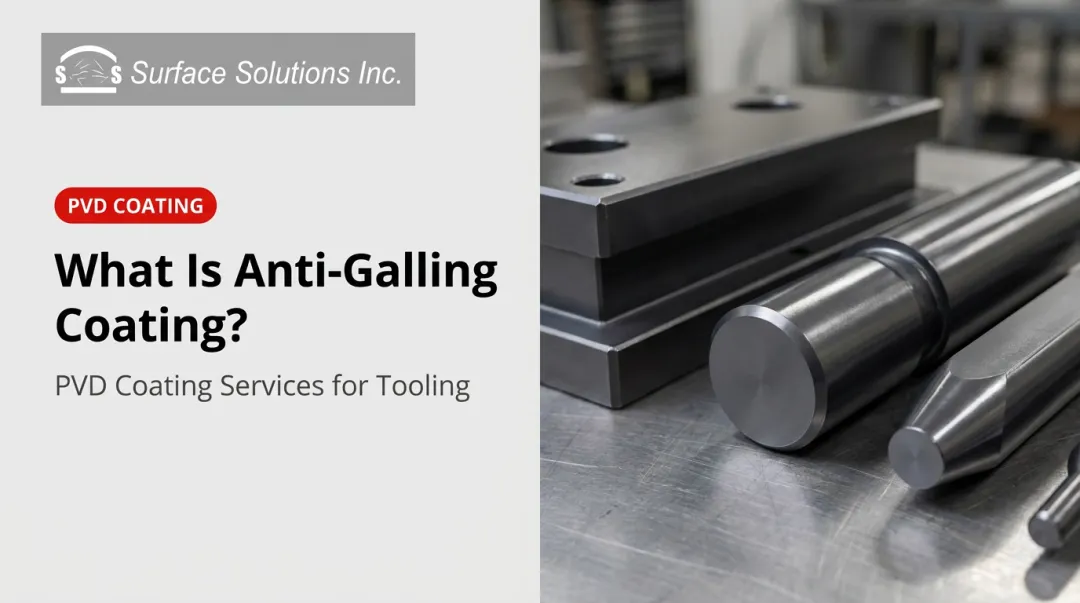
Apply PVD coatings such as CrN or Alpha™ to tooling and high-wear components. The coating forms a hard, low-friction barrier that resists adhesion cycle after cycle. Bare stainless relies on an oxide film that breaks down under heat and does not rebuild on its own during the run. In one stainless-steel drawing application, Alpha™-coated tooling produced only 15 parts before running too hot to touch. After switching to CrN, the same tooling ran past 500 parts while the work stayed just warm. Apply coatings during initial tool manufacturing or scheduled refurbishment. Surface Solutions applies PVD coatings to customer-supplied tooling for metal forming and cutting, extending tool life and cutting galling-related maintenance.

Use Proper Lubrication or Anti-Seize
Before assembly, apply molybdenum disulfide, PTFE, or a dedicated anti-seize compound. Lubrication holds friction and heat down so the oxide layer stays intact instead of stripping away during tightening. Use it every time you assemble stainless fasteners or sliding parts, especially dry-fit joints that often skip anti-seize.
Select Dissimilar or Hardened Material Pairings
Pair stainless with a harder material or a different grade: another stainless alloy, plated hardware, or a coated counterface. Dissimilar metals resist cold welding far better than identical alloys. Lock this in at design and specification, before parts are machined.
Control Installation Speed and Pressure
Tighten and run equipment slowly, and skip power tools on galling-prone joints. Lower speed limits the frictional heat that destroys the protective oxide film. Apply this during final torque on fasteners and throughout high-load metal-forming operations.
Maintain Clean, Smooth Surface Finishes
Clean geometry and controlled finish cut the stress risers where adhesive wear starts:
- Inspect and deburr parts before assembly
- Avoid overly rough finishes and ultra-polished surfaces below 0.25 µm
- Store parts so they cannot rub in transit Build these checks into incoming inspection and pre-assembly as standard practice.

Tips for Long-Term Prevention and Control
Beyond the immediate fixes above, a few habits keep galling from becoming a recurring problem:
- Schedule routine inspections of high-risk fasteners, dies, and sliding components to catch early galling signs before they escalate.
- Train operators on correct torque specs, lubrication steps, and how to recognize binding the moment it starts.
- Document coating type, lubrication schedule, and replacement history for every high-wear component so wear patterns show up over time.
- Recoat or recondition tools periodically rather than waiting for failure. PVD recoating can restore anti-galling performance on tooling already in service.
Conclusion
Galling is a predictable result of material pairing, friction, pressure, and surface condition. Once you know what drives it, you can prevent it.
Combining anti-galling coatings, proper lubrication, and smart material pairing addresses most galling issues before they start. The upfront effort is small compared to cutting a seized bolt out of a housing or scrapping a die mid-run.
Done well, prevention protects uptime, extends part life, and keeps maintenance budgets predictable instead of reactive.
Frequently Asked Questions
What is galling on stainless steel?
Galling is adhesive wear that occurs when the protective oxide layer on stainless surfaces breaks down under friction and pressure, causing the sliding surfaces to fuse or cold-weld together.
What does "anti-galling" mean?
Anti-galling refers to measures, coatings, or material choices specifically designed to prevent adhesive wear and seizing between metal surfaces in contact.
How to stop stainless steel from galling?
Use proper lubrication, apply anti-galling coatings like PVD, choose dissimilar material pairings, and control installation speed and pressure during assembly or operation.
Will Loctite prevent galling?
Certain Loctite anti-seize products are formulated specifically to reduce friction and galling in stainless steel. They work best with proper material pairing, correct torque, and clean surfaces—not as a standalone fix.
Can galled stainless steel be fixed?
Minor galling may still allow removal, but severe galling typically requires cutting the bolt or splitting the nut. Prevention is far more cost-effective than repair once fusion sets in.
Does coating stainless steel tools reduce galling long-term?
Yes. PVD coatings like CrN and Alpha™ create a durable, low-friction barrier that resists adhesion better than bare stainless and extends tool life.