Introduction
A perfectly engineered end mill or insert means nothing once the cutting edge starts generating heat and friction.
Even the sharpest geometry breaks down fast without a surface layer that can handle abrasive wear, chip welding, and the thermal punishment of modern machining speeds.
That's why coating is no longer optional. Sumitomo Electric's technical review found that coated carbide accounted for more than 70% of inserts in use across the industry, a share that has only grown since. PVD (Physical Vapor Deposition) sits at the center of that shift.
This guide covers how PVD coating actually works, the main coating chemistries available, and the performance gains you can expect. It also breaks down how to pick the right coating and the right coating partner for your specific application.
Key Takeaways
- PVD applies at lower temperatures than CVD, preserving edge sharpness and toughness
- Coating chemistry matters: TiN, TiCN, TiAlN/AlTiN, and CrN suit different materials
- Tool life gains are substantial: some shops report 6x more parts before resharpening
- Selection hinges on workpiece material, operation type, and dry versus wet machining
What Is PVD Coating and How Does It Work?
PVD is a vacuum-based process. A solid source material gets vaporized, then condenses onto the tool surface as an ultra-thin, high-purity film. No liquids, no chemical baths — just vapor transport inside a sealed chamber.
That thinness is the whole point. Typical PVD coatings measure 1 to 7 microns, though many cutting-tool applications land in the tighter 2 to 5 micron range. Surface Solutions applies its coatings within this exact window, specifically to avoid changing part tolerances or dulling fine edges on end mills, drills, and inserts.
Common Deposition Methods
Achieving that tolerance starts with the deposition method a coater chooses. Manufacturers rely on a handful of PVD techniques, each with its own trade-offs:
- Magnetron sputtering: argon ions eject atoms from a target material, which then deposit onto the tool; the most widely used method commercially
- Cathodic arc evaporation: an electric arc vaporizes the source material into a wear-resistant film; a common choice among PVD coaters
- Ion plating: energetic ion bombardment improves film cleanliness and adhesion
- Thermal evaporation: heat alone vaporizes the source material

Why Lower Temperature Matters
PVD deposits at roughly 500°C (932°F) in general industry practice, though Surface Solutions runs its process closer to 700–800°F (371–427°C) depending on the coating. Compare that to CVD's 700–950°C (1,292–1,742°F) range, and the difference becomes clear: high heat can soften hardened steel or deplete cobalt near a carbide surface. PVD's lower thermal exposure keeps the substrate's original toughness intact.
Adhesion isn't automatic, though. Oerlikon's process documentation describes ultrasonic cleaning, vacuum degassing, and argon-ion etching before deposition even starts, with each step designed to create an atomically clean surface for a true metallurgical bond.
Poor prep leads to what's known as the "eggshell effect," where a hard coating sits on an unsupported surface and flakes under load. That's why adhesion and scratch testing (standardized under ASTM C1624) matter as much as the coating chemistry itself.
Types of PVD Coatings for Cutting Tools
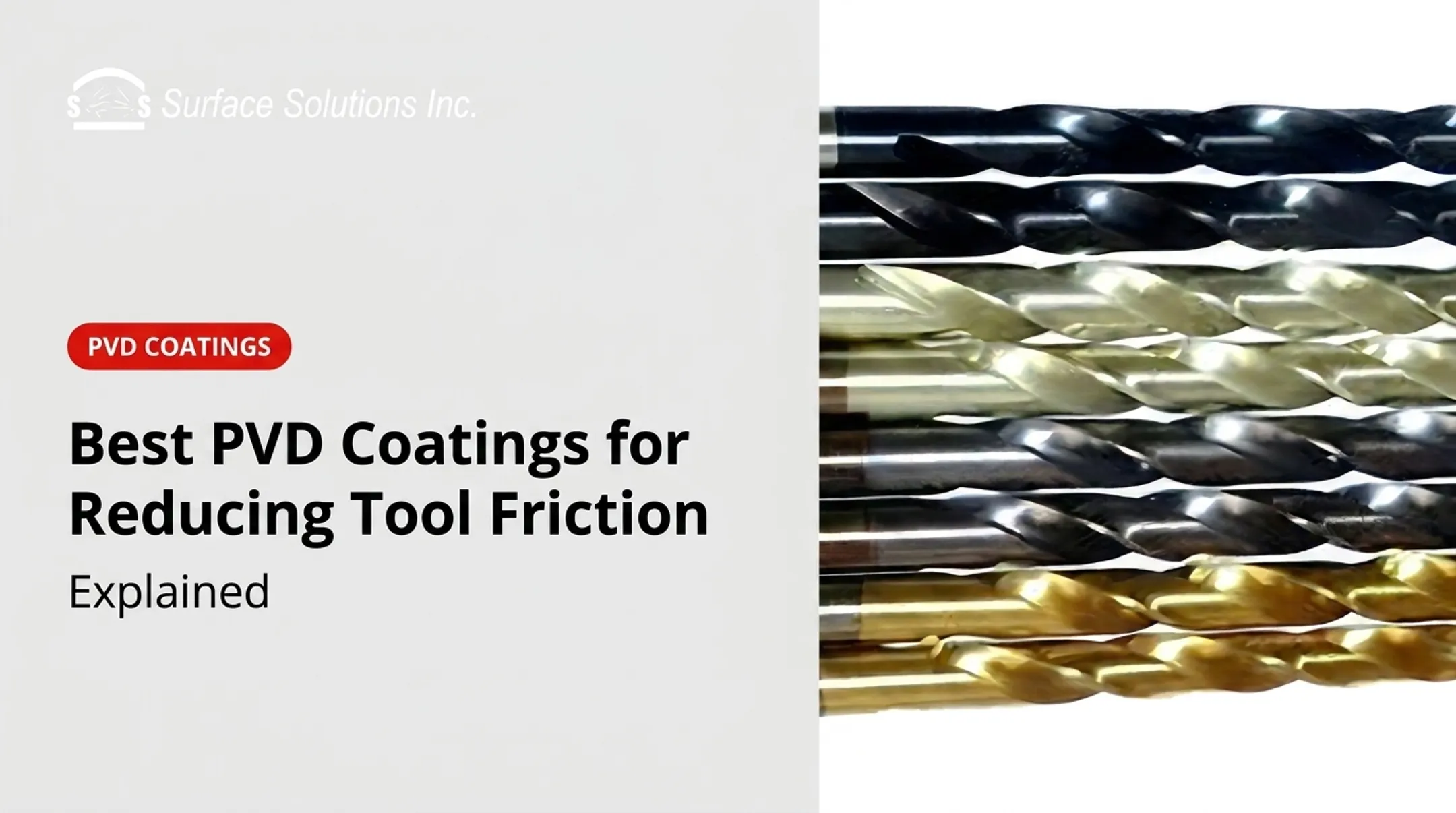
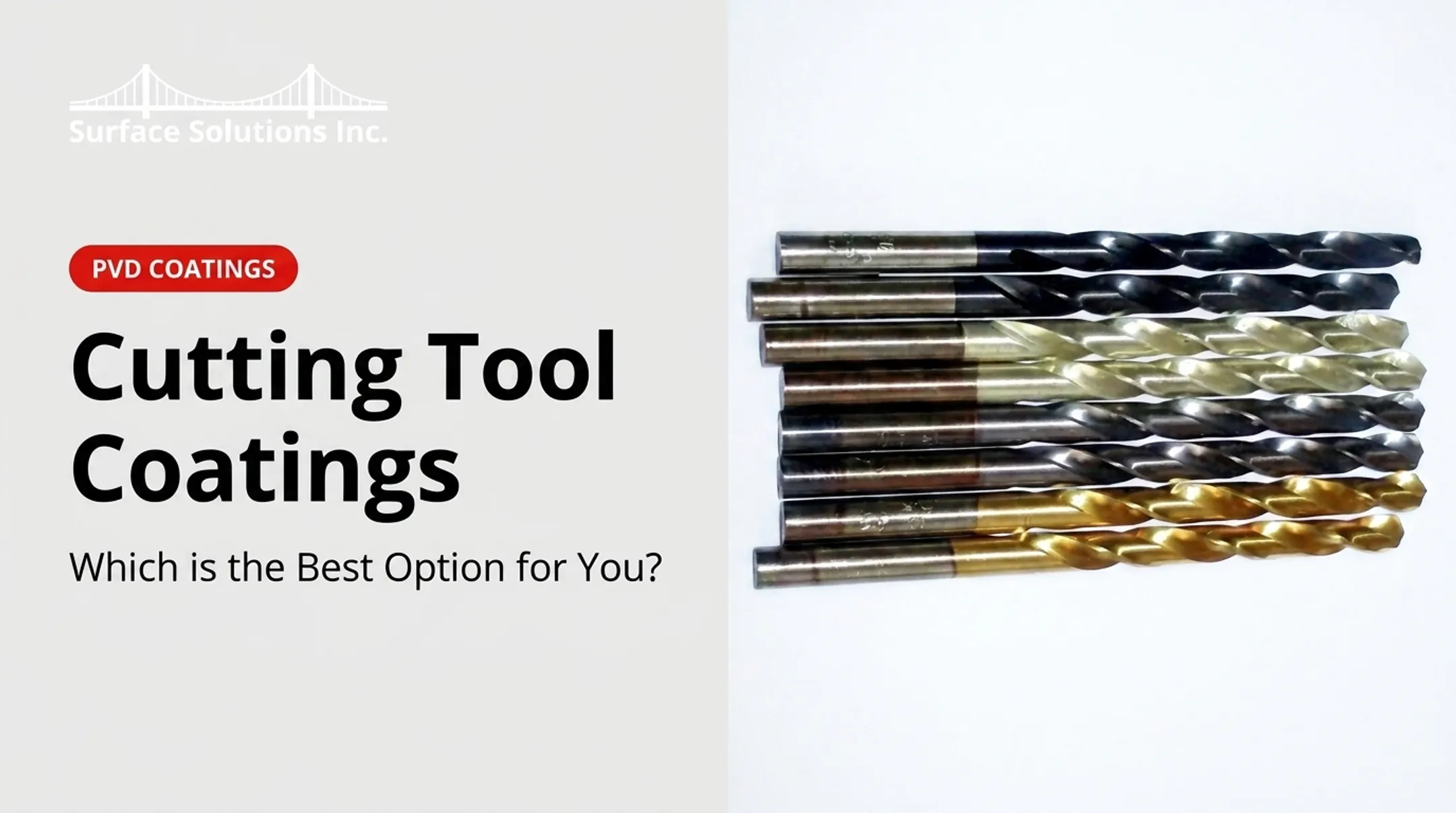
Coating chemistry determines three things: hardness, heat resistance, and friction behavior. Matching the right chemistry to your material and cutting conditions is where the real performance gains come from.
TiN (Titanium Nitride)
TiN was the original PVD coating and remains the most common general-purpose option. It offers solid wear resistance for mild steels and general-purpose tooling, with a maximum working temperature around 1,000°F. It's the baseline most shops still compare newer coatings against.
TiCN (Titanium Carbonitride)
Adding carbon to the nitride structure gives TiCN higher hardness and toughness than TiN. That extra durability makes it a strong fit for stainless steel, tapping, and cut-off operations where edge chipping is a real risk.
TiAlN / AlTiN (Titanium Aluminum Nitride)
At high cutting temperatures, the aluminum content in TiAlN/AlTiN forms a protective aluminum-oxide layer on the surface. That layer insulates the tool from heat rather than absorbing it, a major advantage for dry machining, hardened steels, and high-speed operations. Harvey Tool's technical data puts AlTiN's maximum working temperature at 1,400°F, well above TiN's ceiling.
Surface Solutions' own case study on a 3-corner carbide insert machining 304 stainless steel found AlTiN delivered 6x the tool life of uncoated TiN, at a coating cost of roughly $2.50 to $4.00 per tool depending on size.
CrN (Chromium Nitride) and Specialty Coatings
CrN's defining trait is low galling and minimal buildup, which makes it a strong option for non-ferrous and sticky, adhesive materials. Chromium nitride simply doesn't like to bond with the workpiece the way other coatings can.
In a stainless steel drawing application, Surface Solutions tooling coated with Alpha™ produced just 15 parts before overheating: the parts came out too hot to touch. Switching the same tooling to CrN pushed output past 500 parts, with finished pieces staying just warm to the touch.
Outside high-heat drawing applications like the one above, Surface Solutions also offers a proprietary Alpha™ coating, formulated to stretch resharpening intervals and, in some forming applications, eliminate polishing steps altogether.

Benefits of PVD-Coated Cutting Tools
The SME reports coated tools can deliver 2 to 10 times the life of uncoated tools, depending on chemistry and application. That range holds up in practice, but the real value shows up in how it changes daily operations.
Extended tool life and real labor savings. One Surface Solutions customer, Don Richardson, saw these results after switching to Alpha™-coated tooling on a 60,000-part run:
| Metric | Before Coating | After Alpha™ Coating |
|---|---|---|
| Parts per sharpening cycle | 10,000 | 60,000 |
| Resharpening cycles required | 6 | 0 |
| Labor spent pulling tools to sharpen | 48 hours | 0 hours |
That's 6x more parts per sharpening cycle, plus the full 48 hours of labor saved outright.
Beyond tool life, coated tools bring several operational advantages:
- Lower friction reduces reliance on heavy lubrication, supporting drier or leaner machining setups
- Better chip evacuation cuts down on built-up edge, improving surface finish
- More consistent wear patterns across a production run, which reduces scrap
- Predictable performance that supports unattended or high-volume machining
K&C Manufacturing's CFO, Angela Naasz, put it simply after switching to Alpha™-coated cutters: the coating "eliminated an entire process" her team previously had to run — proof that raw tool-life numbers don't capture the full picture.
PVD vs. CVD Coating: Which Is Right for Cutting Tools?
Both processes deposit a hard, wear-resistant film. The similarities mostly end there.
| Factor | PVD | CVD |
|---|---|---|
| Thickness | 1–7 microns | 5–20 microns |
| Deposition temperature | ~500°C | 700–950°C |
| Edge effect | Preserves sharp edges | Rounds edges due to thickness |
| Substrate toughness | Better preserved | Can embrittle carbide, deplete cobalt |
| Best fit | Milling, drilling, tapping, finishing | Heavy roughing, continuous turning |
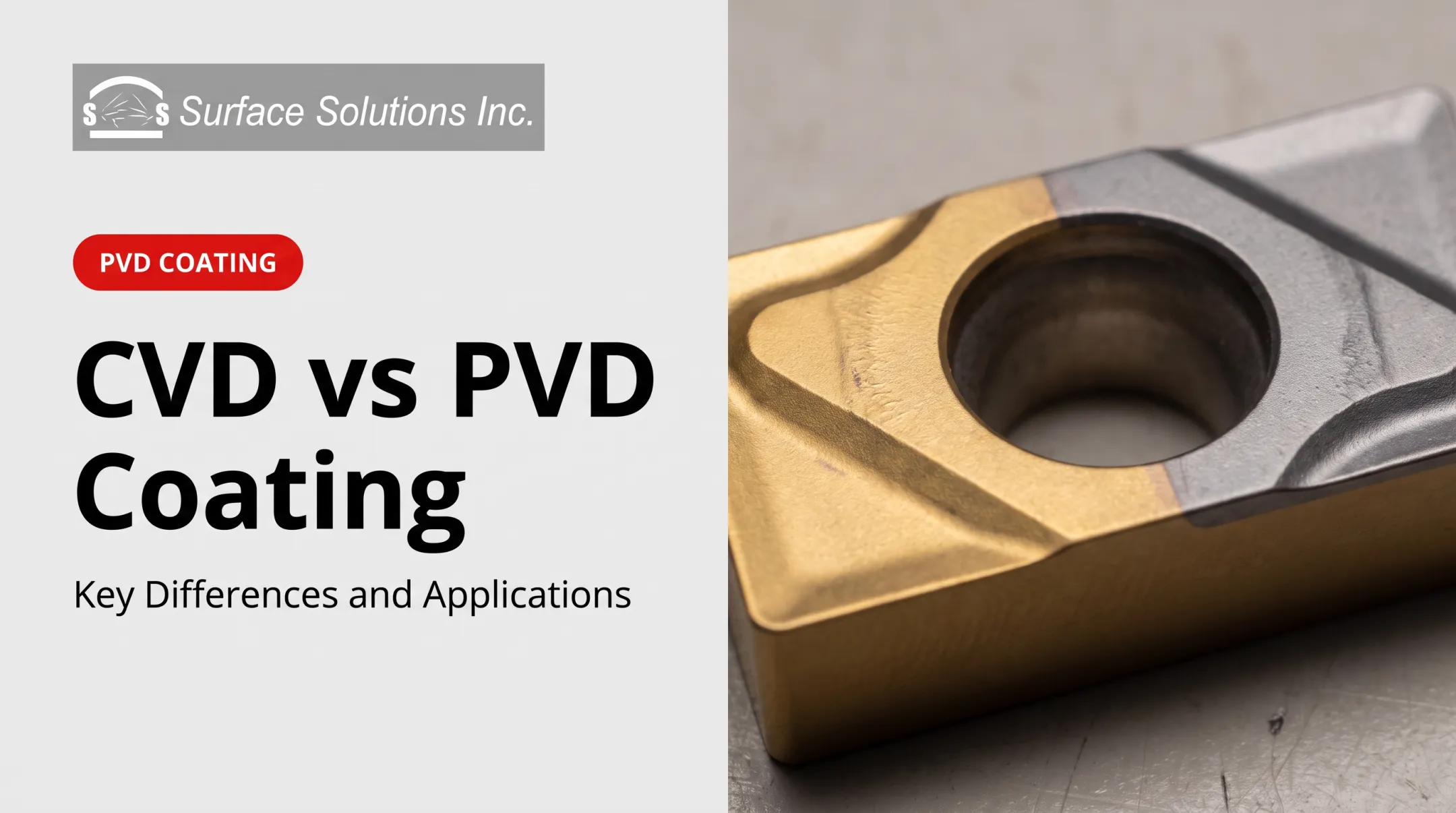
CVD's thicker films provide a strong thermal barrier, which suits heavy-duty roughing inserts where raw wear resistance matters more than edge sharpness. But that same thickness enlarges the edge hone, and the higher deposition temperature can soften the substrate underneath.
PVD is the better fit whenever tool geometry matters, and Surface Solutions reinforces that advantage by running its process at roughly 700–800°F, well below typical ranges, to protect carbide hardness in applications such as:
- Solid carbide end mills and drills that depend on a sharp cutting edge
- Taps and threading tools where edge geometry drives performance
- Fine-feature finishing tools sensitive to edge rounding
- Interrupted cuts, where lower processing heat protects substrate toughness
Choosing the Right PVD Coating and Coating Partner
Picking a coating starts with the material you're cutting and the conditions you're cutting it under.
Match coating to workpiece and operation:
- Abrasive materials need harder coatings like TiCN or AlTiN
- Sticky, gummy, or non-ferrous materials benefit from CrN's low-friction surface
- Hardened steels and high-heat, high-speed cuts favor AlTiN
Consider your machining environment. Dry, high-heat operations rely on AlTiN's oxide barrier to manage temperature. Flood-cooled, wet operations may perform just as well with a lower-cost option like TiN or TiCN, since coolant is already handling heat removal.

Look past chemistry alone. Turnaround time and recoat capability matter just as much for minimizing downtime. Surface Solutions operates a single facility in Fridley, Minnesota, but serves customers across the U.S., Canada, and Mexico, with most shipments returned within three days via standard ground.
"The tools work better than new," says Tony Deschenes of Special Tools, Inc., describing his resharpened tools after coating.
Frequently Asked Questions
How long do PVD coatings on cutting tools typically last?
Coating life depends on chemistry, workpiece material, and cutting conditions. Industry benchmarks put coated tools at 2 to 10 times the life of uncoated ones, though some documented cases show even higher gains before resharpening is needed.
What are better alternatives to PVD coatings for cutting tools?
CVD offers thicker, more heat-resistant films suited to heavy continuous turning, though it rounds edges more than PVD. Uncoated tools can still make sense for very sharp, low-speed, or non-ferrous work where coating adds little benefit.
Which PVD coating materials are widely used to enhance wear resistance in cutting tools?
TiN, TiCN, TiAlN/AlTiN, and CrN cover most applications. TiN handles general-purpose work, TiCN adds toughness for stainless steel, AlTiN resists high heat, and CrN reduces galling on sticky materials.
Can PVD-coated cutting tools be resharpened and recoated?
Most PVD-coated tools can be stripped, resharpened, and recoated, extending usable life further. Surface prep matters: oxides, EDM recast layers, or existing surface treatments need proper removal before recoating for good adhesion.
Does PVD coating affect the sharpness or geometry of a cutting tool?
No. Because PVD films run just 2 to 5 microns thick, they preserve edge sharpness and work safely on fine-geometry tools like micro end mills and threadmills.
How much does PVD coating typically cost for cutting tools?
Cost varies by coating type, tool size, and volume. Surface Solutions' AlTiN coating on carbide inserts runs roughly $2.50 to $4.00 per tool. Weigh that against labor and part-output savings over the tool's extended life.