This explanation is built for manufacturers, tool shops, and metal forming or cutting operations across the US, where tool life, part quality, and production efficiency directly affect the bottom line. PVD gets referenced constantly in industrial circles, but the actual process—what happens inside that vacuum chamber—is often misunderstood.
Here's what this article covers: how PVD works step by step, what factors affect coating performance, and when it makes sense (or doesn't) for your operation.
TL;DR
- PVD vaporizes solid metal in a vacuum and deposits it atom-by-atom onto tools or parts
- Extends tool life in metal forming, cutting, and manufacturing applications
- Runs through cleaning, vacuum loading, vaporization, then deposition and bonding
- Final performance depends on coating type, substrate prep, and equipment settings
- Not every job needs PVD: plating—or no coating—can be the better call
What Is the PVD Coating Process?
Physical Vapor Deposition (PVD) is a thin-film coating technique. Inside a vacuum chamber, a solid coating material is vaporized, then condenses on the part as a film typically 2-5 microns thick (0.0001"–0.0002").
The result is a hard, wear-resistant, low-friction surface layer. Part dimensions barely change, while wear life and cutting or forming performance improve.
How PVD differs from other coating methods:
- Electroplating: Metal ions deposit from a solution through electrolysis
- CVD (chemical vapor deposition): Gas-phase chemical reactions form the coating at the surface
- PVD: A solid source is physically vaporized—no chemical reaction or electrolyte bath
That physical route is why PVD coatings such as TiN, AlTiN, and CrN usually outpace electroplated finishes on hardness and wear resistance—and why they are standard on high-wear tooling.
Why the PVD Coating Process Is Used in Manufacturing
Manufacturers adopt PVD for three core reasons: longer tool life, less downtime, and better part finish. The data backs this up.
A 2019 peer-reviewed stamping study found that an uncoated pressure ring needed reconditioning every 80,000 cycles. With a TiAlN coating, that interval stretched to roughly 500,000 cycles: a lifetime gain exceeding 500%.
What manufacturing demands PVD addresses:
- Consistency across high-volume production runs
- Resistance to galling and material buildup on punches and dies
- Reduced friction, meaning less lubricant needed
What typically goes wrong without it:
- Frequent resharpening that eats into production time
- Higher scrap rates from degraded tool edges
- More labor hours spent on maintenance cycles
Real-world numbers support this. One Surface Solutions customer running metal forming operations saw Alpha™-coated punches produce 60,000 parts before resharpening, compared with the usual 10,000—a 6x improvement.

That avoided six sharpening cycles and saved roughly 48 labor hours, since each cycle took about 8 hours for removal, sharpening, reassembly, and reinstall.
Another customer running M4 punches with Alpha™ coating on galvanized steel reported over 15 months of continuous use, producing an estimated 15 million parts. The same shop had previously sharpened uncoated D2 punches every three weeks.
Whether PVD is worth it depends on the application. For cutting tools, forming dies, and medical instruments under sustained wear, it is usually the stronger operational choice. For low-volume or disposable tooling, the cost may not justify the gain.
How the PVD Coating Process Works (Conceptual Flow)
Parts are cleaned, loaded into a vacuum chamber, then a source material is vaporized and condenses onto the surface as a thin film.
What goes into the process:
- Substrate material (steel, carbide, and other tooling metals)
- Coating source material—titanium, chromium, zirconium, or alloy blends
- Inert or reactive gases (commonly argon, sometimes nitrogen for nitride coatings)
The core transformation: atoms get vaporized via cathodic arc or magnetron sputtering and travel in a line-of-sight path to bond with the substrate.
Operators control temperature, chamber pressure, gas composition, and part rotation for even coverage. Surface Solutions runs PVD coatings at 700°–800°F—hot enough for a strong bond, yet controlled so most tool steels hold dimension.
Typical results include:
- Higher surface hardness
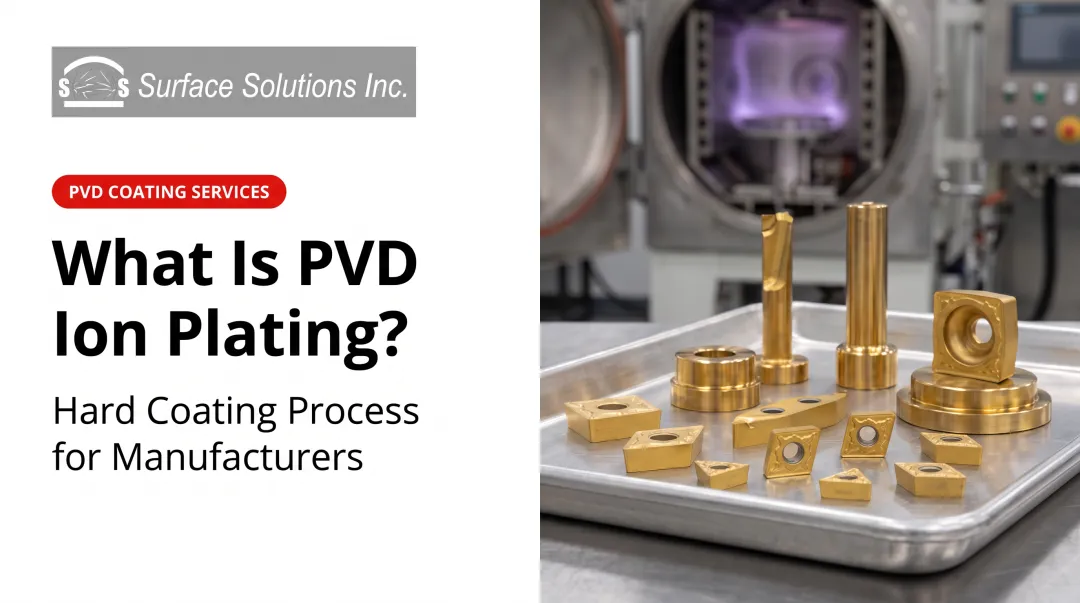
- Distinct color shift (gold for TiN; dark gray/black for AlTiN)
- Improved corrosion resistance
- Lower friction at the tool–workpiece interface

Those outcomes depend on three tightly linked stages.
Step 1: Cleaning and Preparation
Parts are degreased and often plasma-cleaned to strip contaminants. PVD will not bond reliably over surface oxides, EDM recast, or bluing.
Skip this step and coatings flake or lose bond strength, no matter how carefully deposition is run.
Step 2: Vacuum Loading and Vaporization
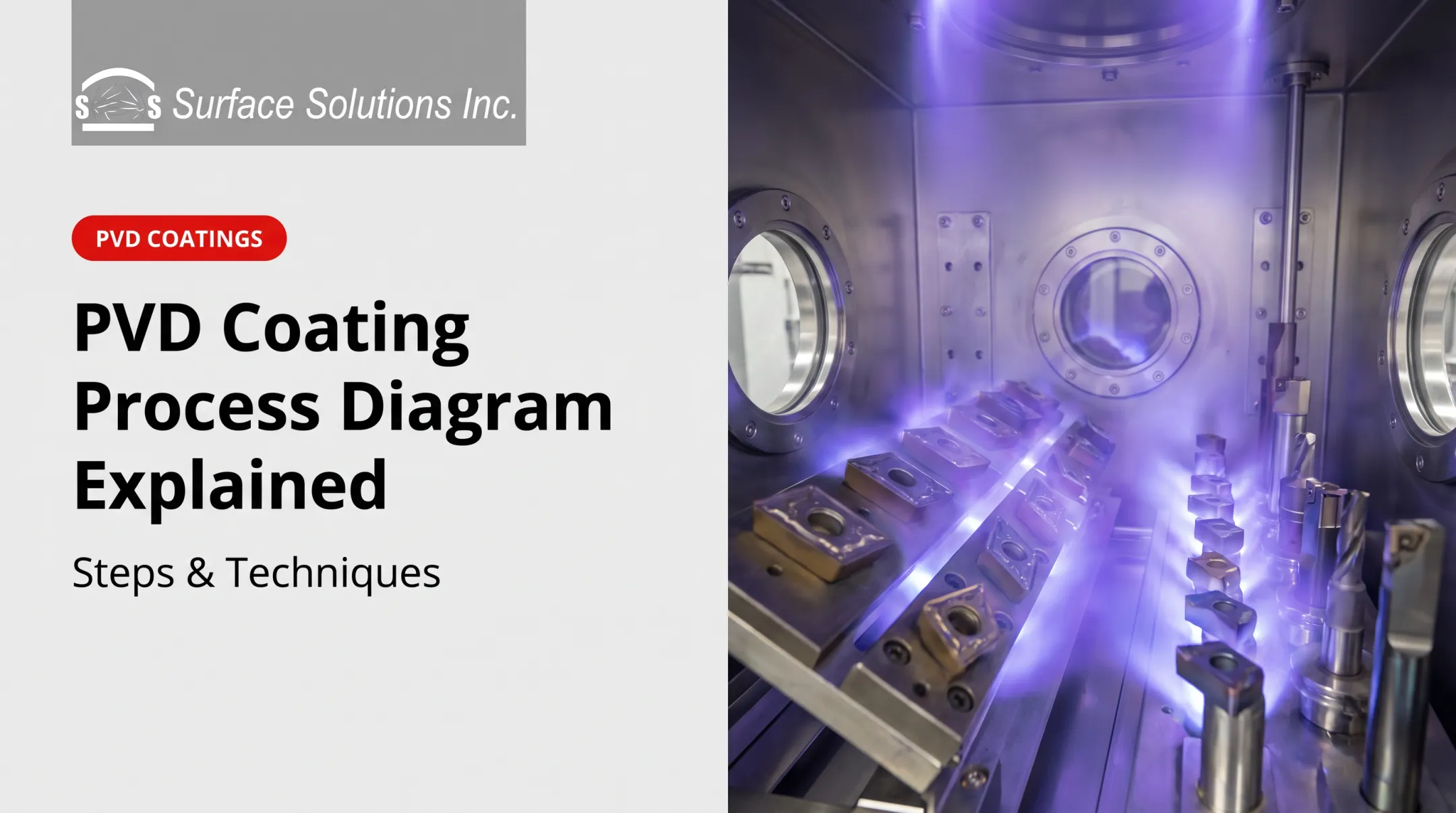
Fixtures hold parts inside the chamber, air is evacuated, and the source material is vaporized by cathodic arc or sputtering. During sputtering, chamber pressure typically sits between 10⁻³ and 10⁻² mbar, with argon providing ion bombardment.
Step 3: Deposition and Bonding
Vaporized atoms travel through the chamber and condense onto the part, forming a thin, tightly bonded film—often just microns thick. Because this is a line-of-sight process, part geometry and rotation matter for even coverage.
Where the PVD Coating Process Is Applied
PVD shows up across a wide range of tooling and equipment:
- Stamping dies and punches
- Cutting tools, drills, and inserts
- Injection molding tools and components
- Medical instruments and surgical devices
- Firearm components

Timing in the tooling lifecycle:
- Pre-production, as part of initial tooling prep
- After resharpening, to restore wear resistance
- As a proactive maintenance step to extend service life before failure
Common triggers for adopting PVD include excessive wear rates, tools needing resharpening too often, or a push to increase throughput without buying new tooling.
This is typically a recurring, maintenance-cycle process: tools get stripped, resharpened, and recoated rather than coated once and forgotten. One shop noted that nearly everything they resharpen gets sent out for recoating afterward, treating it as a standard part of the maintenance loop rather than a one-off investment.
Key Factors That Affect the PVD Coating Process
Several variables determine how well a PVD coating performs in the field:
- Substrate material and surface finish: parts must be pre-polished and free of oxides before coating; PVD won't fix a poor surface finish
- Chamber conditions and vaporization method: temperature, pressure, and arc versus sputtering change deposition characteristics
- Coating material selection: TiN, CrN, AlTiN, or proprietary blends like Alpha™, chosen based on the application's wear and heat demands
- Part geometry and fixture rotation: uniform coverage requires proper positioning, especially on complex shapes
- Turnaround time and batch scheduling: production environments need predictable coating cycles to avoid tooling bottlenecks
Coating choice often drives field performance more than any other variable. AlTiN, for example, offers oxidation resistance up to 1,470–1,650°F with hardness in the 4,000–4,200 Hv range, a strong fit for high-heat cutting. CrN, by contrast, brings corrosion resistance suited to medical and food-processing environments.

Common Issues, Misconceptions, and When PVD May Not Be Appropriate
Common process issues usually trace back to surface condition or geometry. Residual oils, oxides, or EDM recast can cause poor adhesion and flaking. Deep recesses and complex internals often get thinner coverage because PVD is line-of-sight without specialized fixturing.
Misconception #1: All PVD coatings perform identically. They don't. TiN, CrN, AlTiN, and proprietary blends each have distinct hardness, thermal, and friction properties. Choosing the wrong one for your application undermines the whole investment.
Misconception #2: Thicker coating means better performance. Thickness and hardness are separate specs. A thinner coating with higher hardness can outperform a thicker, softer one. Match the coating to your wear mechanism, not just a micron target.
When PVD may not make sense:
- Low-volume or one-off parts, where tool replacement costs less than coating setup
- Parts with deep recesses that can't get uniform line-of-sight coverage without special fixturing
- Assemblies with plastic inserts or non-conductive components most PVD processes can't accommodate
If you're running a handful of parts before retiring the tool, skip the coating. PVD pays off in production runs measured in thousands or millions of cycles, not dozens.
Conclusion
PVD coating is a vacuum-based vaporization and deposition process that produces hard, wear-resistant surface films on tools and parts. Knowing the steps—cleaning, vacuum loading, vaporization, and bonding—helps manufacturers extend tool life, cut downtime, and lower operating costs.
Match the coating type and process parameters to your application. TiN, CrN, AlTiN, and proprietary formulations like Alpha™ each address different wear, heat, and corrosion problems. Surface Solutions provides nationwide PVD coating services and can help evaluate which coating fits your tooling needs.
Frequently Asked Questions
How expensive is PVD coating?
Cost varies by part size, coating type, and volume. Larger batches typically bring per-unit costs down. Most shops offset the expense quickly through extended tool life and fewer resharpening cycles.
What is a physical vapor deposition (PVD) coating?
PVD is a vacuum process that vaporizes solid metal source material and deposits it as a thin, hard film onto a substrate. It creates wear-resistant, low-friction surfaces without significantly changing part dimensions.
Is PVD coating better than plating?
PVD offers superior hardness, durability, and corrosion resistance compared to electroplating. Plating may still suit lower-cost decorative applications where extreme wear resistance isn't required.
Can PVD coating be removed?
Yes, PVD coatings can be stripped through specialized processes. This is uncommon for end users but standard practice when tools get resharpened and sent back for recoating.
How long does a PVD coating typically last on industrial tooling?
Lifespan depends heavily on application and coating type. Some tooling runs over a year and millions of cycles with PVD, versus needing sharpening every few weeks when uncoated.
What materials can be PVD coated?
Common substrates include tool steel, carbide, and other metals used in industrial tooling. Coating materials include titanium nitride, chromium nitride, aluminum titanium nitride, and proprietary blends like Alpha™. Aluminum and zinc alloys aren't compatible with standard PVD processes.