PVD (Physical Vapor Deposition) and CVD (Chemical Vapor Deposition) are the two dominant coating technologies used across industrial tooling. They work differently, perform differently, and suit different applications. Choosing between them requires understanding where each excels — and where each falls short.
This article breaks down both processes, compares them across 8 practical considerations, and provides clear guidance on which coating fits which manufacturing scenario.
Key Takeaways
- PVD operates at lower temperatures (150–500°C), preserving hardness in pre-hardened tool steels and carbide substrates
- CVD coats complex internal geometries uniformly — PVD cannot match this on deep recesses or blind holes
- PVD coatings (2–5 microns) have minimal tolerance impact; CVD coatings (5–12 microns) require upfront tolerance planning
- For precision cutting and forming tools, PVD typically delivers better edge retention and operational cost outcomes
- Matching the coating process to your substrate, geometry, and performance requirements prevents costly tool failures and rework
PVD vs CVD: Quick Comparison
| Factor | PVD | CVD |
|---|---|---|
| Process Type | Physical vapor condensation | Chemical gas-phase reaction |
| Operating Temperature | 150–500°C (typical: 250–450°C) | MT-CVD: 720–900°C; HT-CVD: 900–1,050°C |
| Coating Thickness | 2–5 microns (typical) | 5–12 microns (standard); 20+ microns in specialized systems |
| Surface Coverage | Line-of-sight; selective masking easy | Conformal; coats internal surfaces and complex geometry |
| Wear Resistance | Excellent edge retention at thin thicknesses | Dense, thick layer for heavy abrasion environments |
| Substrate Compatibility | Hardened steel, carbide, most metals | Tungsten carbide, high-temp alloys, ceramics; limited by thermal cycle |
| Cost | Higher per-batch cost; lower lifetime cost per part | Lower equipment cost; requires post-coating heat treatment and grinding |
| Environmental Impact | Avoids metal-halide/HCl pathway; generally cleaner process | Chloride-based CVD produces HCl byproducts requiring scrubbing |
For most cutting tools and precision dies, temperature tolerance is the deciding factor — which is where the real tradeoffs begin.

What Is PVD Coating?
PVD is a vacuum-based process where a solid source material is vaporized — through arc ion plating or sputtering — and deposited as a thin film onto a substrate. No chemical reaction between coating and substrate is required; it's a purely physical transfer.
Two Main PVD Methods
Arc ion plating uses high electrical current to vaporize metal. It produces highly ionized, strongly adherent coatings but can eject liquid-metal droplets that increase surface roughness.
Magnetron sputtering uses magnetic fields and plasma ions for a slower, smoother deposition. It produces fewer macroparticle defects, making it the preferred method when finish quality and sharp edge geometry are critical.
Core Performance Properties
PVD coatings deliver:
- High hardness with thin deposition (2–5 microns typical)
- Low friction coefficients that reduce heat generation during cutting and forming
- Strong adhesion without altering precision tool dimensions
- Compatibility with hardened steel, carbide, and most metal substrates
- Deposition at 700°–800°F (370–427°C), preserving hardness in most hardened tool steels — provided the steel was originally tempered above that temperature (carbide substrates have no tempering concerns at these temperatures)
Common PVD Coating Types
| Coating | Typical Use |
|---|---|
| TiN (Titanium Nitride) | General cutting tools, drills, end mills, press tooling |
| AlTiN (Aluminum Titanium Nitride) | High-speed cutting, dry machining, medical instruments |
| CrN (Chromium Nitride) | Forming tools, corrosion-prone environments, medical devices |
| TiCN (Titanium Carbo-Nitride) | Punching dies, forming tools needing impact + wear resistance |
| Alpha™ (Proprietary) | Sheet metal forming, stamping dies, high-volume punching |
PVD Use Cases
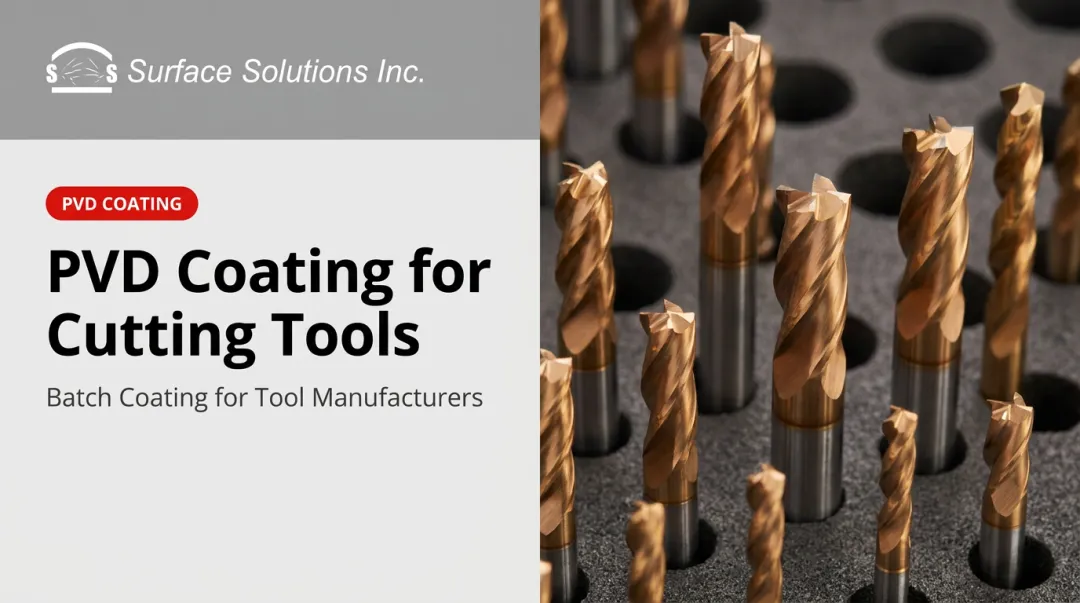
PVD dominates cutting tool applications — end mills, drills, punches, dies — where edge sharpness, dimensional precision, and extended tool life are critical to production output. It's also the standard for metal forming dies and sheet metal stamping tools.
A 2017 CIRP review noted that approximately 85% of cemented-carbide tools are coated (combining both CVD and PVD), reflecting how central coating technology has become to modern cutting tool manufacturing.
Surface Solutions' PVD coatings — CrN, Alpha™, AlTiN, and TiCN — are applied specifically for metal forming, punching, and drawing applications. Customers using Alpha™ coatings have reported producing 6x more parts before resharpening is required, with significantly reduced maintenance downtime.
What Is CVD Coating?
CVD introduces volatile gaseous precursors into a heated vacuum chamber. Those gases chemically react with the substrate surface to form a dense, tightly bonded coating. Unlike PVD, which relies on physical condensation, CVD builds the coating through a direct chemical reaction.
Key Structural Advantage
CVD is a conformal deposition process. The coating gas flows around and into complex geometries — internal surfaces, blind holes, threads, irregular shapes — delivering uniform thickness throughout. PVD cannot replicate this on deep internal surfaces.
If your component has non-line-of-sight surfaces that need protection, CVD is often the only viable option.
CVD Trade-offs
- Conventional CVD operates at 720–1,050°C, far exceeding the tempering temperature of most hardened tool steels — post-coating heat treatment is often required
- Coatings run thicker than PVD — 5–12 microns standard, with specialized aerospace systems like Hardide-A reaching 50–100 microns — so tolerance planning is required
- Difficult to mask selectively for precision coverage
- Chloride-precursor CVD (using TiCl₄ and AlCl₃) generates HCl byproducts requiring scrubbing systems
Despite those trade-offs, CVD's conformality and coating density make it the preferred choice in several demanding industries.
CVD Use Cases
CVD is used in:
- Airbus A320-family flap mechanism wing components, coated with Hardide's low-temperature CVD tungsten/tungsten-carbide system
- Internal sleeves for oil and gas flow valves exposed to proppant erosion
- Semiconductor manufacturing equipment operating in high-temperature, chemically aggressive environments
- Diamond end mills for machining graphite, carbon fiber composites, and high-silicon aluminum — where abrasive wear would quickly defeat other coatings

8 Key Considerations: PVD vs CVD
Consideration 1 — Process Temperature
Temperature is often the deciding factor. PVD operates at 150–500°C. CVD conventional processes run at 720–1,050°C.
Most hardened tool steels have tempering temperatures well below CVD process temperatures. D2 tool steel, for example, can be tempered as low as 180°C. CVD at 720°C+ would strip its hardness entirely, requiring re-hardening after coating.
PVD at 370–430°C is safe for steels tempered above that range — making it the default choice for most hardened tool steel applications.
Important caveat: PVD is not automatically safe for every hardened steel. The steel must have been tempered above the PVD coating temperature. Always verify the grade's tempering cycle before coating.
Consideration 2 — Coating Thickness and Tolerance Impact
PVD at 2–5 microns has minimal effect on tight tolerances. Surface Solutions' coatings at 0.0001″–0.0002″ are specifically noted as not typically affecting how parts fit together — a critical advantage for precision punching dies and forming tools.
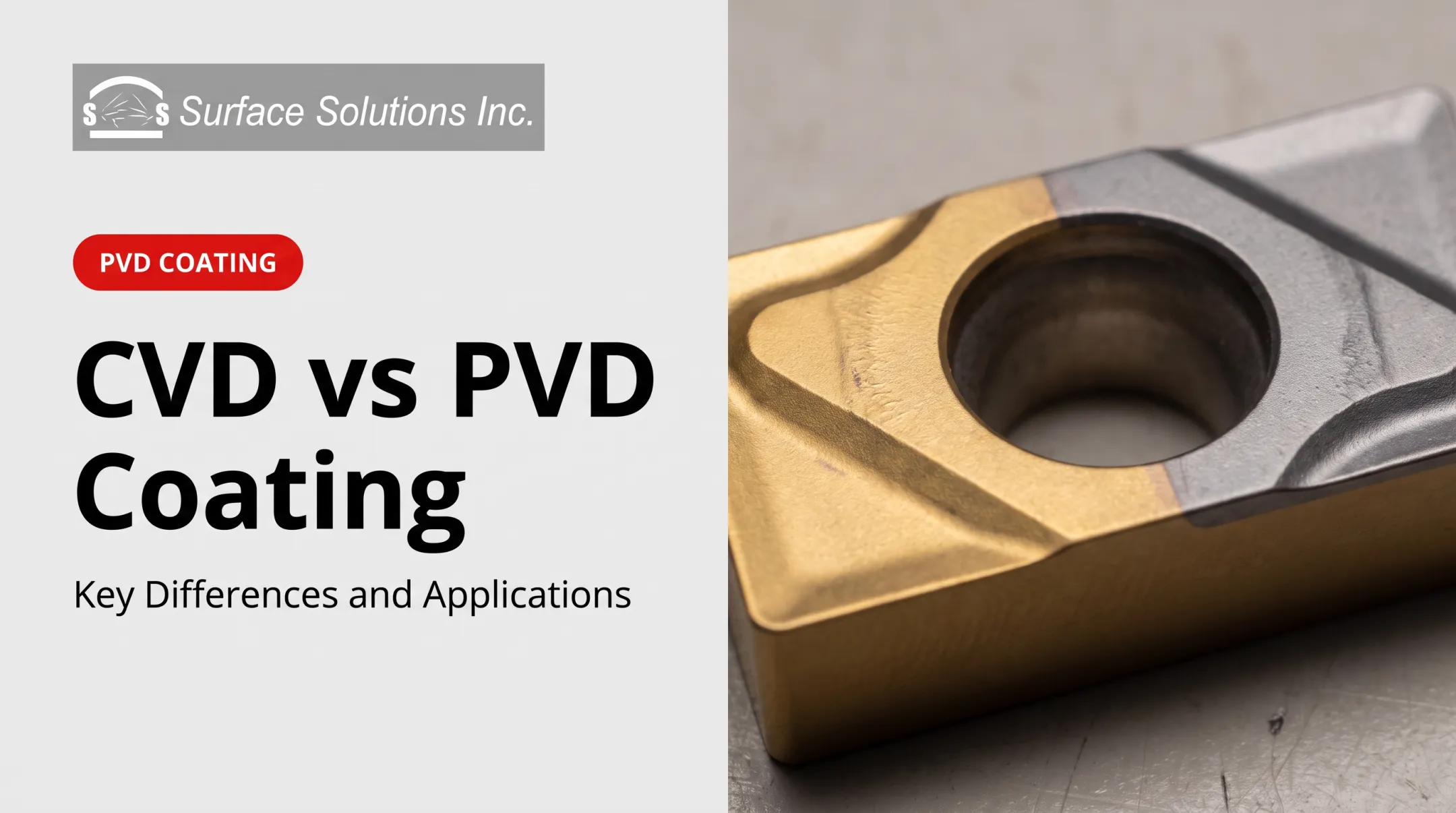
CVD at 5–12 microns (standard tooling) must be included in tolerance planning. Post-coat grinding with diamond or CBN wheels is sometimes needed on critical dimensions.
Thickness is an advantage when heavy abrasion is the primary concern — a thicker CVD layer provides longer protection before wear-through in bulk material environments.
Consideration 3 — Surface Coverage and Geometry
PVD is a line-of-sight process. It coats surfaces directly exposed to the deposition source, working well for cutting edges, punch faces, and die surfaces. It handles selective masking easily.
CVD coats internal surfaces and complex geometries uniformly, making it preferable for turbine blades, pump cylinders, valve internals, and any component with channels or blind holes where PVD simply cannot reach.
If your tooling geometry is primarily external surfaces and cutting edges, PVD is the practical choice. If internal uniformity is the requirement, CVD wins.

Consideration 4 — Wear Resistance and Tool Life
Both coatings improve wear resistance, but they do so differently.
A 2024 dry-turning study of AISI 4340 steel found CVD tool life at 14.75 minutes versus 10.08 minutes for PVD under one matched test condition, showing CVD can outperform PVD in specific heavy-cutting scenarios.
For precision metal forming and cutting applications, however, PVD's edge retention at thin thicknesses is the practical advantage. Surface Solutions' Alpha™ coating has documented results of 6x more parts produced before resharpening compared to uncoated tools, and CrN-coated forming tools producing over 500 parts versus 15 parts with other coatings in a stainless steel drawing application.
Heavy interrupted cuts in steel favor CVD's thicker layer. Precision forming, tight tolerances, and high-frequency resharpening cycles favor PVD. Match the process to the application.
Consideration 5 — Cost (Upfront vs. Lifetime)
No public apples-to-apples price comparison exists between PVD and CVD batch services. The real cost calculation involves:
- CVD adds: post-coating heat treatment, tolerance grinding on critical dimensions, longer lead times
- PVD adds: cleaning, fixturing, masking, and batch loading, but no heat treatment in most cases
On a lifetime cost-per-part basis, PVD-coated tools that dramatically reduce resharpening frequency often deliver a measurably lower total cost. Don Richardson's documented experience with Surface Solutions' Alpha™ coating saved 48 hours of labor on a single production run of 60,000 parts, eliminating 6 resharpening cycles at 8 hours each.
AlTiN coatings from Surface Solutions cost approximately $2.50–$4.00 per tool while delivering 2–7x the tool life of uncoated tools. That math favors PVD for most cutting and forming applications.

Consideration 6 — Environmental Impact and Safety
PVD avoids the metal-halide precursor and HCl byproduct pathway associated with chloride-based CVD. It serves as a direct alternative to hexavalent chrome processes.
Chloride CVD processes using TiCl₄ and AlCl₃ produce HCl byproducts that require specialized wet scrubbing systems. The EPA documents wet scrubbers achieving 95–99% removal efficiency for gaseous pollutants like HCl, functional but adding operational complexity and compliance obligations.
PVD is not completely hazard-free, but it avoids the acid-gas handling requirements that make CVD facilities more operationally intensive.
Consideration 7 — Substrate and Material Compatibility
PVD coats: hardened steels, carbides, most metal alloys. Ionbond also lists pre-plated plastics for decorative applications, though industrial tool coating is metal-focused.
CVD coats: tungsten carbide, tool steel (post-heat treatment required), high-temperature nickel alloys, ceramics, graphite. The practical constraint for tool steels is the 720–1,050°C thermal cycle, which limits CVD to substrates that can tolerate it.
Surface Solutions coats metal parts exclusively — hardened tool steels, carbide, and most metal alloys — excluding aluminum, zinc alloys, and any assembly with non-metal components. The PVD vacuum chamber process requires electrically conductive substrates.
Consideration 8 — Application Volume and Turnaround
Richter Precision documents PVD at 2–5 working days and CVD at 5–7 working days as provider-specific (not industry-guaranteed) estimates.
Surface Solutions accepts shipped parts from across the US, Canada, and Mexico. Most of the country falls within a 3-day UPS Ground shipping window to their Fridley, Minnesota facility.
For manufacturers running regular recoating programs after resharpening, a workflow used by customers like Special Tools Inc. in St. Francis, MN, this turnaround structure fits cleanly into ongoing tool maintenance cycles.
CVD's process complexity, acid-gas handling, and post-coating heat treatment or grinding requirements routinely push lead times beyond the 5–7 day estimate.
Real-World Example: PVD Coating in Metal Forming
Here's a common manufacturing scenario: stainless steel forming tools wearing out after minimal production runs, generating dangerous heat, and requiring constant maintenance.
A sheet metal forming customer documented exactly this when comparing Alpha™ coating against CrN in a stainless steel drawing application:
| Coating | Parts Produced | Part Temperature After Production |
|---|---|---|
| Alpha™ | 15 parts | Too hot to touch |
| CrN | 500+ parts | Just warm to the touch |
That's a 33x increase in parts produced. It also reflects a measurable reduction in heat transfer to the workpiece, which directly affects part quality, dimensional accuracy, and operator safety during handling.

For high-volume punching operations, Alpha™ coating has delivered its own documented results: one customer ran 60,000 parts without a single resharpening cycle, compared to their previous baseline of resharpening after every 10,000 parts. That eliminated 48 hours of labor in a single production order.
If your forming, cutting, or stamping tools are wearing out early, running hot, or driving up maintenance costs, the right PVD coating can change those numbers significantly. Contact Surface Solutions at 763-785-9436 or info@tincoat.net to discuss your specific application.
Conclusion
PVD and CVD are both proven coating technologies — but they are not interchangeable. The application, substrate, geometry, and operating conditions determine which one belongs on your tools.
Choose PVD when: precision cutting and forming tools, heat-sensitive substrates, tight tolerances, and edge retention are priorities. The lower process temperatures, thin deposition, and excellent wear resistance make it the practical choice for most metal forming, punching, and cutting tool applications.
Choose CVD when: complex geometries require conformal internal coverage, thicker protective layers are needed for heavy abrasion, or specialized applications like diamond-coated end mills for composite machining are required.
Getting this decision wrong has real consequences — shorter tool life, more frequent resharpening, unplanned downtime, and higher cost per part. Matching the coating to the application is one of the simplest ways to improve throughput without changing your process.
Frequently Asked Questions
Which is better, PVD or CVD?
Neither is universally better. PVD is typically preferred for precision cutting and forming tools due to lower process temperatures and excellent edge retention at thin thicknesses. CVD is better suited for complex geometries or applications requiring thicker, conformal coatings on internal surfaces.
What is CVD coating?
CVD (Chemical Vapor Deposition) is a coating process where gaseous precursors are introduced into a heated vacuum chamber and chemically react with the substrate surface to form a dense, tightly bonded film. This allows CVD to uniformly coat complex and internal surfaces that PVD line-of-sight processes cannot reach.
Can PVD-coated tools be resharpened?
Yes. PVD-coated tools can be resharpened and recoated — Surface Solutions offers this as a standard service, and customers like Special Tools Inc. send resharpened tools for recoating as a routine part of their tool maintenance cycle.
What is the typical coating thickness for PVD vs CVD?
PVD coatings are typically 2–5 microns (0.0001″–0.0002″), preserving tight dimensional tolerances. Standard CVD coatings for tooling run 5–12 microns, with specialized systems reaching 20 microns or more — a range that makes CVD a poor fit for precision tooling with tight tolerances.
Is PVD coating safe for medical device or food-grade applications?
Many PVD coatings are biocompatible and suitable for medical and food-contact applications. CrN has FDA food contact authorization (FCN 823) for repeat-use food-processing equipment up to 10 microns. TiN and AlTiN appear frequently in medical instrument coating applications, though finished devices require biological evaluation per ISO 10993 for their specific intended use.
Why does PVD coating reduce the need for lubrication in metal forming?
PVD coatings reduce the coefficient of friction on tool surfaces, which lowers heat generation and material adhesion during forming or cutting operations. Less friction means less lubricant is needed to achieve the same surface quality and tool performance — a direct operational cost reduction documented by multiple Surface Solutions customers.