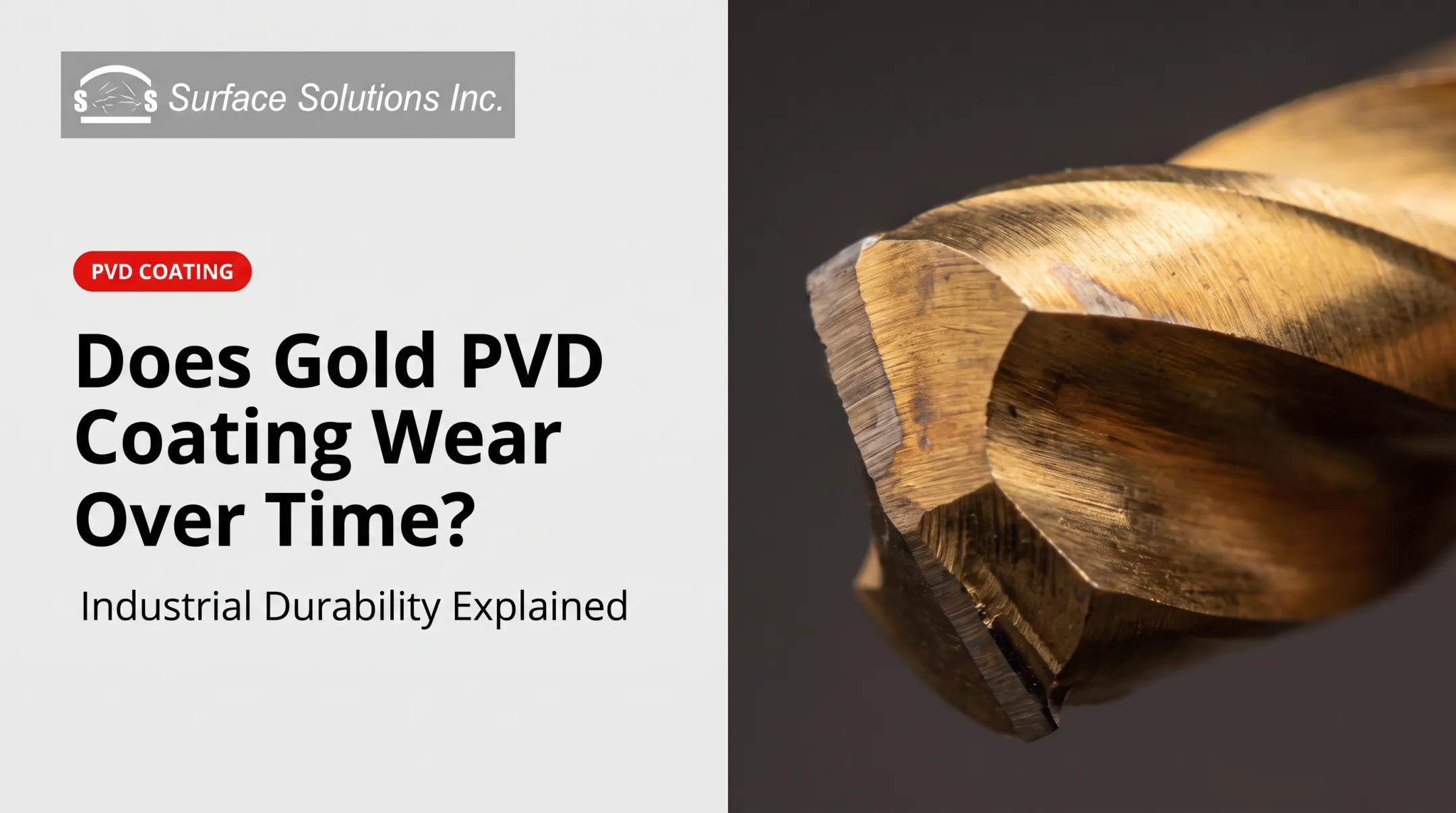
The honest answer is yes, PVD coatings do wear off. But how they wear — and how long it takes — depends almost entirely on context. A cutting tool running high-cycle press work is a completely different story than a decorative consumer part sitting on a shelf. This post focuses on the industrial reality.
We'll cover how PVD wear actually happens, realistic lifespan ranges by application, the factors that control longevity, and when recoating makes sense.
Key Takeaways
- PVD coatings wear gradually through friction and abrasion — they don't peel, flake, or chip under normal conditions
- Industrial tool life is measured in parts produced or production cycles — calendar years are the wrong metric for industrial tooling
- Coating chemistry, substrate hardness, surface prep, and operating conditions are the primary variables
- Recoating is viable and cost-effective when wear is caught early, before the substrate is compromised
Does PVD Coating Actually Wear Off?
Yes — but the mechanism matters more than the simple yes/no answer.
Well-applied PVD doesn't delaminate or peel. Instead, it thins gradually through mechanical abrasion at contact zones. That's a critical distinction: gradual thinning is manageable and predictable. Sudden delamination is not.
Why PVD Resists Sudden Failure
PVD coatings are deposited atom-by-atom in a high-vacuum environment. As Hauzer describes it, ionized metal vapor is attracted to negatively biased parts, forming an atomic-level bond rather than a mechanically retained surface layer. That bond is why PVD resists sudden failure under normal use.
Research confirms abrasive flank wear — where hard particles in the workpiece gradually remove coating material — as the most common end-of-life mechanism for cutting tools. Sandvik identifies this as the dominant wear type in metal cutting.
Premature Failure vs. Normal Wear
These must be treated differently when diagnosing tool performance:
- Gradual thinning in high-contact zones is normal end-of-life wear — predictable and manageable
- Delamination, spalling, or cracking signals premature failure, typically from contaminated substrate prep, coating/substrate mismatch, or excessive contact pressure
Premature failure is almost always a surface prep issue. Surface Solutions is explicit: PVD coatings won't adhere properly to surfaces with oxides, EDM recast, or bluing. Contaminants must be removed before coating — otherwise the result is adhesion failure, not wear.
In lightly loaded applications — certain medical components or precision assemblies — the PVD coating can outlast the useful life of the part itself. Wear never becomes a practical concern.
How Long Does PVD Coating Last?
There's no meaningful universal answer in years. Industrial PVD lifespan is best expressed in output terms: parts produced, cycles completed, or hours of operation at defined wear limits.
The spread in real-world data illustrates why this matters.
Documented Performance Ranges
| Application | Coating | Result |
|---|---|---|
| Steel drilling | Oerlikon BALINIT PERTURA vs. uncoated | 4,500+ holes vs. 28 holes (160x output) |
| Inconel machining | Oerlikon BALINIT TISAFLEX | 14% longer tool life vs. prior benchmark |
| Dry HSS hobbing | Oerlikon BALINIT ALCRONA EVO | 40%+ longer lifespan vs. predecessor |
| Stainless steel drawing | Surface Solutions CrN vs. Alpha™ | 500+ parts vs. 15 parts |
| Press tooling / stamping | Surface Solutions Alpha™ vs. uncoated | 60,000 parts vs. 10,000 parts (6x output) |

That range — from 14% improvement to 160x the output — reflects application dependence. The coating, substrate, workpiece material, and operating conditions all interact, and no two combinations produce the same result.
The Surface Solutions Production Examples
In stainless steel drawing, CrN-coated tooling produced over 500 parts with parts remaining just warm to the touch. The same application with Alpha™ coating produced only 15 parts — and those parts ran too hot to handle. That's a 33x gap driven entirely by coating selection for the specific workpiece material.
In press tooling, customer Don Richardson ran a full order of 60,000 parts without resharpening — compared to his normal threshold of 10,000 parts. Six times the output before the first sharpening cycle. At 8 hours per sharpening event, that's 48 hours of labor saved in a single production run.
What About the "10-Year Lifespan" Claim?
This figure circulates in marketing, particularly for decorative applications like watch cases or architectural hardware — products that see minimal contact stress. For production tooling, it doesn't apply. A stamping die doesn't age in years; it ages in strokes. Manufacturing engineers should benchmark by output metrics, not calendar time.
Recoating extends that output further. A properly recoated tool performs at near-new levels — meaning the same tool can cycle through multiple coating lifespans rather than requiring replacement after the first wear cycle.
What Determines How Long PVD Lasts?
Coating life doesn't fail randomly — it fails predictably, based on four variables. Getting these right determines whether a coated tool runs for months or wears out ahead of schedule.
Coating Chemistry
Different PVD chemistries have meaningfully different performance windows. Selecting the wrong one for an application is the most common cause of shorter-than-expected life.
| Coating | Hardness | Oxidation Limit | Best For |
|---|---|---|---|
| TiN | 2,400–2,600 HV | ~850°F (454°C) | General-purpose cutting, moderate wear |
| CrN | 1,670–2,010 HV | ~1,290°F (700°C) | Corrosion-sensitive, medical, forming |
| AlTiN | 1,869–2,446 HV | 1,475–1,650°F (800–900°C) | High-speed cutting, extreme heat environments |
| TiCN | 4,200–4,600 HV | ~710°F (375°C) | High-hardness wear applications |
| DLC | 5,000–9,000 HV | ~750°F (400°C) | Low-friction, precision components |

Hardness values vary by substrate condition and test method. Nitriding the substrate before coating consistently increases effective hardness of deposited films.
Substrate Hardness and Preparation
A coating is only as durable as what's beneath it. Under high contact pressure, a soft substrate plastically deforms: the hard film above it then cracks or spalls regardless of its intrinsic hardness. This is why Surface Solutions works primarily with hardened tool steels (H-13, A-2, M-2, D2, CPM M4) and carbide substrates.
Surface cleanliness is equally critical. Incomplete removal of oxides, grease, or EDM recast raises delamination risk significantly. In-situ ion etching before deposition removes residual contamination and improves interface quality.
Coating Thickness
Surface Solutions applies coatings at 0.0001″–0.0002″ (2–5 microns) — consistent across their coating chemistries. This is intentionally thin to preserve dimensional tolerances on precision tooling.
Thicker is not always better: excess thickness can alter edge geometry on cutting tools and increase residual stress. The goal is appropriate thickness for the wear environment, not maximum thickness.
Operating Conditions and Application Match
The operating environment drives wear rate as much as coating chemistry does. Four conditions determine how fast any coating degrades:
- Friction intensity — higher contact forces accelerate surface wear
- Temperature — sustained heat above the oxidation limit breaks down coating structure
- Chemical exposure — aggressive coolants or forming fluids can attack certain chemistries
- Lubrication match — using the wrong lubricant, or removing it too early, undermines coating performance

Surface Solutions' Alpha™ coating reduces lubricant requirements in forming applications, but it doesn't eliminate them entirely. Customer data consistently shows lubrication remains part of the process — just in reduced quantities. Pulling it out completely when it's still needed shortens coating life.
Signs Your PVD Coating Is Nearing End of Life
Visual Indicators
- Dulling or color change in high-contact zones (coating thins before it disappears)
- Visible exposure of substrate metal at wear points
- Visible contrast between coated and worn surfaces
In stamping operations, the signal is unmistakable: when Alpha™ coating wears through, the underlying M4 steel shows accelerated wear at exposed spots while protected areas remain intact. PVD wear is gradual and localized — not sudden and widespread like poor-quality plating.
Performance Indicators
In production environments, process output is often a more reliable signal than visual inspection:
- Increased heat generation during operation
- More frequent tool marks or surface finish degradation on parts
- Shorter intervals between sharpening events
- Rising scrap or reject rates
- Increased material build-up on tool surfaces (reduced anti-adhesion effect)
Why Catching Wear Early Matters
Catching wear early preserves recoating as an option. A tool identified at initial wear can be stripped, reconditioned, and recoated — restoring near-original performance. Once the substrate is visibly damaged or dimensionally compromised, recoating is no longer viable — full tool replacement becomes the only option.
How to Maximize PVD Coating Lifespan
Start with the right coating. The most impactful decision happens before deposition. Coating chemistry must match the substrate, workpiece material, and operating conditions — mismatched selection has real costs. The CrN vs. Alpha™ stainless steel drawing example puts a number on it: 485 fewer parts per run.
Maintain proper operating conditions. Avoid process conditions that accelerate wear:
- Excessive heat beyond the coating's oxidation threshold
- Incorrect feed rates that create abnormal contact pressure
- Running without lubrication when it's specified
- Using coated tools on workpiece materials outside their design range
Recoat before complete failure. Ionbond documents that decoating, regrinding, and recoating can be repeated 3 to 12 times depending on the tool and application. Oerlikon reports that reconditioning can restore as-new performance with roughly 50% cost savings versus repeated new-tool purchases.

The practical approach: track parts-produced counts and establish a recoating interval based on your production data — not on waiting for visible failure. One way to implement this is keeping spare pre-coated tooling on hand, so dies stay in service while worn tools cycle through reconditioning. Surface Solutions customers use this rotation to eliminate unplanned downtime between coating runs.
Frequently Asked Questions
What is the life of PVD coating?
PVD coating life varies widely by application. Decorative or lightly loaded parts may last years with no visible degradation. Industrial tooling life is measured in production cycles — documented results range from 14% improvement over uncoated baselines to over 160x the output, depending on coating type, substrate, and conditions.
Can you recoat PVD?
Yes. Most PVD-coated tools can be stripped and recoated multiple times, restoring near-original performance. Recoat proactively before complete failure — once the substrate is damaged, recoating may not be possible and full tool replacement becomes necessary.
Does PVD coating scratch or chip?
High-quality PVD coatings resist scratching due to their hardness, and they don't chip or peel under normal use. Wear occurs as gradual thinning at contact zones, not sudden surface failure. Chipping or delamination typically signals a substrate prep issue or coating/application mismatch rather than normal wear.
What causes PVD coating to wear off faster than expected?
The main accelerants are poor substrate preparation (oxides, EDM recast, contamination), mismatched coating chemistry, and operating conditions that exceed thermal or pressure limits. Inadequate substrate hardness — which allows deformation beneath the coating — is another common culprit.
How do I know when my PVD-coated tools need recoating?
Track parts-produced counts and watch for signals: increased heat, more frequent sharpening, rising reject rates, or color change in high-contact zones. Don't wait for visible failure — early detection keeps recoating viable.
Is PVD coating better than uncoated tools?
Consistently, yes. Surface Solutions customers have documented 6x more parts before resharpening in stamping applications, 33x more parts in stainless steel drawing with the right coating, and 5–8x service life on valve components. The performance gap is clearest in high-volume, high-contact applications where uncoated tools degrade rapidly.