Introduction
In 2025, the EPA settled with a Massachusetts electroplating company for $136,383 in RCRA violations — improper hazardous waste storage, labeling failures, and inadequate worker training. That's one enforcement action at one facility. Multiply that across an industry that routinely handles cyanide baths and hexavalent chromium, and the liability picture becomes substantial.
For manufacturers evaluating surface treatment options, the safety stakes are real: worker health exposure, environmental compliance costs, and regulatory downtime all attach to the chemistry you choose.
PVD coating operates from a fundamentally different starting point: a dry, vacuum-based physical process rather than a wet chemical bath. But "different" doesn't mean risk-free without qualification. This article separates two distinct safety questions that often get conflated:
- Is the finished PVD-coated product toxic? No — with a few specific caveats covered below.
- Are there safety considerations at the coating facility during deposition? Yes — and those are your provider's responsibility to manage, not yours.
Which question matters most depends on where you sit in the supply chain — and both are worth understanding.
Key Takeaways
- Intact PVD coatings (TiN, CrN, AlTiN, ZrN) are chemically stable and do not leach or off-gas under normal end-use conditions
- PVD coatings are used on FDA-reviewed surgical implants and medical instruments — among the most safety-critical applications in manufacturing
- Process-level hazards (plasma, heat, vacuum systems) are contained within the deposition chamber and managed by the coating provider
- PVD generates no hazardous liquid waste, unlike electroplating processes that rely on cyanide baths and hexavalent chromium solutions
- Regrinding or resharpening coated tools requires standard machining dust controls, not special precautions unique to PVD
Is PVD Coating Toxic? What the Science Says
The Chemistry of Common PVD Coatings
PVD coatings like TiN, CrN, AlTiN, and ZrN aren't simply elemental metals deposited on a surface. They're ceramic-like compounds formed through high-energy reactions inside a vacuum chamber. Once bonded, these films behave very differently from the raw materials used to create them.
A peer-reviewed orthopedic review published in PMC/NIH describes TiN as "a ceramic, chemically stable at room temperature, and biologically inert." That's the best-documented case. The evidence picture for other formulations is somewhat thinner:
| Coating | Chemical Character | Evidence Base |
|---|---|---|
| TiN | Ceramic nitride, chemically stable | Strongest biological and regulatory record |
| ZrN | Ceramic nitride, high corrosion resistance | Promising in-vitro data; limited food-contact authorization |
| AlTiN | Hard ceramic, superior oxidation resistance | Excellent thermal stability data; less toxicology research |
| CrN | Ceramic nitride, biomedical applications | Good wear data; thinner normal-handling toxicology record |
| TiCN | Ceramic/carbonitride hybrid | Robust wear application data; less complete safety dataset |

The practical result for manufacturing operators: a TiN-coated punch or cutting tool does not release compounds into workpieces, lubricants, or surrounding air during normal machining. The coating is inert to the conditions it encounters.
The Vaporization Phase — Contained, Not Exposed
During PVD deposition, solid target material is vaporized using high-energy plasma inside a sealed vacuum chamber. The plasma, UV radiation, and elevated temperatures are real hazards — but they're entirely contained within the chamber. End-users of coated tools never encounter the deposition environment.
That containment is what makes the finished coating's safety profile fundamentally different from conditions inside an operating deposition chamber — and it's why regulatory bodies evaluate coated devices on their own merits.
FDA Review and ISO 10993 — The Medical Benchmark
ISO 10993-1:2025 governs biological evaluation of medical devices in direct or indirect body contact. FDA has partially recognized this standard, requiring device-level biological risk assessment rather than blanket material approval.
FDA clearance K924050 — a "Titanium Nitride Coated Hemi-Head Component" for orthopedic use — demonstrates that TiN-coated implants have passed rigorous safety review. That's not approval of TiN as a standalone material, but it reflects the level of scrutiny these coatings can withstand.
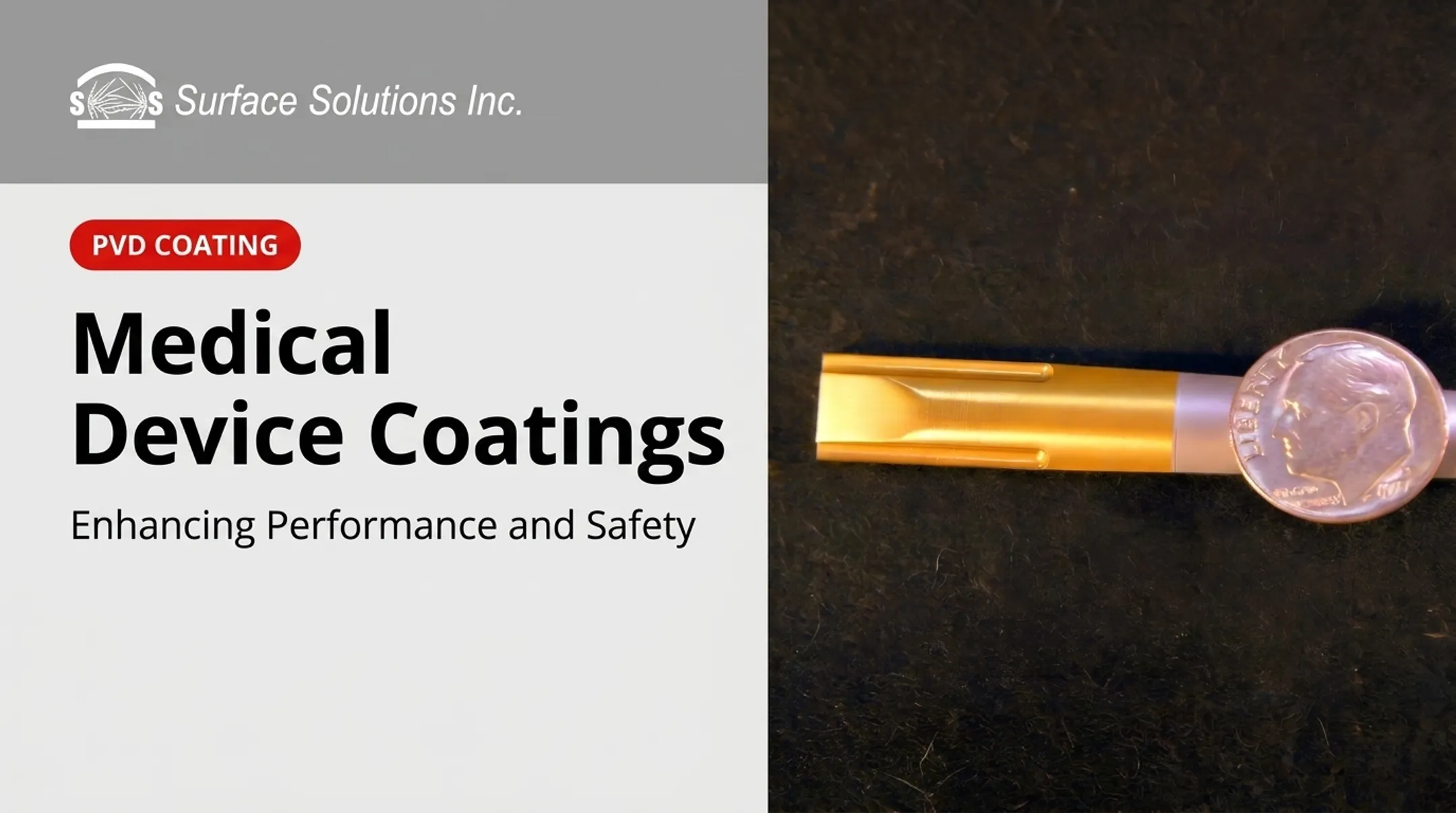
That same scrutiny applies in practice. Surface Solutions coats surgical instruments with TiN, CrN, and AlTiN, with AlTiN used specifically on instruments and implantable devices where biocompatibility and sterilization temperature resistance both matter.
What About Chips and Wear Particles?
An intact, properly adhered PVD coating presents minimal exposure risk. Worn or chipped coating is a different question.
A 2022 rat study found pulmonary effects from airborne TiN particles at higher concentrations — animal evidence rather than a human occupational study, but it establishes that fine TiN dust isn't biologically inert. No compound-specific OSHA PEL or NIOSH REL exists for TiN or CrN dust specifically.
The practical takeaways by exposure scenario:
- Intact coated tools in normal use — minimal risk; coating remains bonded and inert
- Worn tools with surface degradation — inspect and resharpen before coating breakdown generates loose particles
- Grinding or abrading coated tools — treat the resulting dust like any fine metallic particulate; respiratory protection is warranted
- Post-resharpening scrap dust — standard industrial hygiene practices apply regardless of coating type

Safety Considerations in PVD Coating Applications
PVD coating safety falls into two non-overlapping categories. Getting these confused leads to either over-caution (treating coated tools as chemical hazards) or under-caution (assuming the process itself needs no controls).
General Safety Precautions
For anyone handling parts going to or from a PVD coating facility:
- Surface preparation matters. PVD coatings won't adhere to oxides, EDM recast layers, or prior surface treatments like bluing. Contaminated surfaces don't just produce poor coatings — they produce poorly adhered coatings that may flake or delaminate in use.
- Avoid sandblasting for matte finishes before submission. Surface Solutions specifically cautions against this, as it risks surface contamination that undermines adhesion.
- Parts must be polished before coating if a polished final appearance is required. At 0.0001"–0.0002" thickness, PVD coating faithfully replicates the underlying surface — it doesn't hide defects.
Safety During the Coating Process
Inside the coating chamber, legitimate hazards exist: high-energy plasma, UV radiation in cathodic arc systems, and part temperatures approaching 700°–800°F. These are engineering control problems, not end-user concerns.
Reputable PVD providers operate enclosed vacuum systems where these hazards are physically contained. Chamber maintenance, target replacement, and vacuum system repairs are tasks for trained technicians following lockout/tagout protocols.
Surface Solutions processes parts in a vacuum chamber at approximately 800°F, with coating thickness controlled to 0.0001"–0.0002". For specific process safety controls and facility documentation, Surface Solutions' technical team is reachable at 763-785-9436.
Safety When Using PVD-Coated Tools and Equipment
For operators using coated cutting tools, punches, or dies, the safety picture is straightforward:
- Standard gloves and eye protection appropriate for the substrate metal apply
- No additional chemical hazard precautions are needed — the coating itself is inert
- The coating does not affect the hazard classification of the base tool
Regrinding coated tools requires specific attention. When a coated tool is resharpened, the grinding process generates fine metallic dust that warrants:
- Respiratory protection (at minimum a properly fitted N95 or better)
- Dust extraction at the source
- Avoiding compressed-air cleanup of grinding dust
Any grinding of coated metal produces mixed dust from both the substrate and coating. Treat this as standard machining practice and confirm it's part of your shop's operating procedures.
Environmental and Regulatory Safety
The environmental contrast between PVD and electroplating is significant. Under 40 CFR 261.31, electroplating generates federally listed hazardous wastes:
- F006: Wastewater treatment sludges from electroplating
- F007/F008: Spent cyanide plating bath solutions and residues
- F009: Spent stripping/cleaning solutions where cyanides are used
PVD generates none of these waste streams. It's a dry physical process — no liquid chemical baths, no cyanide waste, no hexavalent chromium disposal requirements.
For regulated industries, this matters in procurement terms. RoHS Directive 2011/65/EU restricts ten substances — including Cr(VI), lead, and cadmium — at 0.1% by homogeneous material. TiN, CrN, and AlTiN are not named among the restricted substances.
ECHA registration records confirm TiN (CAS 25583-20-4) and CrN (CAS 24094-93-7) are registered under REACH. Neither appears on current Candidate, Authorization, or Restriction lists.
Important caveat: Registration is not certification. Absence from RoHS restricted lists doesn't automatically certify a finished coated part. Substrate materials, impurities, and supplier declarations all factor into a complete compliance picture.
How PVD Compares to Alternative Coatings in Safety
Electroplating: The Baseline Comparison
OSHA's hexavalent chromium standard 29 CFR 1910.1026 sets an 8-hour PEL of 5 μg/m³ and an action level of 2.5 μg/m³ for Cr(VI) exposure. NIOSH identifies Cr(VI) as carcinogenic, with respiratory, skin, eye, kidney, and liver hazards. Cyanide-based plating baths add acute toxicity risk to that picture.
Electroplating's waste management obligations aren't theoretical — the 2025 EPA settlement with CIL Electroplating ($136,383 for RCRA violations) is a concrete recent example of what inadequate controls cost.
CVD: The Precursor Gas Problem
Chemical Vapor Deposition uses reactive precursor gases to deposit coatings. Common CVD chemistry introduces hazards that PVD simply doesn't carry:
- TiCl₄ — corrosive and water-reactive
- WF₆ — corrosive, acutely toxic; generates hydrofluoric acid on contact with moisture
- NH₃ — toxic by inhalation
PVD vaporizes solid targets rather than feeding these halide precursors. That said, reactive PVD isn't entirely gas-free: nitrogen is used for TiN and CrN deposition, and acetylene for TiCN. The safety advantage over CVD is real but specific: PVD avoids the halide precursor hazards, not all process gases.
Comparative Summary
| Factor | PVD | Electroplating | CVD |
|---|---|---|---|
| Hazardous liquid waste | None | Cyanides, Cr(VI), heavy metals | Some process solutions |
| Precursor gas hazards | N₂, Ar (reactive PVD) | N/A | TiCl₄, WF₆, NH₃ (toxic/corrosive) |
| Cr(VI) exposure risk | None | Significant | None |
| End-use chemical risk | Minimal (intact coating) | Substrate-dependent | Substrate-dependent |
| Regulatory waste codes | None (F-codes) | F006–F009 apply | Process-dependent |

Common Safety Mistakes to Avoid
Most PVD safety problems don't come from the coating chemistry itself — they come from predictable process and handling gaps. Here are three worth addressing directly.
Treating all PVD coatings as equivalent regardless of provider. Coating adhesion, thickness uniformity, and process control vary substantially between providers. A poorly adhered coating that delaminates under load creates the particle exposure risk that a quality process eliminates. Provider selection is a safety decision, not just a cost decision.
Regrinding coated tools without dust controls. Operators who resharpen coated tooling without respiratory protection and dust extraction expose themselves to fine metal nitride particles mixed with substrate grinding dust. The hazard is process discipline, not PVD chemistry itself. Treat regrinding the same way you'd treat any fine metallic dust generated in machining.
Assuming the substrate material is irrelevant. The coating sits atop the base metal. If a worn or chipped coating eventually exposes the substrate, that substrate's properties matter — especially base metals containing known allergens or hazardous elements. Evaluate the full material specification — substrate and coating together — not the coating alone.
Conclusion
PVD coating is not toxic in end-use applications. The chemical stability of properly applied ceramic nitride coatings, the evidence from medical device applications, and the absence of hazardous liquid waste streams all support that conclusion — with the standard conditions that apply to any material claim: proper application, adequate adhesion, and appropriate substrate selection matter.
For manufacturers and procurement teams, PVD coating safety is substantially a provider selection question. The chemistry is favorable — but realizing that depends entirely on who applies it. Process documentation, surface preparation protocols, coating adhesion controls, and quality traceability are what separate a properly inert coated tool from one that flakes under load. Those controls aren't formalities; they're the mechanism by which the safety profile is actually delivered.
Surface Solutions provides PVD coating services to manufacturers in cutting tools, medical instruments, stamping dies, and industrial wear components. For regulated applications where documentation and traceability matter, their technical team can walk through coating specifications and process controls specific to your parts. Reach them at 763-785-9436 or info@tincoat.net.
Frequently Asked Questions
Is PVD coating toxic?
No. Common PVD coatings like TiN and CrN are ceramic-like compounds that are chemically stable after deposition. They don't leach, off-gas, or release harmful substances under normal handling, machining, or contact conditions. The deposition process involves hazards, but those are contained within the coating facility — not present in the finished coated product.
Is PVD finish food safe?
TiN is authorized under FDA Food Contact Notification FCN 1240 as a thin ceramic film (0.1–25 μm) on repeated-use metal parts in food processing and packaging machinery. CrN is similarly used on food processing equipment for its corrosion resistance. FCN 1240 is use-specific — verify authorization against your exact application and coating type before proceeding.
How long will PVD coating last?
It depends on the application. In industrial use, Surface Solutions documents Alpha™-coated punching tools running 15 months and ~15 million parts in galvanized steel stamping. Decorative PVD on jewelry or fixtures typically holds up for several years of daily use with reasonable care.
Is PVD better than gold plated?
Yes, for most industrial applications. PVD coatings are significantly harder and more wear-resistant than gold plating, and they're produced without the toxic chemical baths electroplating requires. Gold plating offers aesthetic appeal but wears through quickly under mechanical contact.
Is PVD coating safe for direct skin contact?
Yes. TiN is used on FDA-reviewed orthopedic implants and surgical instruments — direct, long-term body contact applications. ZrN has demonstrated low toxicity and good biocompatibility in in-vitro implant studies. PVD coatings are among the more thoroughly tested coating options for skin and tissue contact.
What precautions should workers take when grinding or resharpening PVD-coated tools?
Use respiratory protection (N95 or better) and dust extraction when grinding any coated metal tool. Grinding produces a mixed dust of substrate and coating particles — both warrant protection regardless of coating type. Avoid compressed-air cleanup of grinding residue.