Zirconium nitride (ZrN) coating is one of the physical vapor deposition (PVD) solutions manufacturers turn to when uncoated tool steel simply can't keep up. This article breaks down what ZrN is, why its properties matter on the shop floor, how it's applied, and how it stacks up against other hard coatings like TiN and CrN.
Key Takeaways
- ZrN is a pale gold ceramic coating with 2,800 HV hardness, far exceeding tool steel
- Low friction (roughly 0.5) reduces galling, material buildup, and lubricant consumption
- PVD application preserves dimensional tolerances since it happens at relatively low temperatures
- Works best on copper alloys, forming dies, and select medical instruments
- Match coating choice, ZrN, TiN, or CrN, to the job's heat and wear profile
What Is Zirconium Nitride (ZrN) Coating?
ZrN is the chemical pairing of zirconium and nitrogen, deposited as a thin ceramic film onto a tool substrate through PVD. The compound typically forms in a near 1:1 ratio, though slightly nitrogen-deficient versions exist depending on how the coating is processed.
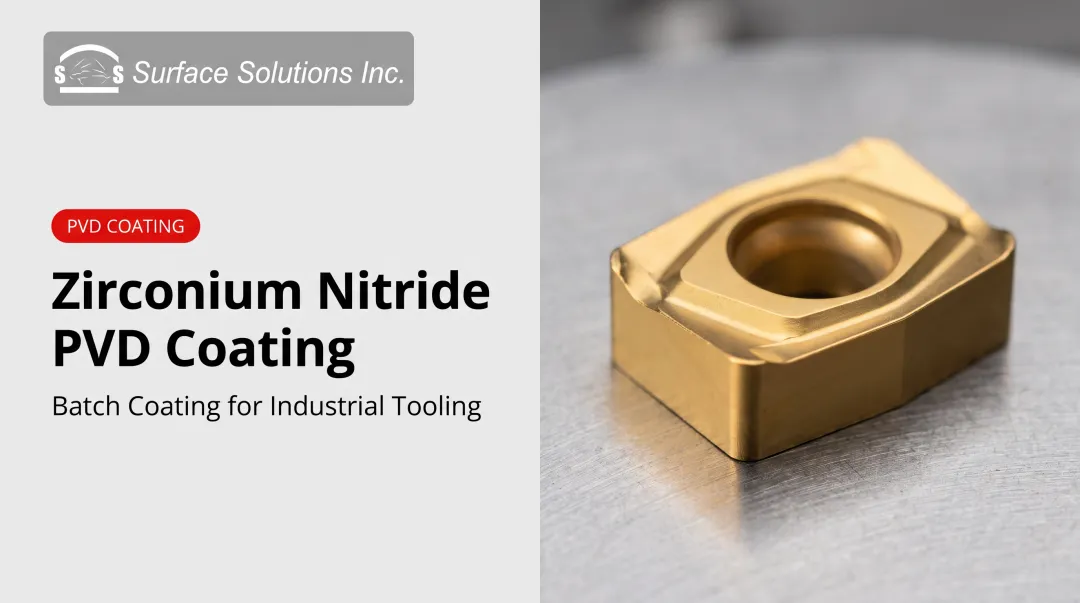
Visually, ZrN reads as a pale gold or champagne color, noticeably softer and lighter than the brassier, deeper gold associated with titanium nitride (TiN). Shops that run both coatings side by side can usually tell them apart at a glance once they know what to look for.
ZrN belongs to the transition-metal nitride family of ceramics, the same broad category as TiN, and shares its crystalline hardness and thermal stability. Coating thickness stays in the low single-digit micron range, so it adds wear resistance without changing a part's dimensions or fit.
For reference, most industrial PVD coatings, including the TiN, AlTiN, and CrN formulations applied at Surface Solutions, run around 0.0001"-0.0002" (2-5 microns), thin enough that finished parts stay within tight tolerances.
Is Zirconium Nitride a Ceramic?
Yes. ZrN falls into the non-oxide, refractory ceramic category, alongside TiN and CrN. It crystallizes in the cubic, face-centered rock-salt structure (space group Fm-3m), with nitrogen atoms occupying the interstitial sites between zirconium atoms. That structure is what gives the coating its hardness and its resistance to heat and chemical attack.
Key Properties That Make ZrN a High-Performance Coating
The numbers behind ZrN explain why it holds up where uncoated steel doesn't.
| Property | Typical Value | Why It Matters |
|---|---|---|
| Hardness | ~2,800 HV (some studies report 31.7 GPa) | Resists abrasive wear on cutting edges |
| Melting point | ~2,980°C-3,400°C+ | Maintains structural integrity under machining heat |
| Density | ~7.09-7.10 g/cm³ | Supports uniform, well-adhered coating layers |
| Electrical resistivity | 15-200 µΩ·cm | Relevant for select electronic and decorative parts |
| Coefficient of friction | ~0.5 | Reduces buildup and heat generation during cutting |
| Chemical resistance | Insoluble in water; resists most common acids | Adds corrosion protection in humid or reactive environments |
Hardness and Heat Resistance in Practice
A 2023 comparative study published in MDPI Coatings measured ZrN coating hardness at 31.7 ± 1.8 GPa, higher than matched TiN samples in the same test, which came in at 24.9 GPa. That hardness translates directly into slower edge rounding and longer intervals between sharpenings.
The high melting point matters just as much. Cutting generates localized heat at the tool-workpiece interface, and a coating that softens under that heat loses its protective value fast. ZrN's thermal stability keeps the crystal structure intact well past the temperatures generated in most machining operations.
Friction, Density, and Chemical Stability
That same study found ZrN's adhesive friction component sitting around 0.15, notably lower than TiN's 0.22. Lower friction means less heat buildup and less material transfer onto the tool surface, which is exactly what drives galling.
Beyond friction, density affects how evenly the coating deposits and how well it bonds to the substrate. At roughly 7.1 g/cm³, ZrN forms a dense, continuous layer rather than a porous one prone to flaking. It's also insoluble in water and holds up against most acids, with concentrated hydrofluoric acid as a notable exception. That chemical stability adds a real layer of corrosion protection in wet or chemically active shop environments.
How ZrN Coating Is Applied: The PVD Process
ZrN coating happens inside a vacuum chamber, where solid zirconium is vaporized and reacts with nitrogen gas before condensing onto the rotating tool surface as a thin ceramic film. The rotation keeps thickness consistent across complex geometries.
Before any coating goes on, the substrate needs proper preparation:
- Clean and degrease the part thoroughly, removing oils, oxides, and residue from prior processing
- Strip surface treatments like bluing or EDM recast layers, as PVD won't adhere properly over them
- Polish beforehand if a smooth finish is required, because a coating this thin (measured in microns) won't mask a rough surface
- Avoid sandblasting as a pre-treatment, since it can roughen or contaminate the surface more than intended

PVD holds a key advantage over older coating methods: it runs at relatively low temperatures.
Why the low-temperature range matters:
- Operates between 300°-930°F (150-500°C), well below the tempering point of most tool steels
- Surface Solutions applies its PVD coatings at approximately 700°-800°F
- Preserves the base material's hardness and dimensional tolerances, unlike high-heat processes that can compromise them
Benefits of ZrN Coating for Tools and Manufacturing
The properties above translate into measurable shop-floor advantages. Surface Solutions has documented these gains with its own light-gold PVD formulation, called Alpha™.
Extended tool life. One customer running production punches saw a 6x improvement in output before needing resharpening, jumping from 10,000 parts on uncoated tooling to a full 60,000-part run without a single sharpening stop.
Labor and downtime savings. Each resharpening cycle on that job required roughly 8 hours of labor to pull tooling, sharpen it, and reinstall it. Eliminating six of those cycles saved an estimated 48 hours of labor on one production run alone.
Reduced lubricant use. A metal forming customer reported wiping 3/8" hot-rolled steel with minimal lubricant after switching to a light-gold PVD coating, alongside a better-looking finished product.
Less galling and buildup. In a direct side-by-side test, punches running through 0.057" galvanized steel showed "almost no galvanized build-up" on the light-gold coating. Standard TiN-coated punches showed noticeably more buildup under identical conditions.
Aesthetic value. The gold finish reads as a quality signal on visible components, and it holds up well even under the functional demands of daily production use.
Surface Solutions applies these coatings from its Fridley, Minnesota facility and serves manufacturers across the Upper Midwest, California, New York, Florida, Canada, and Mexico, helping shops cut resharpening frequency and reclaim production hours. Request a quote to find out what Alpha™ coating could do for your tooling.
Best Applications and Industries for ZrN Coating
ZrN's low friction and hardness make it especially effective on materials that tend to gum up cutting edges.
Non-ferrous metals. ZrN performs well on aluminum, brass, copper, and titanium alloys, common substrates for drill bits and end mills where gummy material buildup is a constant threat. Not every coating provider processes aluminum, though. Surface Solutions, for example, excludes aluminum and zinc alloys from its own service, so confirm substrate compatibility with any coating partner before sending parts.
Metal forming, punching, and drawing. Reduced friction directly addresses the galling problem that drives so much die-maintenance cost. Industry data shows galling alone can eat up 71% of maintenance budgets in some forming operations, so a coating that minimizes material transfer between tool and workpiece pays for itself quickly.
Medical device manufacturing. Research on PVD zirconium nitride coatings found no significant reduction in osteoblast-like cell viability compared to polished titanium. One study also measured notably higher early-stage cell adhesion on ZrN-coated titanium screws versus uncoated surfaces (see the full biocompatibility study). That evidence supports ZrN's use on select surgical instruments and implant components, though results vary by bacterial strain and application.
Decorative and architectural finishes. The gold appearance, close to 24-carat gold but slightly cooler in tone, shows up on architectural hardware, fixtures, and cutlery where durability needs to look as good as it performs.
ZrN vs Other PVD Coatings: Choosing the Right Option
No single PVD coating wins every application. The right choice depends on what's actually degrading tool performance: abrasion, heat, or chemical attack.
ZrN vs TiN. Both share similar hardness ranges, but ZrN generally runs lower friction and shows less material buildup in demanding conditions.
Surface Solutions' own testing bears this out: its light-gold Alpha™ coating showed almost no galvanized buildup running alongside standard TiN-coated punches under identical stamping conditions. TiN remains a solid, cost-effective baseline, but coatings in the ZrN performance class pull ahead when adhesion and release are the priority.
ZrN vs CrN for high-heat work. CrN typically holds up better under sustained thermal load.
In a stainless-steel drawing operation, Surface Solutions found that its light-gold coating produced only 15 parts before the workpieces became too hot to touch. Switching to CrN on the same tool produced over 500 parts, with parts staying just warm.
When heat dissipation, not just hardness, is the limiting factor, CrN often outperforms ZrN-class coatings.
Making the call. A quick way to think about it:
- Abrasion and galling are the main issue → ZrN or a comparable light-gold coating
- Heat buildup is shortening tool or part life → CrN
- Cost matters most and demands are moderate → TiN

Surface Solutions' team routinely walks customers through this exact tradeoff, matching coating choice to the specific tool, material, and production volume involved rather than defaulting to one option across the board.
Frequently Asked Questions
What does ZrN stand for?
ZrN is the chemical formula for zirconium nitride, a compound formed from zirconium and nitrogen. It's applied as a hard, thin-film PVD coating on tools and components.
Is ZrN a ceramic?
Yes. ZrN is a non-oxide, refractory ceramic with a cubic crystal structure. Its hardness and thermal stability place it in the same family as TiN and CrN.
What is zirconium nitride coating?
Zirconium nitride coating is a thin, pale-gold PVD finish applied to tools and parts, boosting surface hardness and cutting friction while extending service life without altering part dimensions.
How long does ZrN coating last?
Lifespan depends heavily on the application, material, and cycle conditions. In general, ZrN-coated tools substantially outlast uncoated tooling in both cutting and forming operations.
Can ZrN coating be applied to any metal substrate?
ZrN works well on most tool steels and carbide substrates, but compatibility varies by base material and part geometry. Check with Surface Solutions before committing to a job.
Is ZrN coating better than TiN?
It depends on the application. ZrN-class coatings typically show less material buildup and better release than TiN, especially on non-ferrous and galling-prone jobs. TiN remains a solid general-purpose option.