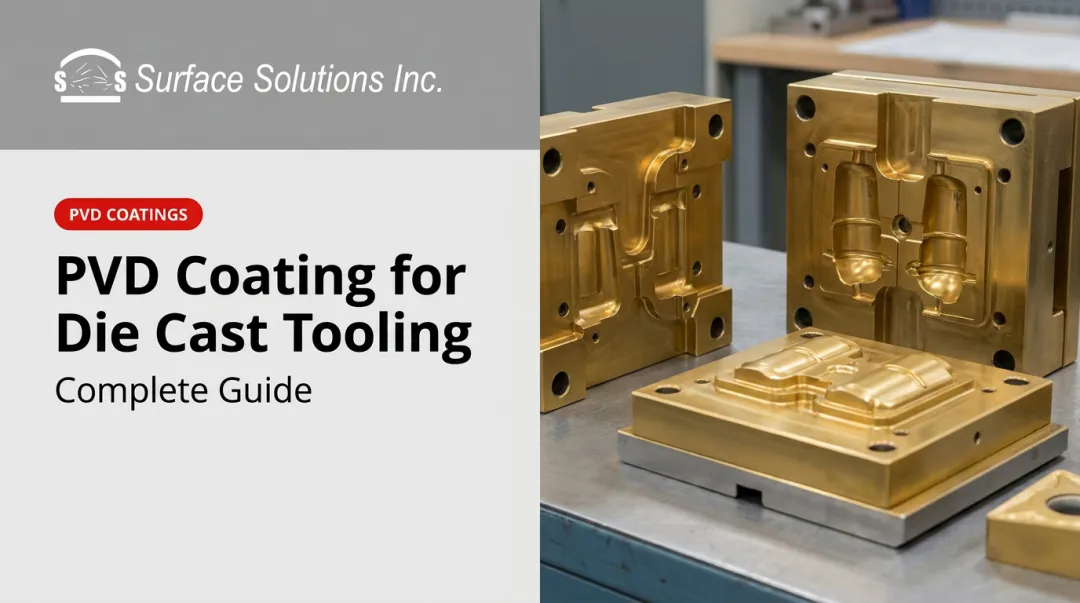
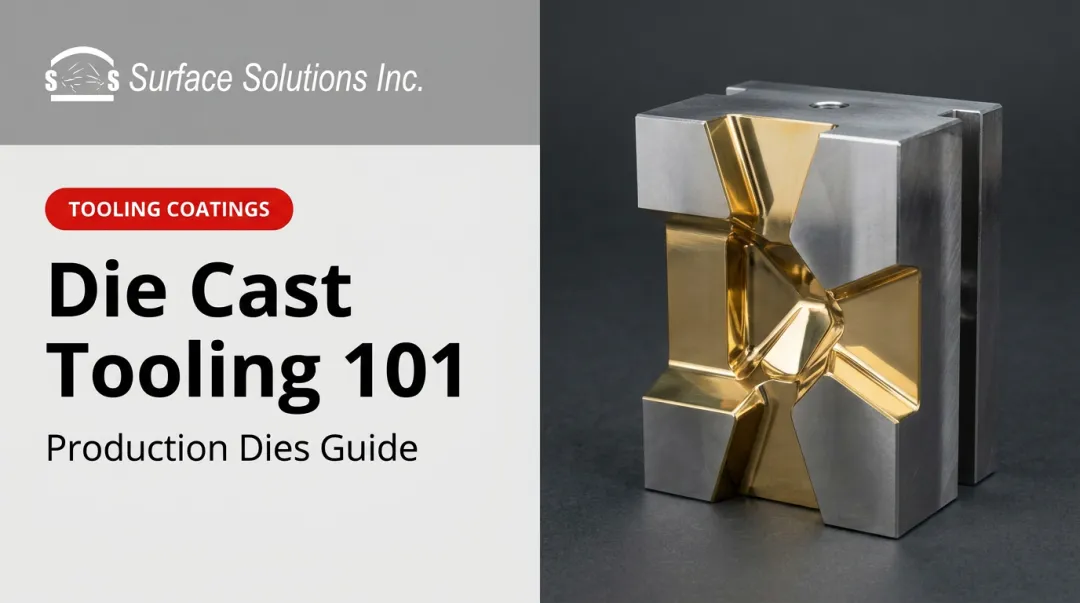
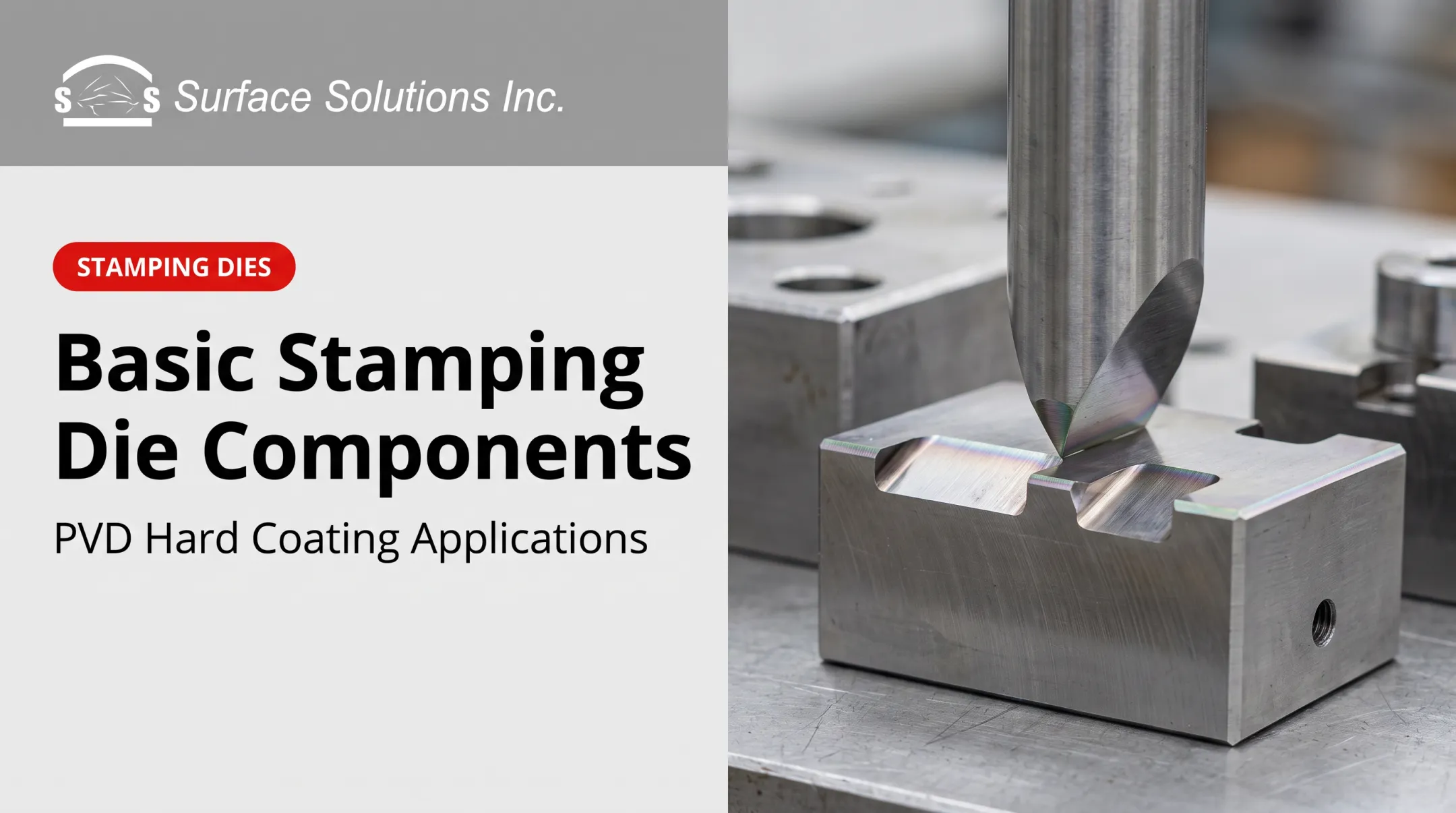
Manufacturers know the pain points well: tool wear from friction and heat, unplanned downtime for resharpening, and the labor cost of pulling dies out of production. A single resharpening cycle can eat up eight hours of shop time.
This article breaks down the three main die types, the components that make up a die assembly, the core stamping operations, and how PVD coatings like Alpha and CrN can stretch tool life well beyond what uncoated steel delivers.
Key Takeaways
- Progressive, compound, and transfer dies each fit different part complexity and volume needs
- Die performance depends on design quality and ongoing maintenance, not just the initial build
- PVD coatings extend tool life and cut resharpening frequency, based on documented customer results
- Coatings often upgrade existing tooling instead of adding a full replacement expense
What Is a Metal Stamping Die?
A stamping die is a precision tool, typically built from hardened tool steel, that cuts, forms, or shapes sheet metal inside a mechanical or hydraulic press. According to SME's overview of stamping dies and processes, dies are engineered with CAD and analytical software, built by diemakers, then mounted in presses and fed sheet metal to produce finished parts.
In standard die terminology, a punch is the male component that does the cutting or forming. The matrix, or die opening, is the female cavity it works against. The full assembly, including the shoes, guides, and all working components, is the "die" or "tooling."
Die sizes and applications vary widely by industry:
- Automotive — brackets, panels, and structural components at high volume
- Medical devices — tight-tolerance parts requiring repeatability and consistency
- Appliances — larger sheet metal components with moderate complexity
Types of Metal Stamping Dies
Choosing a die type shapes your tooling cost, per-part economics, and maintenance burden for the life of the program.
Progressive Dies
A coil strip advances through a series of stations, each performing one operation—cutting, piercing, or bending—until the finished part separates from the strip. This setup suits high-volume, complex parts where speed and repeatability matter most.
The tradeoff: tooling design and build costs run high upfront, but per-part cost drops fast once you hit scale.
Compound Dies
Compound dies perform multiple operations, like cutting and punching, in a single press stroke. They're built for simpler, flat parts that don't need multi-station sequencing.
- Lower tooling investment than progressive dies
- Faster to design and build
- Limits scalability on complex geometry or high-volume runs
Transfer Dies
Transfer dies cut blanks and move them mechanically between independent stations, rather than relying on a strip carrier. This approach suits larger or more intricate parts. Eliminating carrier webs can improve material utilization—especially valuable with thick or expensive stock.
Comparison at a glance:
| Die Type | Design Cost | Per-Part Cost | Maintenance |
|---|---|---|---|
| Progressive | High | Low at volume | Moderate (many stations) |
| Compound | Low | Higher at scale | Lower complexity |
| Transfer | High | Moderate | Higher (station handling) |

Die type drives where wear concentrates—strip-fed stations, single-stroke compound surfaces, or independent transfer tools—and how often those working surfaces need service over the program life.
Key Components of Die Tooling
Every die, regardless of type, relies on the same core building blocks.
Structural base: Upper and lower die shoes anchor the entire assembly to the press bed. They need to stay flat and parallel to hold tolerances over the die's life.
Guiding elements: Guide posts, bushings, and heel blocks keep the upper and lower halves aligned under load. Heel blocks absorb side thrust that would otherwise throw off alignment.
Cutting and forming components: Punches, die inserts, and pilots do the actual shaping work. Pilots register the strip precisely at each station before pressure is applied.
Stock control components:
- Stripper plates pull metal off cutting punches and hold it flat
- Pressure pads hold material against the lower die before forming
- Stock lifters manage strip position between strokes
Support and fastening components:
- Retainers secure cutting and forming components to the shoes
- Dowels locate die sections precisely
- Shims allow fine adjustment for wear over long production runs

Common Stamping Methods and Process Steps
Die design and the stamping method go hand in hand. The core operations include:
- Blanking — cuts sheet metal while keeping the piece for further processing
- Piercing — cuts a hole in the sheet, keeping the workpiece and discarding the slug
- Notching — cuts strip edges to form the starting blank shape
- Trimming — cuts the perimeter of a formed or flat part
- Shearing — cuts along a straight line for square or rectangular blanks
- Lancing — slits material without fully separating it from the sheet
- Forming/bending — deforms sheet along an axis using a punch and cavity
A typical run flows through material feed, cutting, forming, piercing, stripping, and part ejection. Exact order depends on the part's geometry and die design.

Method selection comes down to three factors:
- Part complexity and number of features
- Tolerance requirements
- Production volume and cycle-time targets
Extending Die Tooling Life with Advanced Coatings
Uncoated tool steel wears fast. Friction, heat buildup, and galling drive frequent resharpening and unplanned downtime, cutting into throughput on every job.
PVD coatings address this directly. Research on tribology in metal forming confirms that hard coatings reduce friction, improve surface wear resistance, and lower galling risk on punches and die inserts. That's the mechanism. Here's what it looks like in real production.
Real Results from Alpha Coating
One customer running Alpha-coated M4 punches through 0.057-inch galvanized steel reported 15 million parts over more than 15 months of service. Their uncoated D2 punches previously needed sharpening every three weeks.
Another documented case is more direct:
"We ran a full order of 60,000 parts and still don't need to sharpen. Normally we have to resharpen after 10,000."
That's six times more production between sharpening events. Since each resharpening cycle took roughly eight hours to pull tools and service them, avoiding six sharpening events saved an estimated 48 hours of labor on that run alone.
Alpha-coated punches also showed almost no galvanized build-up compared to TiN-coated punches in the same application, and less chipping over the tooling's service life.

CrN for High-Heat Applications
Not every job calls for the same coating. In a stainless-steel drawing application, Alpha-coated tooling produced 15 parts before they became too hot to touch. Switching to CrN coating on the same job pushed output past 500 parts, with parts staying just warm.
That's a meaningful difference for shops running long draws where heat buildup causes dimensional drift or surface defects.
Coating as an Upgrade, Not a Replacement
You don't need to scrap existing dies to get these benefits. Alpha and CrN coatings apply directly to customer-supplied punches, inserts, and die components. At Surface Solutions, coating thickness runs 0.0001–0.0002 inches, applied at 700°–800°F.
- Works on hardened tool steel, M4, D2, and similar substrates
- Doesn't require new tooling investment
- Available to shops nationwide
One forming customer using Alpha-coated blocks reported they never needed to polish again, used less lubricant, and got a better-looking finished part, all from coating tooling they already owned.

Choosing the Right Die Tooling Partner
Picking a die builder or coating provider is a total-cost-of-ownership decision, not just a quote comparison.
Evaluate these factors before committing:
- Engineering collaboration and design-for-manufacturing input
- Turnaround time for both initial builds and repair/recoat cycles
- Maintenance support, including coating services for existing tooling
- Track record with your specific material and part geometry
Outsourcing guidance from MetalForming Magazine recommends checking a supplier's CAD/CAM/CAE capability, industry-specific experience, and how they handle rush programs before signing a large tooling contract.
Before you sign a coating contract:
- Ask for sample runs or documented tool-life data, not just marketing claims
- Confirm which materials and part geometries the provider can coat
- Factor in shipping and turnaround, not just the coating price
- Ask about material exclusions—many PVD coaters cannot process aluminum or zinc alloys
A low upfront tooling price doesn't help if maintenance costs and downtime erase the savings within a year.
Frequently Asked Questions
What are the 7 steps in the stamping method?
The general sequence includes material feed, blanking or piercing, bending or forming, drawing, trimming, stripping, and final part ejection. Exact order varies by part design and die type.
What is a stamping die?
A stamping die is a precision tool, usually made from tool steel, that cuts, forms, or shapes sheet metal under press force. It typically consists of punches, matching die openings, and supporting structural components.
What are the different types of stamping methods?
Stamping methods fall into cutting operations (blanking, piercing, trimming), forming operations (bending, flanging), and drawing operations that pull metal into a cavity. The die type used depends on which operations the part requires.
What are the different types of dies?
The three main types are progressive dies (sequential stations on a strip), compound dies (multiple operations in one stroke), and transfer dies (mechanical movement between independent stations). Each fits different volume and complexity needs.
How often should a stamping die be resharpened or maintained?
Frequency depends on material, coating, and production volume, so there's no universal schedule. Documented cases show PVD-coated tooling running 6x longer between sharpening events compared to uncoated tooling in the same application.
Can existing stamping dies be upgraded with coatings instead of replaced?
Yes. Coatings like Alpha and CrN apply directly to customer-supplied punches and die inserts, extending tool life without a new tooling investment. This works for existing hardened tool steel components already in production.