Introduction
Picture this: a stamping press mid-run, cranking out parts at one stroke per second. Then the punch seizes. Metal has welded to metal, the die's ruined, and the line stops cold.
That's galling, and it's one of the most frustrating failure modes in metal forming and fastening.
One Minnesota-based stamper watched an uncoated punch fail after just 15,000 hits. After switching to a CrN PVD treatment, the same tool ran for several million hits before needing replacement, according to MetalForming Magazine.
Anti-galling coatings are the engineered fix for this problem. This guide breaks down what they are, how they work, the main types available, and how to pick the right one for your application.
Key Takeaways
- Anti-galling coating stops metal-to-metal cold-welding under friction and pressure.
- PVD coatings (TiN, CrN, Alpha-type) and metallic platings dominate the market, with choice depending on application.
- The right coating extends tool life, cuts labor hours, and reduces lubricant use
- Substrate material, load, temperature, and part function all drive coating selection
What Is Anti-Galling Coating?
Anti-galling coating is an engineered surface layer, applied through PVD, electroplating, or chemical conversion, that sits between two sliding metal surfaces and physically prevents them from bonding together.
Here's the mechanism: metal surfaces look smooth to the eye but are covered in microscopic peaks called asperities. Under pressure and friction, these peaks can fracture their protective oxide layer, exposing raw metal. That raw metal adheres to the opposing surface, transfers material, and creates the tearing, seizing damage known as galling.

PEM's technical reference describes thread galling specifically as seizing or abrading caused by adhesion between the sliding surfaces of mating threads. A properly applied coating interrupts that adhesion before it starts.
Why Stainless Steel and Tool Steel Are High-Risk
Stainless steel relies on a passive, chromium-rich oxide film for corrosion resistance, but that same film is thin and fragile.
- High contact pressure breaks the oxide layer, exposing bare metal
- Rapid tightening (on threaded parts) generates heat that accelerates film breakdown
- Once exposed, clean metal surfaces bond almost instantly under load
Uncoated tool steel dies face a similar issue when punching or drawing stainless or high-strength alloys repeatedly.
Coatings vs. Wear-Resistant Treatments vs. Lubricants
Not every hard coating stops galling, since general wear-resistant coatings are built to resist abrasive wear, meaning scratching and erosion from particles or repeated contact. Anti-galling coatings target a different failure mode: adhesive wear, where metal actually transfers between surfaces.
Lubricants can help, but they're consumable. They break down, get displaced, and need constant reapplication. Coatings, by contrast, are semi-permanent. They stay bonded to the part and keep working shift after shift without a refresh.
In tooling, galling shows up fast: material buildup on punches, rough or torn part edges, and more frequent trips to the sharpening bench. Each of those is downtime you didn't plan for.
Types of Anti-Galling Coatings
Coating choice depends heavily on the application. Here's a breakdown of the major categories.
PVD Coatings
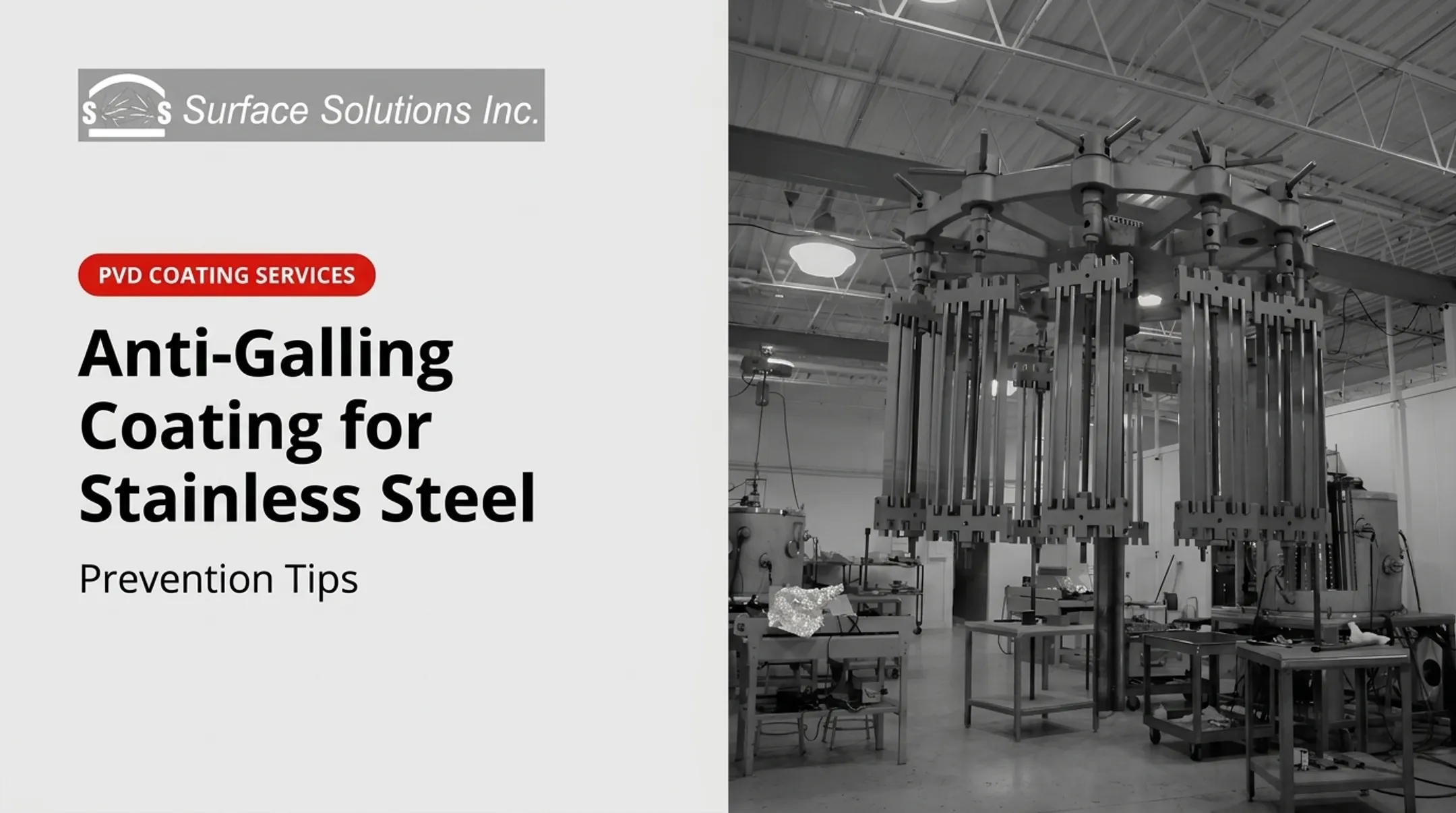
Physical Vapor Deposition coatings such as TiN, CrN, and AlTiN form ultra-hard, thin layers, typically just a few microns thick, with low friction coefficients. Because PVD is applied without the high heat of some other treatments, it avoids distorting precision-ground tooling.
Surface Solutions applies both Alpha™ and CrN PVD coatings for metal forming and punching applications, and the performance gap between them can be dramatic depending on the job. In one documented stainless steel drawing application, Alpha-coated tooling produced only 15 parts before the parts came out too hot to touch.
Switching to CrN on the same tool produced over 500 parts, with parts staying merely warm.
That's not a knock on Alpha coating. In a separate high-volume stamping case, Alpha-coated M4 punches ran through .057-inch galvanized steel for over 15 months and roughly 15 million parts, compared to uncoated D2 punches that needed sharpening every three weeks.
The same test showed Alpha coating left almost no galvanized buildup, while standard TiN coating on an identical punch, run side by side, accumulated noticeably more.

Metallic Platings and Chemical/Conversion Coatings
Beyond PVD's hard-coating approach, several other methods tackle galling through different mechanisms, ranging from sacrificial metal barriers to thin friction-reducing films that protect fasteners and lower-load components without adding bulk.
- Copper and nickel platings act as a soft, sacrificial barrier, commonly used on threaded connections and fasteners where a component can sacrifice itself to protect the base metal
- Phosphate coatings provide a conversion layer, often paired with an oil topcoat, primarily for corrosion protection on fasteners under standards like ASTM F1137
- Dry film lubricants (PTFE, MoS2) reduce friction on bolts and lower-load parts without the bulk of a wet lubricant
Nitriding as a Complementary Approach
Plasma nitriding diffuses nitrogen into the surface rather than depositing a separate layer. It's a strong option for compatible tool and stainless steels, though it can reduce corrosion resistance in some alloys, so testing matters.
Quick comparison:
| Application | Best-Suited Coating Type |
|---|---|
| Forming/stamping dies and punches | PVD (Alpha, CrN, TiN) |
| Threaded connections, stainless bolts | Metallic plating, dry film lubricant |
| General fasteners, lower-load parts | Phosphate conversion, PTFE/MoS2 |
| Tool steel resistant to high load | Nitriding (with corrosion testing) |
The substrate matters as much as the coating. Stainless steel and aluminum are inherently more galling-prone due to oxide layer disruption, so coating choice has to account for what you're coating, not just what you're coating it with.
Key Benefits of Anti-Galling Coatings
The case for anti-galling coating isn't theoretical. It shows up in production numbers.
Extended tool life. One Surface Solutions customer, Don Richardson, ran a punching operation that normally required resharpening every 10,000 parts. With Alpha coating applied, he ran a full 60,000-part order without a single resharpening (a 6x improvement).
Reduced labor and maintenance costs. That same 6x tool life gain translated directly into saved labor. Resharpening took 8 hours per cycle; avoiding five extra cycles saved 48 hours of labor on one order alone.

Reduced lubricant dependency. A metal forming customer, Chris, runs 3/8-inch thick, grade 80 hot-rolled steel into a tight channel using minimal lubricant since switching to Alpha coating.
"We used to polish a few times a run. Now, with the Alpha coating, we have never had to polish, we use less lubricant and have a better looking product."
Improved surface finish. Eliminating galling-related buildup means fewer surface defects transferred onto finished parts, which cuts secondary finishing work.
Overall productivity gains. Fewer stoppages for resharpening and polishing add up:
- Reduces unplanned downtime per shift
- Cuts down on die removals and reinstalls
- Delivers more consistent part quality across long runs
Every hour a die stays in the press instead of on the sharpening bench is an hour of output you'd otherwise lose.
Industries and Applications of Anti-Galling Coatings
Anti-galling coatings show up anywhere metal slides against metal under sustained pressure.
- Metal forming, punching, and sheet metal drawing: Dies and punches face constant sliding contact, making this one of the highest-value applications for PVD coatings like Alpha and CrN
- Medical device manufacturing and precision cutting tools: Surface consistency and contamination-free performance are non-negotiable here. PVD coatings deliver up to 10 times longer tool life than uncoated tools, based on overall tool-life data, not galling resistance alone
- Threaded connections, fasteners, and stainless bolts: Galling here means seized threads and stripped fasteners, often during final assembly when it's most costly to fix
- Oil and gas and industrial equipment: Valve stems and threaded tooling in this sector face similar adhesive wear risks, and anti-galling treatments are a common specification on both
Each of these industries shares one thing in common: unplanned adhesive wear costs far more than the coating that would have prevented it.
How to Choose the Right Anti-Galling Coating
Getting coating selection right starts with three questions.
- What's the substrate? Stainless steel and aluminum are more prone to galling because their oxide layers break down under contact pressure more easily than plain carbon steel. Identify your base material before anything else.
- What are the operating conditions? Contact pressure, temperature, and corrosive exposure all narrow your options. A coating rated for moderate loads won't hold up in a high-pressure stamping die.
- Who's applying it? Coating quality varies. Working with a provider experienced in your specific application, and who can turn parts around quickly, matters as much as the coating chemistry itself.
With those questions answered, Surface Solutions, based in Fridley, Minnesota, works with manufacturers across the Upper Midwest, California, New York, Florida, Canada, and Mexico. The company applies TiN, CrN, AlTiN, and its proprietary Alpha coating to cutting tools, punching dies, and forming tools:
- TiN, CrN, AlTiN for general wear resistance
- Alpha for high-cycle stamping and forming
- Thickness of 0.0001"-0.0002", applied at 700-800°F
PVD processing works on single-piece metal parts only, excluding aluminum and zinc alloys. If your substrate is aluminum, confirm compatibility before choosing PVD to avoid delays.
Frequently Asked Questions
What is an anti-galling coating?
It's a protective barrier, applied through PVD, plating, or chemical treatment, that prevents metal-to-metal adhesion and material transfer under friction and pressure. It works by keeping sliding surfaces from bonding at the microscopic level.
What is the anti-galling coating for stainless steel?
Common options include PVD coatings like CrN and TiN, copper or nickel plating, and dry film lubricants. Stainless steel's thin passive oxide layer makes it especially vulnerable, so the coating needs to compensate for that weakness directly.
What is the compound for anti-galling?
Common anti-galling compounds include copper-based and nickel-based anti-seize pastes, along with MoS2 and PTFE additives. These are typically used on threaded fasteners rather than tooling surfaces.
What materials are resistant to galling?
Harder, dissimilar-metal pairings such as bronze against steel, along with PVD-coated tool steels, resist galling far better than untreated stainless steel or aluminum. Resistance depends on the material pair, not just one alloy alone.
How does anti-galling coating work?
It lowers friction between sliding surfaces and prevents the cold-welding of microscopic surface peaks that leads to material transfer. Surface Solutions' CrN coating, for instance, keeps tooling running 500+ cycles while staying cool to the touch, versus just 15 cycles before uncoated tools overheat and gall.
Is anti-galling coating permanent, or does it wear off over time?
PVD coatings are highly durable but not indestructible. Lifespan depends on load, application, and maintenance cycles, with some tooling running millions of cycles before recoating is needed.