This explanation is written for manufacturers, toolmakers, and engineers working in metal forming, cutting tools, and tool resharpening who need coatings that actually hold up under production stress. Cathodic arc PVD gets mentioned in the same breath as sputtering constantly, but the two processes work differently and produce different results.
Here's what we'll cover: how the process physically works, where its strengths and limits show up in real applications, and how to decide if it's the right fit for your tooling.
TL;DR
- Cathodic arc PVD uses an electric arc to vaporize a metal cathode into highly ionized plasma for dense, hard coatings
- Top-tier ionization rates drive strong adhesion and wear resistance versus other PVD methods
- Cutting tools, forming dies, and punches gain the most when tool life drives productivity
- Match coating chemistry and provider to the job—don’t treat “PVD” as one generic option
What Is Cathodic Arc PVD?
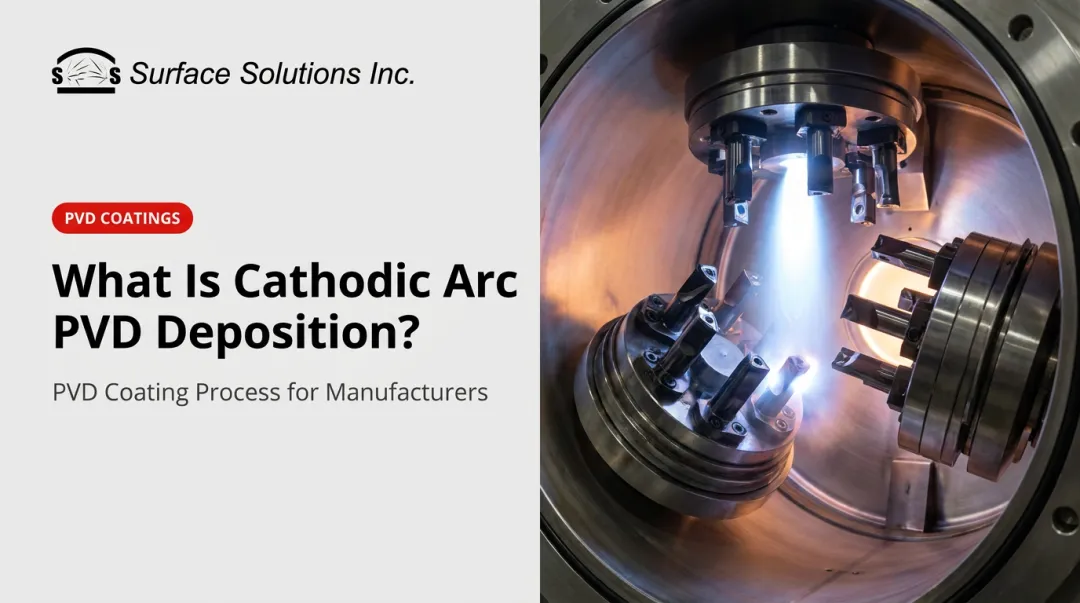
Cathodic arc PVD is a vacuum-based coating process. An electric arc strikes the surface of a solid cathode, vaporizing the material into ionized plasma. That plasma travels through the vacuum chamber and condenses onto the substrate as a thin film.
The result is a dense, hard coating—TiN, CrN, or AlTiN—tightly bonded to the tool surface. Because the material arrives largely as ions rather than neutral atoms, adhesion stays strong even on demanding tool geometries.
Compared with magnetron sputtering, the differences are clear:
- Cathodic arc generates plasma directly from an arc strike, producing very high ionization
- Sputtering relies on ion bombardment of a target, producing lower ionization
- Arc evaporation deposits faster; sputtered films tend to finish smoother with fewer surface defects
A 2024 comparison study backs that split: higher ionization and rate for arc, smoother surfaces for sputter. Choose arc when hardness and adhesion matter most; choose sputter when surface finish is the priority.

Why Cathodic Arc PVD Is Used in Metal Forming and Cutting Tool Manufacturing
Tool and die manufacturers deal with extreme friction, heat, and repetitive mechanical loading every shift. Uncoated tools gall, wear unevenly, and need constant sharpening.
Cathodic arc PVD coatings address this directly by:
- Reducing galling and material transfer onto tool surfaces
- Cutting lubricant dependency during forming and stamping
- Extending the interval between sharpenings
This isn't a regulatory requirement anywhere. It's an operational choice manufacturers make because the math on downtime and tool replacement favors it.
Real-World Impact on Sharpening Frequency
At Surface Solutions, one customer resharpened punches every 10,000 parts with uncoated tooling. After switching to Alpha™ coating, the same tools ran a full 60,000-part order without a single resharpening—6x more parts than before.
Each sharpening cycle took roughly 8 hours to pull tools, resharpen, and reinstall. Avoiding six of those cycles saved roughly 48 hours of labor.
Alpha coating also showed a clear edge over TiN in a galvanized-steel stamping comparison: the Alpha-coated punch had almost no galvanized build-up, while the TiN-coated punch accumulated noticeably more material over the same run.
Not every job favors the same chemistry. CrN coating proved better suited to a stainless-steel drawing application, where parts stayed just warm to the touch past 500 pieces, compared to only 15 parts with Alpha before overheating became an issue. Different jobs call for different chemistries, which is the whole point of understanding the process rather than treating "PVD" as one product.

How the Cathodic Arc PVD Process Works
A solid metal cathode sits inside a vacuum chamber. An arc vaporizes it into plasma, and reactive gases like nitrogen or acetylene combine with the vaporized metal to form compound coatings on the substrate.
Four variables control the outcome:
- Bias voltage on the substrate
- Arc current at the cathode
- Gas pressure inside the chamber
- Substrate temperature during deposition
Get these right, and you get a hard, dense film with the composition and thickness you want.
Step 1: Vacuum Chamber Preparation and Arc Ignition
Parts are loaded into the chamber and the system is pumped down to high vacuum. An electric arc then strikes the cathode surface, creating a self-sustaining plasma discharge that keeps running as long as current flows.
Step 2: Vaporization and Ionization at the Cathode Spot
The arc doesn't sit still. It moves rapidly across the cathode surface as a "cathode spot," melting and vaporizing target material as it goes. This produces a stream of ions and electrons, along with some macroparticles (tiny molten droplets ejected from the surface).
Research on cathodic arc plasma describes these active spots as reaching extremely high current and power density, generating a highly ionized plasma stream.
Step 3: Plasma Transport and Film Deposition
The negatively biased substrate pulls ions toward it. As they arrive, reactive gases in the chamber combine with the metal ions to form nitride or carbonitride compounds. High ion energy helps the film pack densely and adhere as it builds layer by layer.

Where Cathodic Arc PVD Is Applied
Cathodic arc PVD is commonly applied to high-wear tooling and precision components:
- Cutting tools and carbide inserts
- Stamping punches and forming dies
- Drawing tools
- Injection molding tooling
- Medical and surgical instruments
- Industrial wear components
Those tools are typically coated at two points in their lifecycle: during initial manufacturing, and again after resharpening or regrinding removes the original coating. It's rarely a one-time event.
Typical triggers for coating (or recoating) a tool:
- Tool life is shorter than production schedules demand
- Downtime from frequent sharpening is cutting into throughput
- Part finish quality is inconsistent due to tool wear
At Surface Solutions, recoating is a recurring service tied to maintenance cycles. Tony Deschenes of Special Tools, Inc. put it simply: "Nearly everything we resharpen gets sent out to Surface Solutions for coatings." Recoating after regrinding is standard practice, not an afterthought.
Key Factors That Affect the Cathodic Arc PVD Process
Several variables determine how a batch of coated tools turns out:
- Cathode/target material composition and purity — directly affects coating hardness and chemistry
- Arc current, bias voltage, and gas pressure — control ionization rate and film density
- Vacuum chamber design and substrate positioning — affect line-of-sight coverage since arc-generated plasma travels in fairly direct paths
- Batch size, part geometry, and throughput needs — influence cycle time and cost per part
- Macroparticle/droplet formation — requires filtering to maintain surface finish quality, since target melting inevitably ejects some microparticles
Bias voltage is especially sensitive: a 2024 process review found settings below 100V tend to produce defective, columnar coatings, while 100–200V yields denser films.
None of these variables work in isolation. Push arc current higher for faster deposition, and you'll likely see more macroparticle defects and rougher surfaces as a trade-off.

Common Issues and Misconceptions
"Cathodic arc and sputtering are the same thing." They're not. Both fall under the PVD umbrella, but arc evaporation produces much higher ionization and faster deposition, while sputtering produces smoother, lower-defect films at a slower rate.
"Macroparticle defects mean the coating failed." Not necessarily. Some surface roughness is inherent to how cathodic arc works. Target melting always ejects some droplets. Filtering systems manage this, and a coating with minor macroparticle texture can still perform well in cutting or forming applications.
"Coating color tells you about performance." Color comes from the chemistry and thickness of the film, not directly from hardness or wear resistance. A gold TiN coating and a darker AlTiN coating can both perform well, just for different applications.
"PVD coating is one product." It's a family of chemistries: TiN, CrN, AlTiN, TiCN, and proprietary blends like Alpha™. Each has a different performance profile. Assuming any PVD coating will solve a specific wear problem skips the step of matching chemistry to application.
When Cathodic Arc PVD May Not Be the Right Choice
Cathodic arc PVD isn't universal. A few scenarios call for a different approach:
- Complex 3D geometries with shadowed areas. Because arc-generated plasma travels in direct paths, deeply recessed features and tight internal cavities often get uneven coverage.
- Ultra-smooth, defect-free surfaces. Optics and similar applications typically favor sputtering when macroparticle-related roughness is unacceptable.
- Temperature-sensitive substrates. Cathodic arc deposition runs hot enough that heat-sensitive materials usually need a lower-temperature process.
Conclusion
Cathodic arc PVD uses high-energy arc plasma to deposit dense, hard, well-adhered coatings onto cutting tools, dies, and forming equipment. Understanding how the process actually works, not just that it's "a type of PVD", makes it easier to extend tool life and cut the operational costs tied to frequent sharpening and downtime.
Match the chemistry—TiN, CrN, AlTiN, Alpha™, or another option—to your specific application, load, and material instead of defaulting to one coating type.
Frequently Asked Questions
Are PVD and sputtering the same?
No. Sputtering is one type of PVD process. Cathodic arc is another. Both are physical vapor deposition methods, but they differ in ionization mechanism, deposition rate, and resulting film characteristics.
What materials can be coated using cathodic arc PVD?
Common coatings include TiN, CrN, AlTiN, TiCN, and AlCrN, applied to tool steels, carbide substrates, and various metal components used in cutting and forming.
How long does a cathodic arc PVD coating last?
Coating life depends heavily on the application, load, and material being processed. Properly matched coatings can extend the interval before resharpening becomes necessary.
Does cathodic arc PVD increase part cost significantly?
There's an upfront coating cost. It is typically offset by fewer tool replacements, less frequent sharpening, and reduced downtime over the tool's working life.
Can cathodic arc PVD coatings be reapplied after resharpening?
Yes. Recoating after regrinding is a standard part of tool maintenance cycles, not an exception. Most shops that sharpen tools regularly build recoating into that same workflow.
What industries benefit most from cathodic arc PVD coatings?
Cutting tools, metal forming and stamping, medical device manufacturing, and automotive and aerospace components see the most consistent benefits from arc-deposited coatings.