The numbers back this up. NACE International's IMPACT study put the global cost of corrosion at roughly $2.5 trillion, or 3.4% of world GDP, a benchmark that's still widely cited across the industrial coatings industry. In the US, an earlier Federal Highway Administration analysis pegged direct annual corrosion costs at $276 billion.
For manufacturers, tooling shops, and construction firms, the pain points are familiar: shortened equipment life, unplanned downtime, safety risks from failing components, and repair bills that keep climbing. This guide breaks down the corrosion types you're up against, the coating solutions that actually work, and how to pick the right one for your application.
Key Takeaways
- Corrosion coatings block oxygen, moisture, and chemicals as barrier or sacrificial layers on bare metal
- Pick organic, metallic, or inorganic/ceramic coatings based on the environment the part will face
- PVD options like CrN and Alpha™ add wear resistance plus corrosion protection for precision tooling
- Match coating choice to substrate, exposure, and whether durability, wear life, or appearance comes first
Understanding Corrosion: Why Protection Matters
Corrosion is an electrochemical reaction — metal loses electrons to its environment, and the surface degrades. Water acts as the electrolyte; oxygen typically drives the reaction. NASA's corrosion research notes that oxygen reduction is involved in over 90% of corrosion reactions in steel.
Not all corrosion looks the same. Here's what shows up most often on industrial metal:
- Galvanic corrosion — happens when dissimilar metals contact each other in a corrosive electrolyte; the more active metal corrodes first
- Pitting — localized breakdown of a protective layer, often accelerated by chlorides, creating small but deep cavities
- Crevice corrosion — occurs in stagnant, oxygen-starved gaps like bolted joints or overlapping surfaces
- Stress-corrosion cracking (SCC) — tensile stress plus a specific corrosive environment causes cracks that spread through the metal

Each mechanism demands a different defense. That's why a one-size-fits-all coating rarely works.
Types of Corrosion Protection Coatings
Organic Coatings
Epoxy, alkyd, acrylic, and silicone coatings form a barrier film over the substrate:
- Epoxies — strong adhesion and chemical resistance, but they degrade under UV exposure
- Alkyds — flex well but resist moisture poorly
- Acrylics — hold color and UV stability; sacrifice chemical durability
- Silicones — handle high heat but cost more and need compatible primers
Metallic Coatings
Zinc galvanizing and electroplating protect through sacrificial action: zinc corrodes preferentially, shielding the steel underneath. This is the backbone of structural steel protection in construction and automotive manufacturing.
Inorganic and Ceramic Coatings
These form a hard, often chemically bonded barrier. They hold up in high-heat or chemically aggressive settings where organic coatings would break down.
Advanced Vapor Deposition (PVD)
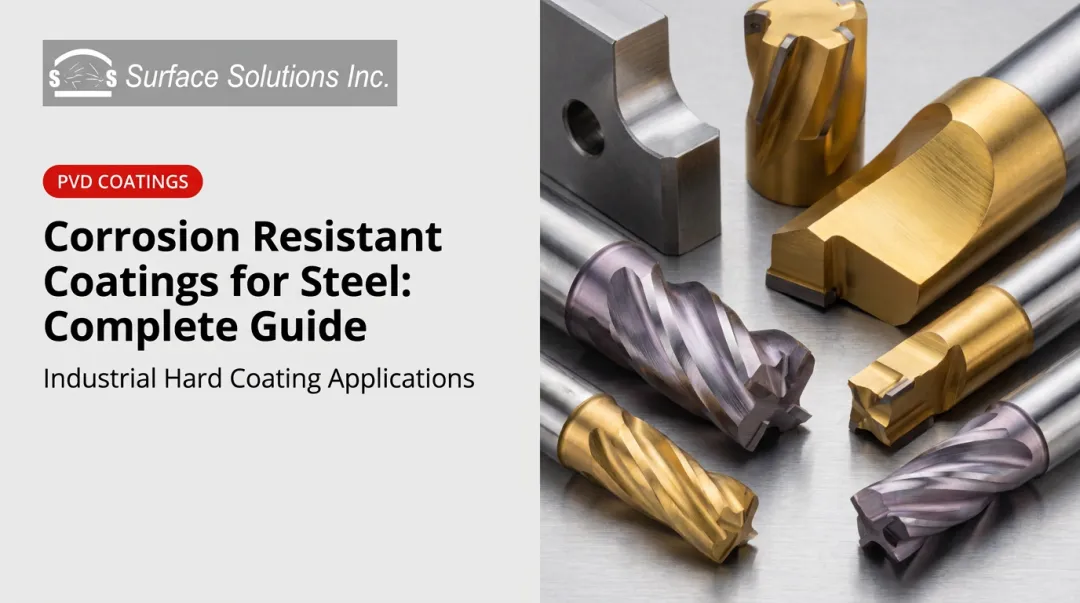
PVD coatings deposit an ultra-thin, extremely hard layer, typically 2–5 microns, directly onto tooling surfaces. Unlike bulk coatings, they don't add measurable dimension but improve wear and corrosion resistance significantly. CVD (chemical vapor deposition) is a related process used in some industrial settings. Most tooling work still favors PVD for lower process temperatures and tighter dimensional control. At Surface Solutions, we apply PVD coatings including TiN, AlTiN, CrN, TiCN, and our proprietary Alpha™ formulation to metal forming, cutting, and stamping tools. When corrosion resistance is the top priority, CrN is our go-to recommendation. It's formulated for moisture-heavy, medical, and food-processing environments. In one stainless-steel drawing application, CrN-coated tooling ran over 500 parts with the tool staying just warm to the touch, compared to only 15 parts (and overheating) with Alpha™-coated tooling on the same job.
| Coating Type | Typical Substrate | Protection Mechanism | Best-Fit Industry |
|---|---|---|---|
| Organic (epoxy, alkyd) | Structural steel, equipment | Barrier film | Construction, general manufacturing |
| Metallic (zinc/galvanizing) | Structural steel, fasteners | Sacrificial anode | Construction, automotive |
| Inorganic/ceramic | High-heat components | Hard barrier layer | Chemical processing, aerospace |
| PVD (CrN, AlTiN, Alpha™) | Tool steel, carbide, stainless | Hard, low-friction surface layer | Tooling, medical devices, stamping/forming |

Best Coatings for Steel and Rust Prevention
Steel oxidizes easily because iron readily gives up electrons in the presence of water and oxygen. That's the core electrochemical cell driving rust, and it's why bare steel needs deliberate protection almost anywhere it's exposed to moisture.
For structural steel, two approaches dominate:
- Zinc-rich primers and hot-dip galvanization — still the most cost-effective, widely specified options (ASTM A123/A123M for hot-dip; ASTM A653/A653M for galvanized sheet)
- Two-layer systems — an epoxy or zinc-rich primer plus a powder coating topcoat, which extends service life beyond either layer alone
Structural coatings aren't built for friction and repeated mechanical contact. Tooling runs into trouble fast:
- Standard galvanized coatings build up residue on punches during high-volume stamping
- Paint and powder systems chip or wear through under repeated die contact
- Neither approach stops corrosion and mechanical wear at the same time
For steel tooling facing both threats, PVD hard coatings outperform traditional rust-prevention methods. They resist mechanical wear while still blocking moisture and chemical attack. In one customer comparison, Alpha™-coated punches showed almost no galvanized build-up, while TiN-coated punches accumulated significantly more during the same production run.

Testing note: ASTM B117 (Salt Spray/Fog Testing) is the standard method for evaluating relative corrosion resistance. It's useful for comparing coatings under controlled conditions, but results don't always predict real-world performance. Always ask for field-relevant validation alongside salt-spray data.
Key Benefits of Corrosion Protection Coatings
Corrosion protection coatings pay off in longer tool life, less downtime, simpler processes, and lower operating cost.
- Coated tools and components outlast uncoated ones, cutting capital expenditure on replacements
- One customer's Alpha™-coated forming tool ran 60,000 parts without resharpening versus 10,000 uncoated—at 8 hours per cycle, that's 48 hours of labor saved on a single run
- Alpha™-coated forming tooling needed minimal lubricant and eliminated polishing for one sheet-metal customer; coated D2 punches stretched sharpening well beyond the old three-week cycle
- In medical device manufacturing, PVD coatings protect instruments from bodily fluids and repeated sterilization. They also reduce galling and seizure in high-friction tools such as robotic surgical instruments
- Fewer replacements mean less raw material use and scrap; MetalForming Magazine notes unplanned tooling downtime can cost four times more than planned maintenance, and wear protection cuts that exposure

How to Choose the Right Corrosion Protection Coating
Start with three questions:
- What's the substrate? Steel, aluminum, and alloys each respond differently to coatings. PVD, for instance, is applied to steel, stainless steel, and carbide, not aluminum or zinc alloys.
- What's the exposure environment? Chemical contact, humidity, temperature swings, and abrasive contaminants (like galvanized steel dust) all change which coating makes sense.
- What's the application demand? A low-volume fixture has different needs than a stamping die running one stroke per second for 16 hours a day.
Surface preparation matters just as much as coating selection. Before PVD application, remove:
- Oxides
- EDM recast
- Existing rust
The coating will not adhere properly otherwise, and it will not hide a rough surface. PVD layers run just 2–5 microns thick.
Before committing, talk with a PVD coating provider about batch turnaround, application method, and total cost of ownership. A cheaper coating that fails in six months is not actually cheaper.
Frequently Asked Questions
What is the best corrosion protection coating for preventing rust?
Zinc-rich primers and epoxy coatings are the standard choice for general rust prevention on structural steel. For tools facing both wear and corrosion, PVD coatings like CrN offer superior combined protection.
What are the best corrosion protection coatings for steel?
Hot-dip galvanizing, epoxy/zinc-rich primer systems, and powder coating are the top steel-specific solutions. Each follows established ASTM specifications for coating weight and application.
What are the main types of corrosion protection coatings?
The three main categories are organic (paints, epoxies), metallic (zinc, electroplating), and inorganic/ceramic coatings. PVD coatings form a specialized fourth category for precision tooling.
How long do corrosion protection coatings typically last?
Lifespan varies widely by coating and environment. AMPP notes typical protective systems last 10-15 years, depending on the specific system and exposure conditions.
Can corrosion protection coatings be applied to existing rusted metal?
No — surface preparation is essential first. Cleaning, degreasing, and rust removal must happen before coating application, since contaminants prevent proper adhesion regardless of coating type.
Is PVD coating better than traditional paint for corrosion resistance?
PVD offers superior hardness and wear resistance, making it ideal for tooling exposed to friction and chemicals. Paint and epoxy systems remain more cost-effective for large structural surfaces where wear isn't a factor.