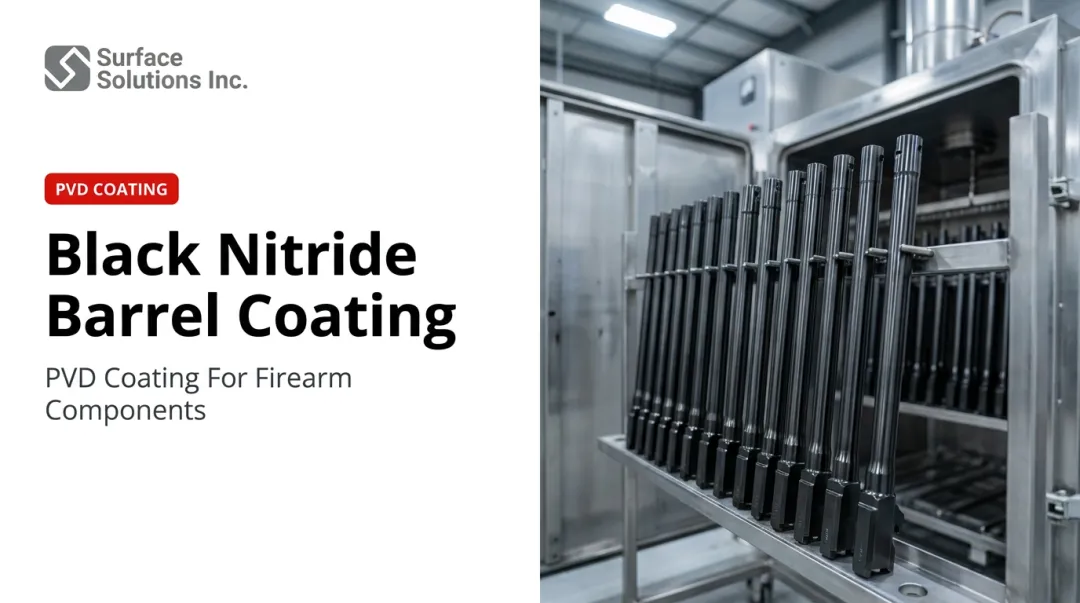
Black nitride, also sold as QPQ or Melonite, is a case-hardening treatment. It changes the steel itself rather than adding a film on top of it. That distinction matters because a BCG's reliability under sustained firing depends on how well that treatment was executed, not just whether the box says "nitride."
This guide breaks down what nitride actually is, the hardness and case depth it should achieve, how it compares to phosphate, nickel boron, and PVD/DLC coatings, and how to spot a poorly treated BCG before you buy one.
Key Takeaways
- Nitride hardens the steel surface itself instead of adding a coating layer
- Treated correctly, nitride resists corrosion and reduces friction better than phosphate, at a fraction of DLC/PVD cost
- Most nitride BCG failures come from inconsistent quality control, not the process itself
- This process fills the value tier between mil-spec phosphate and premium DLC/PVD coatings
What Nitride Coating Represents in an AR-15 BCG
Nitride is a thermochemical diffusion process. Parts are heated and exposed to a nitrogen-rich salt bath (or gas atmosphere for gas nitriding), which drives nitrogen atoms into the surface of the steel.
According to ASM International, this process produces two distinct zones: an outer compound layer containing iron carbonitride phases, and a diffusion zone beneath it where nitrogen and precipitated nitrides sit within the existing microstructure.
That's fundamentally different from PVD coatings like DLC or TiN, or electroless treatments like nickel boron. Those processes deposit a separate material on top of the steel. Nitride transforms the steel that's already there.
On a BCG, this matters in two ways:
- Wear resistance at high-friction contact points like the bolt lugs, cam pin channel, and carrier rails
- Corrosion protection across the entire treated surface, without relying on a topcoat that can chip or wear through
Factors That Influence Nitride Performance in Real-World Use
Not every "nitride BCG" performs the same, because several variables outside the process name determine the final result.
- Base steel selection. Carpenter 158 is the military-spec bolt steel; 9310 is reported to run roughly 7% stronger, but only when appropriately heat-treated first, according to Faxon Firearms' analysis of 9310 steel. Unspecified "mystery steel" gives no such assurance.
- Bath temperature, time, and quench control. These directly determine case depth and whether the resulting surface hardens properly or turns brittle. This is the most common source of documented nitride BCG failures.
- Assembly quality. A hardened bolt and carrier still fail if the gas key isn't properly staked. Independent reviews of budget BCGs have repeatedly flagged loose gas key screws as a recurring problem, proof that finish is only one piece of the reliability picture.
- Sustained heat from rapid fire. High round counts generate heat that accelerates surface wear on any BCG. How well nitride holds up under that stress depends entirely on how well it was applied in the first place.
Hardness, Case Depth, and Performance Range of Nitride Coatings
Nitride performance comes down to two measurable factors: case depth and surface hardness. There's no single universal number that applies across every manufacturer, because both depend on the specific process parameters used.
Nominal Hardness and Case Depth Range
IBC Coatings' published QPQ results offer a useful reference point. On 4140 alloy steel, a properly executed QPQ cycle reached roughly 800 HV at the immediate surface, tapering to around 650 HV further into the case, with a softer 350 HV core underneath.
Different steels produce different numbers, but the pattern holds: a hard outer case sitting on a tougher, more ductile core.
That range only holds true under specific conditions:
- Correct base steel with a stable prior heat treatment
- Controlled bath chemistry throughout the cycle
- Adequate treatment time to build sufficient case depth
Skip any one of these, and the "nitride" label stops meaning much.
Tolerance and Boundary Limits
Gas nitriding and salt-bath nitriding aren't interchangeable processes. Gas nitriding cycles for structural case depth (roughly 0.010–0.020 inch of diffusion zone) can run anywhere from 5 hours for a shallow case to 55 hours for a deep one. A black surface color simply doesn't tell you which end of that range a part received.
A finish that looks black doesn't confirm anything about diffusion depth. The only way to know is through the manufacturer's process specification and measured hardness profile, not the visual appearance of the part.
Safe Operating Margin
Reputable manufacturers build in margin above the minimum case depth their application requires. That margin accounts for round-count variability, environmental exposure, and normal manufacturing tolerance stacking.
Skip that margin, and the consequences show up under heavy use: spalling or premature wear at the cam pin and locking lugs, the highest-friction contact points on the entire bolt carrier group. A marginal nitride job might pass a quick inspection and still fail at round count 8,000.

Nitride vs Other BCG Coatings: Key Properties and Trade-offs
Nitride sits alongside several other treatments in the AR-15 world: phosphate, nickel boron, chrome, titanium nitride, and DLC. Each makes different trade-offs between cost, friction, and durability.
Nitride vs Phosphate
Phosphate (often called Parkerizing) is the traditional mil-spec finish, applied under specifications like MIL-DTL-16232 for manganese and zinc phosphate coatings. Recoil's BCG comparison notes that black nitride is smoother and easier to clean than phosphate, though nitride itself isn't the official mil-spec designation.
| Property | Nitride | Phosphate |
|---|---|---|
| Surface texture | Smooth, low-friction | Porous, matte |
| Lubricant retention | Lower, needs reapplication | Holds oil well in pores |
| Corrosion resistance | Strong, uniform | Good, but oil-dependent |
| Cleaning effort | Easier, less carbon adhesion | More carbon buildup in pores |
Phosphate's porosity is actually a feature: it holds lubricant in the surface texture, and that oil film acts as part of the corrosion barrier. Nitride skips that step because the hardened surface itself resists corrosion directly.
Nitride vs Nickel Boron (NiB)
NiB coatings feel noticeably slicker right out of the box, which is why they're popular for suppressed builds and cold-weather use. But that slickness comes with trade-offs.
NiB is an electroless-plated layer, typically 0.0003–0.0005 inch thick according to industry coating specs, meaning it does add real dimensional thickness to the part. On tight-tolerance components, that added thickness can create stacking issues that nitride simply doesn't have, since nitride penetrates the steel rather than building on it.
NiB is also a deposited layer, and deposited layers can delaminate or flake under sustained heat and friction cycling. Nitride, being a hardened version of the steel itself, doesn't have a separate layer to peel away in the first place.
Nitride vs PVD Coatings (TiN, DLC)
DLC and titanium nitride are true additive coatings, applied through physical vapor deposition inside a vacuum chamber. These coatings offer higher surface hardness and lower friction than nitride, but they cost significantly more to apply.
The reason comes down to equipment. Surface Solutions, which applies PVD coatings like TiN, CrN, and AlTiN to cutting tools and metal-forming components, runs its process at a controlled deposition temperature of roughly 700°F–800°F inside a vacuum chamber. The result is a coating layer of just 0.0001–0.0002 inch. That level of process control requires far more specialized equipment than a thermochemical salt bath.
That equipment cost shows up in pricing. As one commercial example, a nitride-treated BCG might list around $117–$140, while a DLC-coated version of the same BCG runs closer to $250–$290. The performance gain is real, but it comes at a real premium.
For most builders, nitride offers the strongest value-to-performance ratio. Nickel boron introduces avoidable delamination risk for a marginal lubricity gain. DLC and PVD coatings are a legitimate upgrade, but one you're paying a real premium to access.

How to Verify Nitride Quality and Avoid Common Red Flags
Since "nitride" alone doesn't guarantee quality, look for documentation that confirms the manufacturer controlled the process.
- Named base steel. Carpenter 158 or 9310, specifically, not "high-grade steel" or no mention at all.
- HP/MPI testing. High Pressure proof testing and Magnetic Particle Inspection catch cracks, laps, and subsurface flaws that a visual inspection can't.
- Gas key staking. Staking marks should visibly displace metal against the screw heads. Screws that spin freely signal an assembly shortcut, no matter how good the nitride underneath is.
- Machining tolerances. Rough tool marks or inconsistent fitment on the carrier rails often point to a manufacturer cutting corners elsewhere too.
Two misconceptions cause most buying mistakes here:
- Process labels don't equal process control. Not every BCG labeled "nitride" performs the same way. Bath chemistry, time, and quench determine the outcome far more than the name on the label.
- A single test result doesn't guarantee batch consistency. A lab-rated hardness value from one sample doesn't confirm that every unit in a production run matches it. Batch-to-batch consistency is where budget manufacturers most often fall short.
Conclusion
Nitride is a governing surface treatment whose real-world performance depends far more on the manufacturer's process control than on the word printed on the product listing.
Understanding case depth, hardness range, and how nitride trades off against phosphate, nickel boron, and PVD coatings gives you a framework for choosing the right BCG. When comparing options, prioritize:
- Documented testing: Manufacturers who publish HP/MPI results back their claims with data, not marketing copy
- Named base steel: Knowing the substrate tells you what performance to actually expect
- Case depth and hardness range: These numbers matter more than whichever coating sounds best on paper
Frequently Asked Questions
What is the best coating for a bolt carrier group?
Black nitride offers the strongest balance of durability, corrosion resistance, and cost for most builders. DLC/PVD is a legitimate premium upgrade, while nickel boron is worth avoiding due to delamination risk.
Nitride vs nickel boron: which coating is better for a bolt carrier group?
Nitride is generally more reliable long-term because it hardens the steel itself and can't flake. Nickel boron feels slicker initially but can delaminate or tarnish under sustained heavy use.
What are the different coatings for bolt carrier groups?
The main options are phosphate, nitride/QPQ, hard chrome, nickel boron, titanium nitride, DLC, and NP3. Each trades off differently on hardness, friction, and cost.
Is a nitride BCG mil-spec?
Standard military-issue BCGs use phosphate/Parkerizing per mil-spec. Nitride is a commercial upgrade, not the official mil-spec designation.
How can I tell if a nitride BCG is good quality?
Look for a named base steel (Carpenter 158 or 9310), documented HP/MPI testing, properly staked gas key screws, and a manufacturer with a track record of consistent quality control.
Does nitride wear out or wear off a BCG over time?
Properly executed nitride can't flake or peel since it hardens the steel itself rather than coating the surface. It may polish slightly at high-friction points after very high round counts.