Chromium Nitride (CrN) and Hard Chrome Plating are two of the most frequently compared options — but they differ fundamentally in how they're applied, how they perform under stress, and what they cost over time. Choosing the wrong one doesn't just affect a single tool. It affects resharpening schedules, downtime, labor, and in today's regulatory environment, compliance costs too.
This guide breaks down both coatings across every relevant performance dimension, so you can match the right solution to your actual application.
Key Takeaways
- CrN is a PVD-applied ceramic coating with 2,300 HV hardness, applied at 1–5 microns — no post-coat grinding required
- Hard Chrome is an electroplated layer reaching 65–70 HRC, best suited for dimensional buildup and component restoration
- CrN outperforms hard chrome in heat management — one documented stainless steel drawing case produced 500+ parts versus 15 with other coatings
- Hard chrome uses hexavalent chromium (Cr6+), triggering OSHA, EPA, and REACH compliance costs that compound over time
- The right coating depends on application type, failure mode, and part geometry — not a single universal answer
CrN vs. Hard Chrome: Quick Comparison
| Attribute | Chromium Nitride (CrN) | Hard Chrome Plating |
|---|---|---|
| Application Method | PVD — dry, vacuum-based process | Electroplating in hexavalent chromium bath |
| Hardness | ~2,300 HV (Ionbond spec) | 65–70 HRC / 940–1,210 HV |
| Coating Thickness | 1–5 microns (no geometry change) | 20–500+ microns (requires post-grind) |
| Post-Coat Machining | Not required | Often required for uniformity |
| Environmental Profile | No Cr6+, no toxic liquid waste | Cr6+ bath — OSHA, EPA, REACH regulated |
| Best For | Precision tooling, forming, cutting | Dimensional restoration, hydraulic components |
| Cost Profile | Higher upfront; lower long-term spend on compliance and rework | Lower upfront; higher compliance and maintenance costs |

What Is Chromium Nitride (CrN)?
CrN is a thin ceramic coating composed of chromium and nitrogen, deposited onto metal substrates through Physical Vapor Deposition (PVD) — a dry, vacuum-based process that bonds the coating at the atomic level without adding meaningful thickness to the part.
Core Performance Properties
- Hardness: ~2,300 HV per Ionbond's product specification — significantly harder than hard chrome's 940–1,210 HV range
- Thermal stability: Rated to 700°C in service; a 2014 study observed oxidation onset at 750°C for Cr2N films, though exact thresholds vary by formulation
- Friction coefficient: 0.50–0.55 against steel in vendor testing — lower than uncoated steel, which reduces galling in forming applications
- Corrosion resistance: Stable oxide layer provides strong protection in moisture-exposed and chemically active environments
Because CrN adds only microns of thickness, components can be finished to final tolerances before coating. No post-coat grinding is needed — which preserves geometric precision and eliminates an entire processing step.
Environmental and Regulatory Profile
That dimensional advantage carries into the regulatory picture as well. The PVD process uses no hexavalent chromium and produces no toxic liquid waste streams. Chromium trioxide — the carcinogenic substance used in hard chrome baths — is listed as a Substance of Very High Concern (SVHC) under REACH and is subject to authorization controls, meaning facilities must obtain explicit regulatory approval to continue using it. CrN PVD avoids this chemistry entirely, removing both the compliance burden and the liability exposure that comes with Cr6+ operations.
Surface Solutions applies CrN PVD coating specifically engineered for metal forming, punching, cutting tool, and medical instrument applications — environments where heat buildup and wear cycles drive tool failure. Their standard PVD thickness runs 0.0001"–0.0002" (2–5 microns), applied at approximately 800°F in a vacuum chamber.
Where CrN Is Used
- Performs consistently in metal forming, stamping, and deep drawing — particularly with stainless steel, which generates high heat and galling pressure
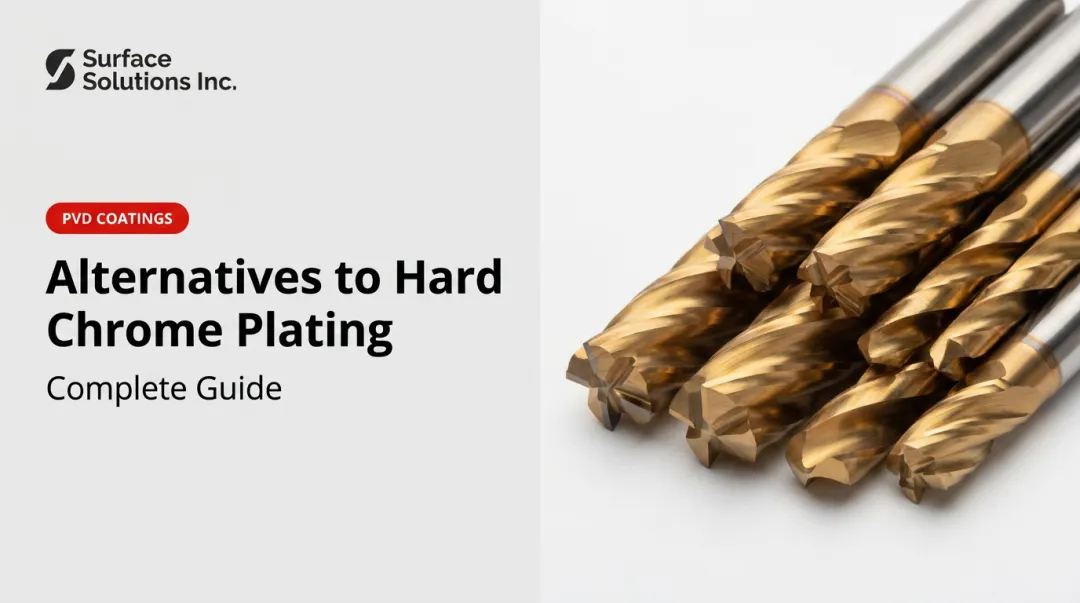
- Cutting tool manufacturing (punches, dies, carbide inserts)
- Medical device manufacturing requiring biocompatibility and resistance to repeated sterilization cycles
- Food processing equipment where moisture and sanitation chemicals create corrosive conditions
- Firearm components requiring a metallic finish with dimensional precision
What Is Hard Chrome Plating?
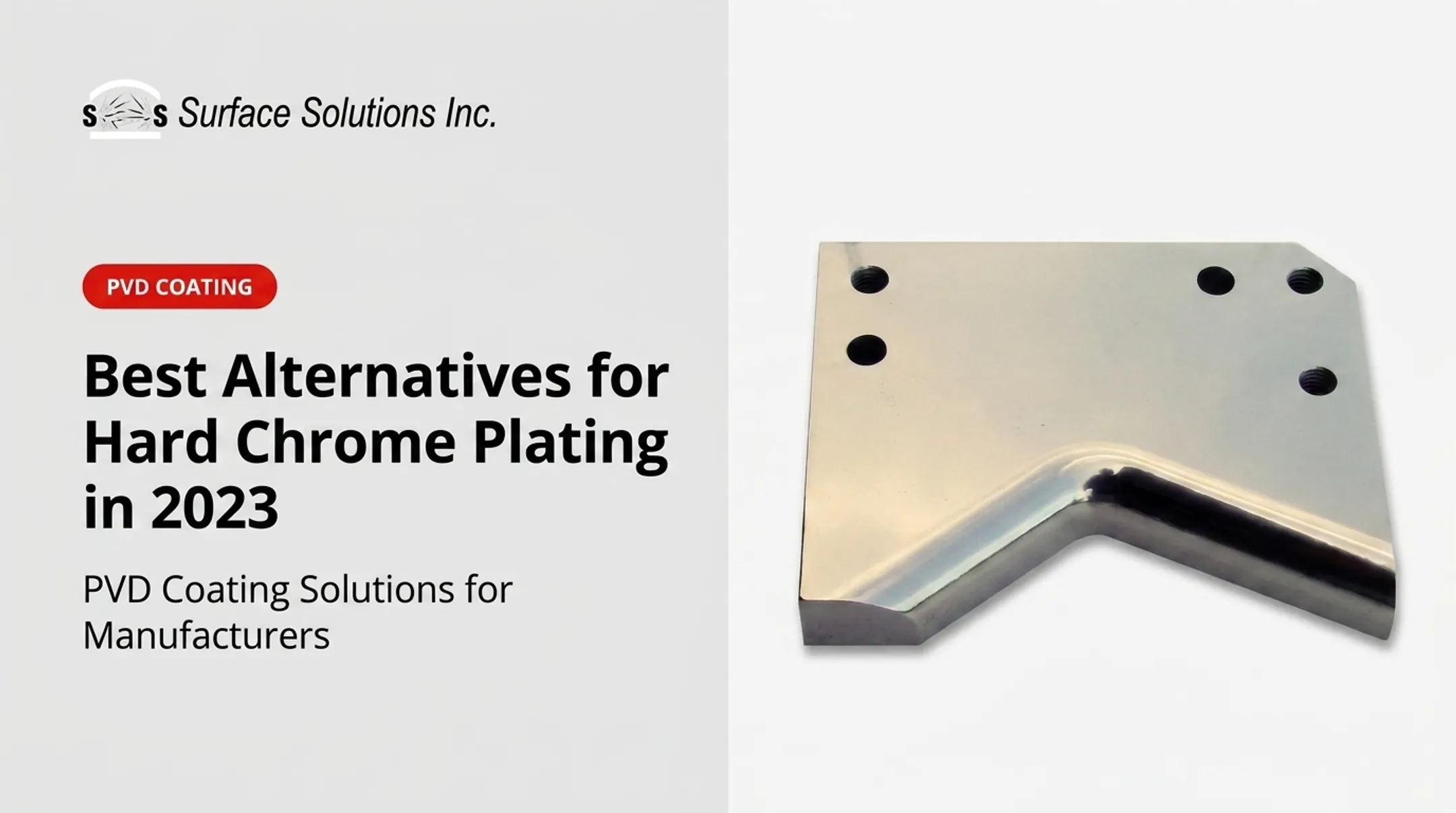
Hard Chrome Plating (HCP) is an electroplating process where chromium is deposited onto a metal substrate from a hexavalent chromium (Cr6+) bath using electrical current. The result is a thick, hard layer that can be built up to precise dimensions and then ground to final tolerances.
Two distinct types exist: hard chrome (industrial/engineered chrome) is thick, functional, and applied for wear and corrosion resistance; decorative chrome is thin, applied over nickel, and purely aesthetic. This guide focuses entirely on hard chrome.
Core Performance Properties
- Hardness: 65–70 HRC (940–1,210 HV per U.S. Chrome's general guide)
- Thickness: Typically 20–127 microns for engineered applications; can reach 500+ microns for dimensional rebuilding
- Wear resistance: Strong performance in sliding and reciprocating contact
- Corrosion resistance: Present, though microcracking in the deposit can allow corrosive agents to reach the substrate
NASA's process specification PRC-5003 notes that electrodeposited chromium often contains cracks extending from the surface toward the basis metal. The Bal Seal engineering guide reports increasing porosity and cracking as thickness rises above 20 microns. In demanding environments, those cracks become a direct pathway for corrosion to reach the substrate.
Where Hard Chrome Is Used
Hard chrome fits best in applications where coating thickness provides functional value:
- Hydraulic cylinders, piston rods, pump shafts, and valve components
- Dimensional restoration of worn or undersized machine components
- Heavy-duty rollers, press components, and bearing surfaces
- Applications where established hard chrome infrastructure is already in place
The EPA estimated approximately 188 large and 394 small hard chrome electroplating facilities operating in the United States as of its 2012 rulemaking — illustrating its established industrial footprint, though those numbers reflect regulatory populations from over a decade ago.
Chromium Nitride vs. Hard Chrome: Which Is Better for Your Application?
The right coating depends on what's actually failing — tool wear, dimensional loss, heat buildup, or regulatory exposure. Here's how to match the coating to the problem.
When CrN Is the Right Choice
Choose CrN when your primary problem is tool wear, heat buildup, or shortened run cycles in forming and cutting operations:
- Precision tooling where post-coat grinding isn't practical and tolerances must hold
- High-cycle metal forming with stainless steel, where heat generation is the limiting factor
- Medical or food processing parts requiring both corrosion resistance and biocompatibility
- Operations where running a Cr6+ process adds compliance cost and regulatory complexity
When Hard Chrome Is the Right Choice
Hard chrome remains the appropriate option in specific situations:
- Dimensional restoration of worn hydraulic components or undersized shafts where thick build-up is the goal
- Heavy-duty mechanical systems — cylinders, rods, valves — where coating thickness provides load-bearing support
- Shops with existing hard chrome equipment and process expertise, where precision tooling isn't the primary concern
The Total Cost Calculation
Hard chrome typically costs less per initial application. That gap closes fast when you account for the full cost picture.
A MetalForming Magazine case study found that a single unplanned die-maintenance event exceeded $500 — and unplanned maintenance runs 4x more than planned maintenance. The real cost factors include:
- Resharpening frequency and associated downtime
- Labor to pull, regrind, and reinstall tools
- Compliance overhead of operating a Cr6+ process
One Surface Solutions customer quantifies this directly: the manufacturer ran 60,000 parts without resharpening using a PVD coating, compared to resharpening every 10,000 parts uncoated — eliminating six resharpening events and saving 48 hours of labor on a single production run.

Real-World Performance: CrN in Metal Forming Operations
The most direct evidence for CrN's advantage in metal forming comes from a documented stainless steel drawing application.
The Stainless Steel Drawing Case
A sheet metal forming customer compared Alpha™ coating against CrN on the same forming tooling in a stainless steel drawing operation. The results were stark:
- Alpha™ coated tooling: 15 parts produced — parts were too hot to touch
- CrN coated tooling: 500+ parts produced — parts remained only warm to the touch
A 33x increase in output before heat became a limiting factor. Stainless steel drawing is one of the more thermally demanding forming operations — the material's work-hardening characteristics generate significant friction heat during the draw cycle. CrN's thermal stability and low-friction surface prevented the heat buildup that stopped Alpha™ at 15 parts.
Downstream Operational Impact
The production gains from better tool coatings extend well beyond the coating itself:
- Fewer resharpening cycles — up to 6x more parts before resharpening is required (from customer Don Richardson's production run)
- 48 hours of labor saved per run — eliminating 6 resharpening events, each requiring 8 hours to pull and restore tooling
- Parts produced at lower temperatures show fewer heat-related defects
- Reduced maintenance interruptions mean longer continuous production windows
Independent research backs these results. A 2004 peer-reviewed comparison by Bozyazi et al. found arc-PVD CrN outperformed electrolytic hard chrome under lubricated reciprocating-wear conditions — consistent with the wear behavior seen in production data above.
Manufacturers evaluating CrN for their tooling can contact Surface Solutions to discuss their application, current coating challenges, and expected production volumes at 763-785-9436 or info@tincoat.net.
Conclusion
Neither coating wins universally. The right choice comes down to what you're solving for.
CrN is the stronger choice for precision tooling, high-cycle metal forming, and any environment where heat, friction, dimensional accuracy, and regulatory compliance are priorities. Its thin PVD deposition preserves tolerances, hardness exceeds hard chrome's, and it sidesteps the Cr6+ compliance burden entirely.
Hard chrome remains relevant for dimensional restoration, heavy-duty hydraulic and mechanical systems, and applications where substantial coating thickness is the primary requirement rather than cutting performance.
The right coating selection reduces unplanned downtime, extends tool life, lowers total maintenance labor, and — for CrN specifically — eliminates the growing compliance costs tied to hexavalent chromium regulation. If you're running high-cycle metal forming or precision tooling and haven't evaluated CrN yet, that's the first place to start.
Frequently Asked Questions
What is the difference between hard chrome and chromium nitride?
Hard chrome is an electroplated layer deposited from a hexavalent chromium solution, typically 20–127+ microns thick with hardness of 65–70 HRC. Chromium nitride (CrN) is a PVD-applied ceramic coating, 1–5 microns thick, with hardness around 2,300 HV. CrN is harder, environmentally safer, and better suited for precision tooling where geometry must be maintained.
What are the two types of chrome plating?
Hard chrome (industrial/engineered chrome) is thick, functional, and used for wear resistance, corrosion protection, and dimensional buildup in machinery. Decorative chrome is thin, applied over nickel primarily for appearance, and is not suitable for heavy industrial use.
Is chromium nitride better than hard chrome for barrel finishes?
For firearm barrels, CrN PVD generally offers better dimensional accuracy and corrosion resistance, while hard chrome has historically dominated military applications for sustained-fire durability. The Army has sought Cr6+-free replacements, though no fielded CrN PVD barrel specification has been publicly confirmed. Application volume and operating conditions determine the better fit.
Can CrN coating replace hard chrome for industrial tooling applications?
Yes, CrN PVD is increasingly adopted as a hard chrome alternative for punches, dies, forming tools, and cutting tools — particularly where the goal is extending tool life and reducing resharpening frequency. CrN doesn't suit applications requiring thick dimensional buildup or component restoration.
Is chromium nitride coating environmentally safer than hard chrome?
CrN PVD uses no hexavalent chromium and produces no toxic liquid effluents. Hard chrome relies on a Cr6+ bath regulated under OSHA's 5 µg/m³ exposure limit, EPA 40 CFR Part 63 Subpart N air emission standards, and REACH authorization controls — all tied to chromium trioxide's carcinogenic classification.
How thick is a chromium nitride coating compared to hard chrome?
CrN PVD coatings are typically applied at 1–5 microns, preserving tight tolerances without any post-coat grinding. Hard chrome ranges from 20 to 500+ microns depending on the application — useful for dimensional restoration, but that thickness requires post-coat grinding to achieve surface uniformity.