At the same time, patients expect implants to last decades, not years. Coatings often get treated as a materials-science footnote. In practice, they determine whether an implant integrates cleanly or triggers complications that lead to revision surgery.
This article covers coating types, their biocompatibility benefits, what goes wrong when coating quality slips, and how manufacturers pick the right coating partner—for both implants and the tooling that produces them.
TL;DR
- Coatings improve osseointegration, cut infection risk, and extend implant longevity
- Common types: hydroxyapatite (HA), PVD coatings (TiN, CrN), hydrophilic surfaces, antimicrobial treatments
- Adhesion, thickness, and uniformity determine success: poor execution causes delamination and failure
- An experienced coating partner reduces regulatory risk and improves clinical outcomes
What Are Implant Coatings?
Implant coatings are engineered surface layers applied to medical devices to improve how surrounding tissue responds to them. ISO 17327-1 formally covers these coatings and surface modifications for non-active surgical implants.
You'll find them on:
- Orthopedic implants (hips, knees)
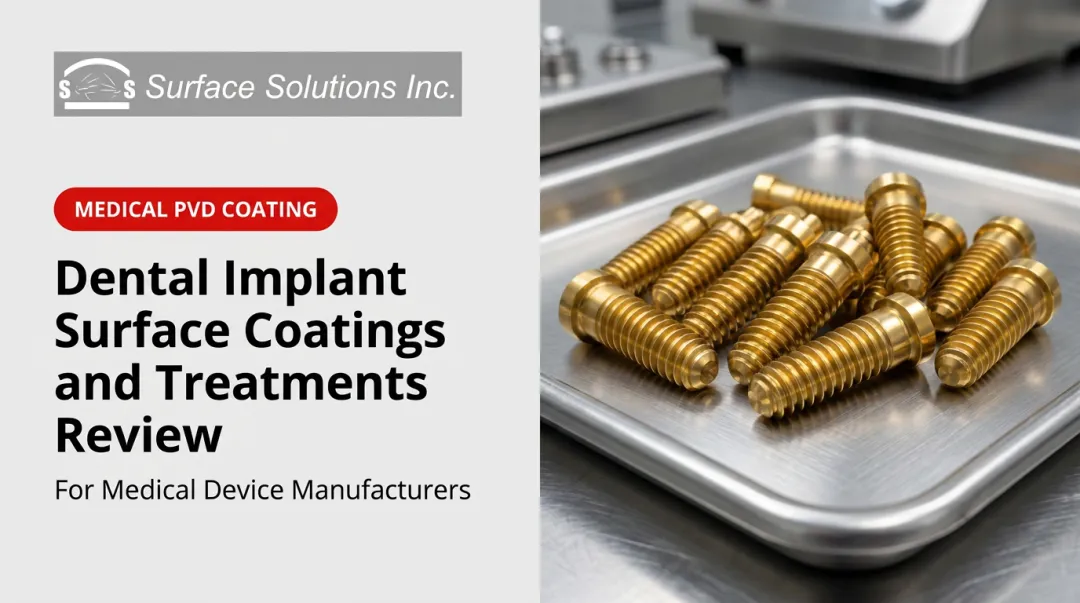
- Dental implants
- Cardiovascular devices
- Spinal hardware
- Trauma fixation devices (plates, screws, pins)
These layers support tissue integration, lower rejection risk, and help implants last longer in service.

Key Advantages of Implant Coatings
Each advantage below maps to metrics manufacturers already track: regulatory compliance, patient safety, implant longevity, and production efficiency.
Advantage 1: Improved Osseointegration and Biocompatibility
Coatings like hydroxyapatite and porous titanium create surface textures that encourage bone cells to attach and grow. This reduces the "foreign body" response you'd see with uncoated metal.
The clinical evidence is mixed but instructive. A 2024 randomized dental trial found HA nano-coated implants showed higher stability scores at every checkpoint (79.08 vs. 73.43 at four months), while two uncoated control implants failed outright.
Long-term hip data is more nuanced. A 13-year follow-up trial found no clinical advantage for HA coating in that particular stem design, with all implants well-fixed regardless of coating.
KPIs impacted: implant survival rate, revision surgery frequency, healing time, patient-reported outcomes.
When it matters most: Load-bearing orthopedic implants (hip, knee) and dental implants, where direct bone contact determines long-term success.

Advantage 2: Reduced Infection and Corrosion Risk
Antimicrobial and hydrophilic coatings resist bacterial adhesion and biofilm formation. Corrosion-resistant coatings, including PVD-based options, prevent ion release and material degradation inside the body.
Why it matters: Infection remains a leading cause of implant failure. Baseline periprosthetic joint infection rates run 1–3% after initial hip or knee replacement.
A 2019 systematic review of surface modifications found promising case-series results, including one iodine-coating series with zero infections in 21 patients. The authors still flagged small samples and a lack of randomized trials.
Lower infection risk cuts hospital readmissions and liability exposure for manufacturers.
KPIs impacted: infection rate, corrosion resistance, device recall frequency, patient safety incidents.
When it matters most: High-risk environments like cardiovascular and spinal implants, or any extended-wear device.
Advantage 3: Extended Device Longevity and Manufacturing Efficiency
Wear-resistant, low-friction coatings reduce mechanical degradation two ways: on the implant surface itself, and on the tooling used to machine implant components.
PVD coatings on cutting tools can extend tool life substantially. Industry benchmarks cite up to 10x longer life versus uncoated tools in general cutting applications.
Surface Solutions applies PVD coatings such as TiN, AlTiN, CrN, and TiCN to cutting and forming tools used in manufacturing, helping shops hold sharper edges longer between resharpening cycles.
Consistent tooling matters in implant production:
- Worn tools drift out of tolerance gradually, not all at once
- Tighter tolerances mean fewer dimensional defects in finished components
- Fewer resharpening cycles keep output consistent across a production run
KPIs impacted: tool life, production throughput, implant surface wear rate, manufacturing defect rate.
When it matters most: High-volume implant manufacturing, where tooling consistency directly affects finished device quality.

What Happens When Coating Quality Is Overlooked
Poor coating execution has a well-documented failure pattern.
A study of HA-coated acetabular cups followed 155 patients for 7-10 years and found cumulative survival dropped to 65% by year 10. At revision, most of the HA coating had disappeared from the metal cup entirely.
Common consequences include:
- Delamination and osteolysis: a 1993 case report found HA coating separating at 3.3 years, with particles driving third-body wear
- Higher infection and rejection risk when the surface fails to perform as designed
- More revision surgeries: a 15-year comparison found 57% of HA-coated cups revised versus 17% of titanium-coated cups
- Inconsistent coating quality from adhesion gaps, thickness drift, or weak process control
- Rising long-term costs from field failures, revisions, and recalls

Coating chemistry alone does not decide outcomes. Adhesion, thickness control, and process consistency determine whether a coating helps or hurts.
How to Get the Most Value from Implant Coatings
Coatings deliver the most value when three things align:
- Coating type matches the application. Hydroxyapatite suits load-bearing bone contact; PVD suits wear surfaces and tooling; hydrophilic treatments suit early-stage cell response.
- Adhesion, thickness, and uniformity are validated against recognized standards, including ASTM F1147 for coating tension testing and ISO 14242 for hip-joint wear testing.
- Manufacturers partner with experienced coating providers for both implant surfaces and the precision tooling that produces them.
Validation carries extra weight. FDA guidance recommends testing coated and noncoated specimens side by side, examining failure modes, and evaluating the coating across the full manufacturing chain, not only the finished implant.
Conclusion
The real value of implant coatings shows up in fewer complications, stronger tissue integration, and steadier manufacturing outcomes. Those gains compound over time and cut lifetime costs for patients and manufacturers alike.
Coating strategy shouldn't be a one-time material choice bolted onto a design. Treat it as an ongoing engineering practice, validated against standards, and applied consistently across both the implant and the tooling that shapes it.
Frequently Asked Questions
What is the best surface treatment for dental implants?
Hydroxyapatite and hydrophilic coatings are widely considered top options due to proven osseointegration and infection-resistant properties. The right choice still depends on implant material and clinical need.
What happens after 20 years of dental implants?
A 2024 meta-analysis found roughly 4 of 5 implants surviving 20 years, though results vary by case. Wear, bone remodeling, or coating degradation over decades may eventually require monitoring or revision.
How do implant coatings improve biocompatibility?
Coatings modify an implant's surface chemistry and texture to encourage cell attachment and reduce immune rejection, making the surface more like the biological environment it's placed in.
What are the most common causes of implant coating failure?
Delamination from poor adhesion, incorrect thickness, and improper sterilization all affect coating stability. Documented failures include coating resorption, particle migration, and third-body wear.
Are PVD coatings used in medical device manufacturing?
Yes. PVD coatings appear on implant surfaces and on precision tooling used to machine implant components, offering wear resistance and biocompatibility benefits. Surface Solutions applies PVD coatings such as TiN, AlTiN, and CrN to medical instruments and to tooling used to machine implant components.
How is implant coating quality tested before market approval?
Key tests include adhesion testing (ASTM F1147), wear and friction testing (ISO 14242), and fatigue testing (ASTM F1160) to validate coating performance under real-world conditions.