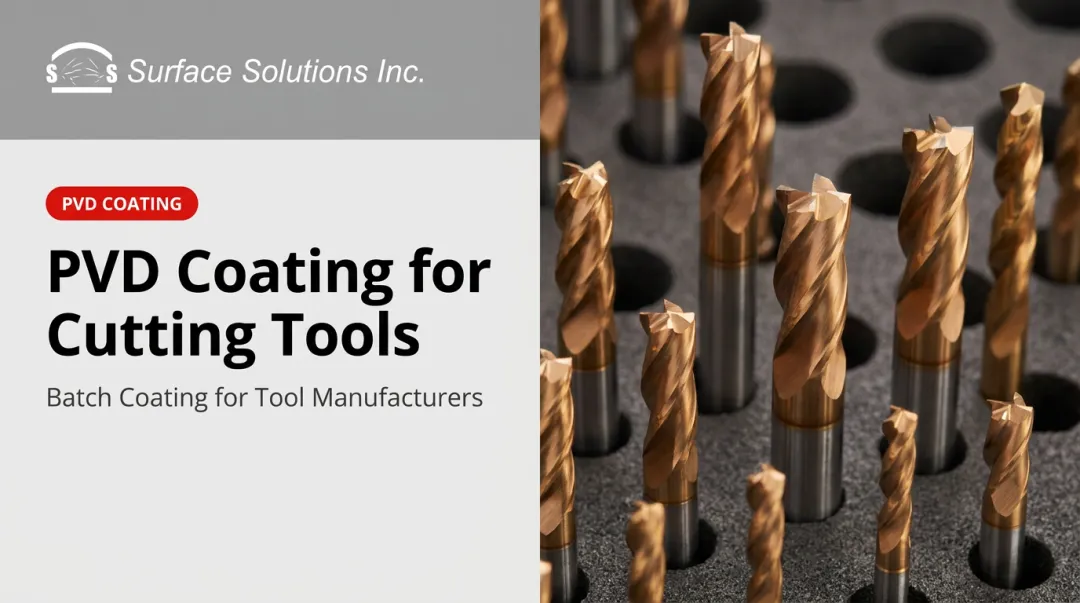
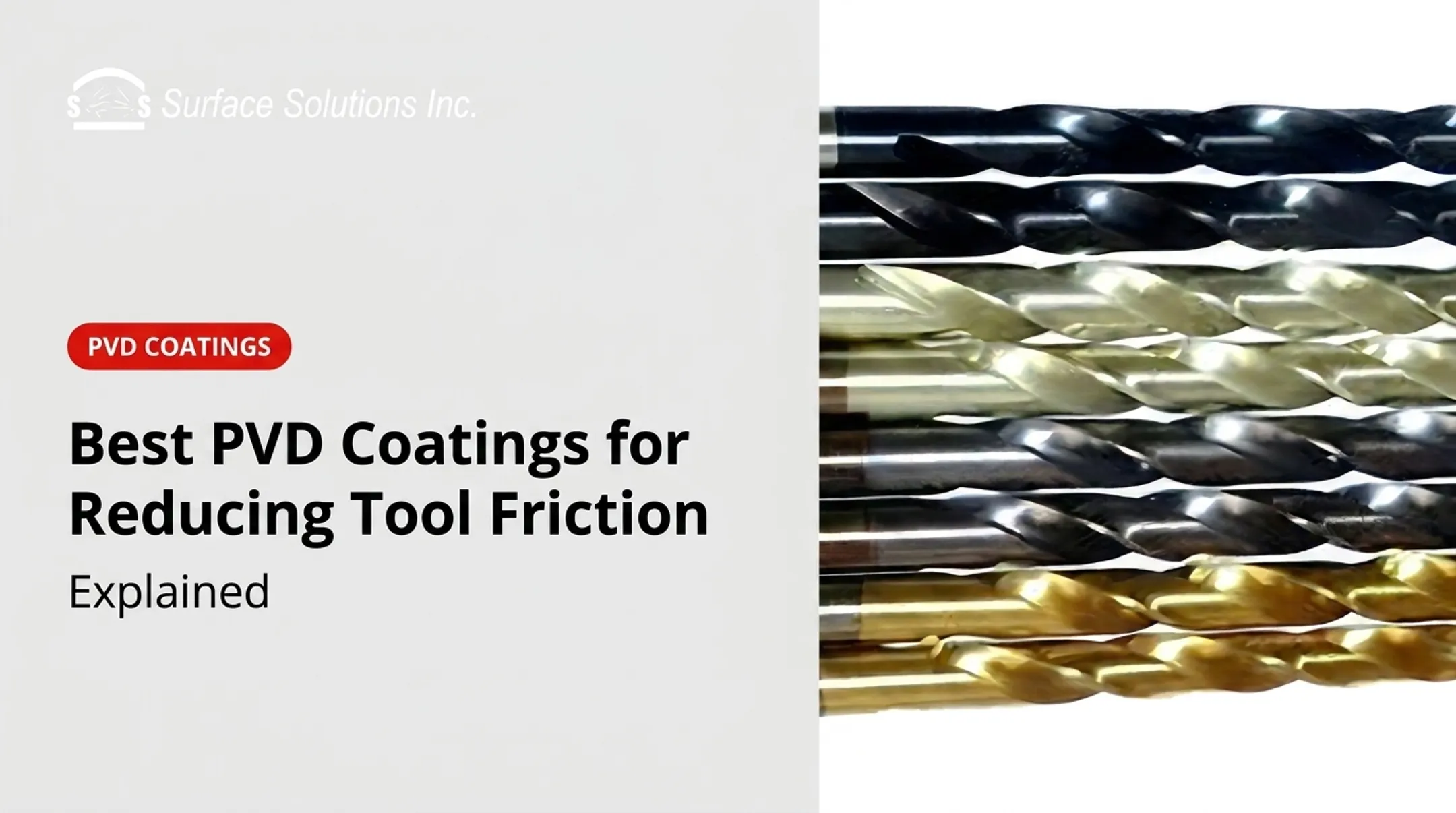
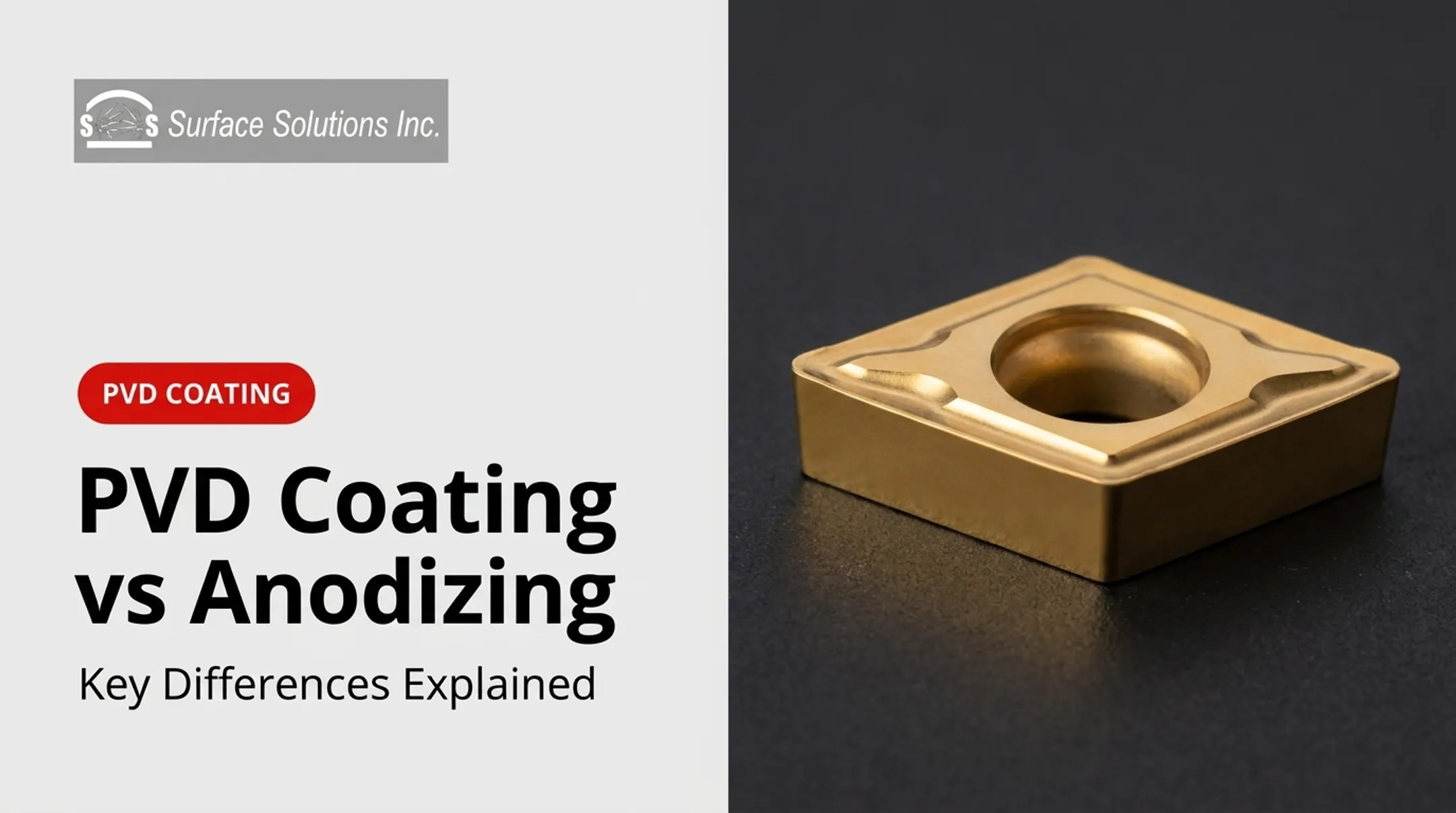
Most manufacturers default to TiN because it's familiar, not because it's the best fit. But a mismatch between coating chemistry and your actual failure mode, whether that's wear, corrosion, heat, or friction, can mean the difference between resharpening every 10,000 parts or every 60,000.
This guide breaks down the major PVD coating types, what each one actually solves, and a practical framework for picking the right one for your process.
TL;DR
- Match each coating (TiN, CrN, TiAlN, ZrN, TiCN, DLC) to the failure mode you need to stop
- Factor in substrate, temperature, chemical exposure, and target part life before you choose
- Wrong coating choice means premature resharpening, buildup, and higher labor costs
- Decide on performance data, not price or habit
What is PVD Coating?
Physical Vapor Deposition (PVD) is a vacuum-based process that deposits a thin, hard film onto tools and parts to improve wear resistance, corrosion resistance, and friction performance. The coating material is vaporized in a vacuum chamber, then bonds to the part's surface as an extremely thin layer, typically 0.0001 to 0.0002 inches thick.
Manufacturers commonly run this process between 150°C and 500°C, depending on the chemistry involved (Oerlikon Balzers). PVD coatings are grouped by chemistry: nitrides, carbonitrides, carbon-based films, and specialty blends. That chemistry drives coating selection.
Core Types of PVD Coatings
Each coating chemistry solves a different wear, heat, or corrosion problem.
Titanium Nitride (TiN) TiN is the familiar gold-colored general-purpose coating. It delivers hardness around 2800 HV and solid wear resistance, with a service temperature near 500°C (Ionbond). It suits moderate-duty work, but performance drops quickly at high cutting temperatures.
Chromium Nitride (CrN) Built for corrosion resistance and minimal buildup. In a 2019 electrochemical study, CrN showed a corrosion-current density of 1.5 microA/cm² versus TiN's 4.8 microA/cm² in salt-spray testing, meaning CrN resisted corrosion roughly three times better under the same conditions (Suo et al., 2019). CrN also handles heat well, with service temperatures reaching 700°C.
Titanium Aluminum Nitride (TiAlN/AlTiN) Forms a protective oxide layer at high heat, making it a go-to for dry, high-speed machining and hardened steels. AlTiN in particular tolerates temperatures up to 926°C, while TiAlN offers slightly higher hardness and lower friction at moderate temperatures (Oerlikon).
Zirconium Nitride (ZrN) ZrN balances appearance with solid corrosion resistance. It is often chosen when surface finish matters as much as wear performance.
Titanium Carbonitride (TiCN) TiCN adds extra hardness and lower friction (as low as 0.2 against 100Cr6 steel) for abrasive conditions. It is more brittle than TiN or CrN, so it is a poor fit when impact resistance is the priority.

Specialty and Proprietary Coatings Beyond the standard chemistries, some providers engineer proprietary blends for specific failure modes. Surface Solutions' Alpha™ coating, for example, targets resharpening frequency and galvanized buildup issues that standard TiN handles poorly.
Why Manufacturers Rely on PVD Coatings
PVD is more than a hardness upgrade. It changes the operating math:
- Fewer resharpening cycles — one punching operation hit 60,000 parts on Alpha™-coated tooling vs. a normal 10,000-part interval
- Less lubricant use — thick hot-rolled steel formed with minimal lubricant after a coating switch
- Reduced scrap and chipping — coated punches showed less chipping in production
- Longer die run times — a PVD CrN forming tool exceeded 1.2 million parts in one case (AHSS Guidelines)
- Less maintenance downtime — fewer press stoppages and more uptime per shift

What to Consider When Choosing the Best PVD Coating
The right coating matches chemistry to your specific failure mode. Match the factors below to the conditions your tools actually face, and the gains show up in parts-per-sharpening, cycle time, and labor hours saved.
Substrate Material and Tool Type
Your base material affects adhesion. Surface Solutions coats hardened tool steel and carbide substrates directly. Surface condition is non-negotiable:
- Oxides, EDM recast, and bluing must be removed before coating
- Mismatched substrate-coating combinations lead to premature flaking
- Parts must be conductive, single-piece metal (no assemblies, pressed-in parts, or plastic inserts)
Skipping pre-treatment is the fastest way to waste a coating cycle.
Operating Temperature
High-heat operations need oxidation-resistant chemistry. Standard TiN handles moderate conditions fine up to about 500°C, but push past that and you need TiAlN or AlTiN, which tolerate temperatures up to 926°C without breaking down.
The KPI is straightforward: extended tool life at elevated cutting speeds means fewer changeouts per shift.
Corrosion and Chemical Exposure
Moisture, lubricants, and cleaning chemicals push the decision toward CrN, ZrN, or Alpha-type coatings. In one documented stainless-steel drawing application, switching from Alpha™ to CrN took production from 15 parts (tool too hot to touch) to over 500 parts (tool just warm to touch). That's not a marginal improvement, that's a different production plan entirely.

The KPI: fewer rejected parts due to rust or pitting, and less galvanized buildup on tooling.
Friction and Galling Requirements
Low-lubricant or dry-forming operations need low-friction coatings. Alpha™ coating, for example, has been used to form 3/8-inch-thick Grade 80 hot-rolled steel with minimal lubricant while producing a cleaner-looking finished part. Reduced friction means:
- Lower lubricant consumption per run
- Better surface finish on finished parts
- Less galling and material pickup on tooling
Production Volume and Resharpening Frequency
High-volume punching and stamping operations should prioritize coatings that stretch out sharpening intervals. One documented case: Alpha™-coated tooling completed a 60,000-part order without sharpening, against a normal 10,000-part interval, a sixfold increase. That customer estimated the change saved roughly 48 labor hours, based on eight hours per resharpening event avoided.
In a separate high-volume stamping application, Alpha™-coated M4 punches ran for over 15 months and an estimated 15 million parts, compared to uncoated D2 punches needing sharpening every three weeks.

Cost vs. Long-Term ROI
Upfront coating cost matters less than total parts produced per dollar spent. One Surface Solutions customer, after adopting coatings for the first time, wanted every tool in his shop coated because, in his words, the tools were "working better than new."
The real ROI question is not price-per-coating-cycle, but cost-per-part-produced across the tool's entire working life.
How Surface Solutions Can Help
Surface Solutions applies PVD coatings that extend tool life and cut operational costs for metal forming, cutting, and manufacturing shops.
Two coatings solve specific problems most shops run into:
- Alpha™ coating delays basic sharpening far longer than uncoated tools and virtually eliminates galvanized buildup compared to standard TiN
- CrN coating keeps parts warm to the touch after 500+ parts in drawing work, versus about 15 parts that run too hot with other coatings
What sets Surface Solutions apart:
- Reasonable turnaround times on coating orders
- Coverage across the US, Canada, and Mexico
- Durability and value that outperform competitor coatings
- Tools that work better than new after coating
If your current tooling is underperforming, or if you're not sure which chemistry fits your process, reach Surface Solutions at 763-785-9436 or info@tincoat.net.
Conclusion
Match coating chemistry to what's actually failing in your process: wear, heat, corrosion, or friction. The most common option is rarely the right default.
Review coating performance periodically, especially as production volumes, materials, or tolerances shift.
Take a hard look at your current tooling performance. A coating upgrade might be the simplest lever you haven't pulled yet to cut downtime and labor costs.
Frequently Asked Questions
What are the main types of PVD coatings?
The main types are TiN, CrN, TiAlN/AlTiN, ZrN, TiCN, and specialty/proprietary blends like Alpha™. Each targets a different failure mode: wear, corrosion, heat, or friction. The "best" choice depends entirely on your application.
What are the main steps in the PVD coating process?
Parts are cleaned to remove oils and oxides, then loaded into a vacuum chamber. Coating material is vaporized with reactive gas to form the film; parts rotate during deposition for even coverage, then cool and go through final inspection.
Which is better: PVD coating or DLC coating?
DLC is a carbon-based coating, often applied via PVD-related processes, best suited for low-friction and anti-galling needs. Standard PVD nitrides like TiN, CrN, and TiAlN are better suited for general wear and corrosion resistance across broader applications.
How do I know which PVD coating is right for my tools?
Match your substrate, operating temperature, and primary failure mode (wear, corrosion, heat, friction) to the appropriate chemistry using the selection factors outlined above. If you're unsure, a coating provider can help assess your specific application.
How long does a PVD coating last before resharpening is needed?
It depends on coating type, application, and production volume. Advanced coatings like Alpha™ have extended the time between sharpenings up to sixfold in documented cases versus uncoated tools on the same job.
Can PVD coatings be reapplied after resharpening?
Yes. Tools can usually be stripped and recoated after resharpening to restore wear resistance. Confirm strip-and-recoat requirements with your coating service before submitting parts.