Choosing the right finish isn't just about looks. Corrosion resistance, heat tolerance under heavy use, and even resale value all hinge on the coating you pick. Some states also regulate firearm coloring, so legality matters too.
This guide breaks down Cerakote, DuraCoat, GunKote, traditional finishes, and where PVD coatings fit into the picture, plus how to choose based on your actual needs.
TL;DR
- Options run from classic bluing and Parkerizing to modern Cerakote, DuraCoat, and PVD
- Weigh durability, cost, application method, and color options side by side before you choose
- Match the coating to your use case, budget, and DIY vs. professional application preference
- Confirm state laws before applying non-standard firearm colors
What Is a Firearm Coating?
A firearm coating is a protective or cosmetic layer applied to metal (and sometimes polymer) components. It's designed to resist corrosion, wear, and heat during normal use.
Coatings go on barrels, slides, receivers, and small parts. Some are applied at the factory; others come from aftermarket specialists after the gun leaves the manufacturer.
A quality finish is a functional upgrade. The right coating:
- Reduces cleaning frequency
- Slows wear on moving parts
- Extends component life against friction and moisture
Why Firearm Coatings Matter
Rust happens when moisture and oxygen meet bare metal. It's that simple. According to the NRA National Firearms Museum, the ideal firearm storage environment sits at 70°F and 50-55% relative humidity — anything outside that range, especially with temperature swings, invites condensation and pitting.
Uncoated metal in humid or coastal environments degrades fastest. A quality coating acts as a barrier between that metal and the elements.
Beyond rust prevention, coatings reduce friction on moving parts:
- Slides cycling against frames
- Bolts moving through receivers
- Locking lugs bearing under fire
Less friction means less wear, which means fewer cleanings and longer service life.
The Industrial Parallel
This isn't unique to firearms. Physical Vapor Deposition (PVD) coatings have protected industrial tooling for decades. Surface Solutions applies PVD coatings like AlTiN to cutting tools and dies, and the results are telling: AlTiN measures 4,000-4,200 Hv in hardness and extends tool life 2-7 times longer than uncoated tools, even at operating temperatures up to 800-900°C.

Firearm coatings use the same idea: a hard, thin barrier that takes the wear instead of the steel underneath. That is why coated slides, bolts, and barrels hold up longer under heat, moisture, and repeated cycling.
Types of Firearm Coatings
No single coating wins across the board. Each one trades off cost, durability, cure time, and customization differently. Here's how the major players stack up.
Cerakote
Cerakote is a ceramic-polymer coating sprayed on in a thin film. It comes in two main lines:
- H-Series: oven-cured, widely used for firearms
- C-Series: air-cured, rated for extreme heat up to 1,800°F
What sets it apart: Cerakote offers the widest color and pattern customization of any coating available today, including camo, fades, logos, and multi-tone builds.
According to Cerakote's H-Series technical data sheet, film thickness runs 1.0-2.0 mil. Hardness reaches 9H on the pencil scratch scale, and salt-spray corrosion resistance hits 2,000+ hours for many colors under ASTM B117 testing.
Best for: Hunters, competitive shooters, and anyone wanting a durable finish with serious visual customization.

Limitations:
- Requires professional equipment — spray gun, curing oven, media blaster
- Skilled application matters; DIY results vary widely
- Higher cost and longer turnaround than simpler finishes
DuraCoat
DuraCoat is a two-part, air-cured chemical coating. Unlike Cerakote, it doesn't need an oven, which makes it the go-to for home refinishing.
Per DuraCoat's application instructions, the mix ratio is 12 parts DuraCoat to 1 part hardener, with a 6-8 hour working window. Optimum spray thickness sits around 1 mil.
Timeline reality check:
- Dry to touch: 20 minutes
- Safe to handle: 1 hour
- Reassemble: 24 hours
- Full cure for heavy use: 3-4 weeks
Best for: Budget-conscious owners or hobbyists doing their own refinish work.
Key strengths:
- Around 300 color options
- Accessible application process
- Decent heat resistance in upgraded formulas
Limitations: Full cure takes weeks, not hours. The coating also runs thicker than Cerakote, which can affect tight-tolerance parts.
GunKote and Traditional Finishes
This category covers everything from century-old bluing to modern one-part sprayed coatings.
Bluing is a controlled oxidation reaction that converts the steel's surface into a thin black oxide layer rather than applying an external film. According to NRA Women, bluing scratches easily and offers minimal rust protection unless the gun is kept dry and regularly oiled.
Parkerizing (phosphating) goes further. It's a heated phosphoric-acid bath process using zinc or manganese, governed by military spec MIL-DTL-16232. It's tougher than bluing and more resistant to nicks and corrosion.
GunKote, made by KG Industries, is a one-part, bake-on sprayed film similar in concept to Cerakote but with faster cure times and no hardener mixing required.
Nitride/QPQ (Tenifer) finishes, popularized by Glock, use ferritic nitrocarburizing to harden the surface. These rival ceramic coatings in hardness and corrosion resistance without adding a separate layer.
| Finish | Type | Corrosion Resistance | Customization |
|---|---|---|---|
| Bluing | Chemical conversion | Minimal | None |
| Parkerizing | Chemical conversion | Good | None |
| GunKote | Sprayed film | Good | Limited colors |
| Nitride/QPQ | Surface hardening | Excellent | None |

Best for:
- Bluing: classic look on guns that stay dry and oiled
- Parkerizing: working guns that need stronger corrosion protection
- Nitride/QPQ: maximum hardness and corrosion resistance without a film layer
- GunKote: cost-effective sprayed alternative with a simpler bake-on process
Where PVD Coatings Fit In
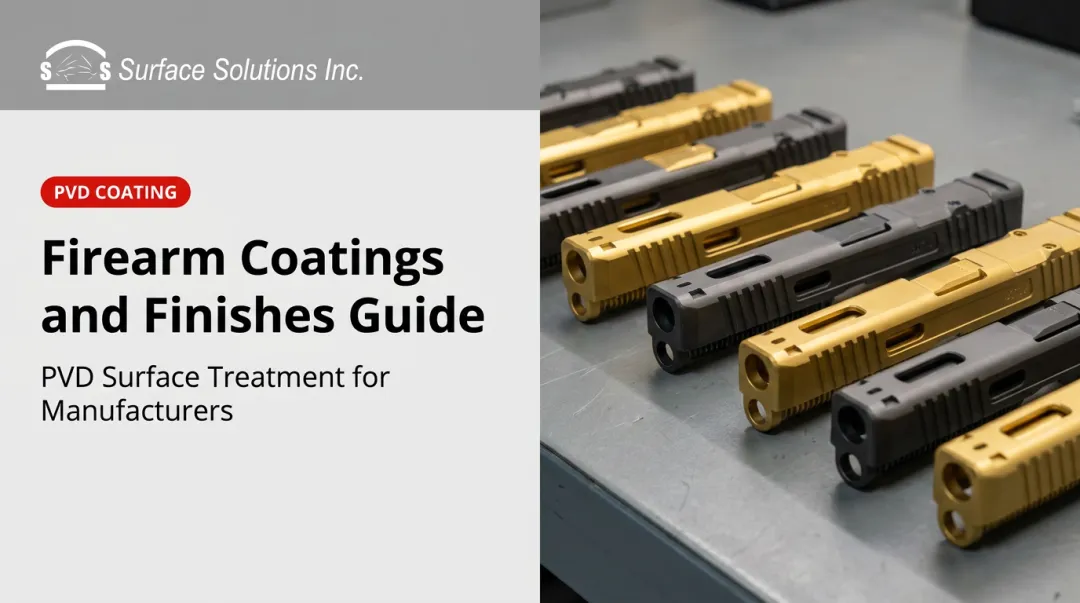
PVD (Physical Vapor Deposition) coatings are a different animal entirely. Surface Solutions applies these to firearm components at roughly 0.0001"-0.0002" thick — a fraction of what sprayed coatings like Cerakote or DuraCoat lay down.
That thinness means PVD won't hide surface imperfections. Parts need to be pre-polished, since PVD reveals the underlying finish rather than smoothing it over. The tradeoff: a hard, thin layer with minimal impact on tight-tolerance fit, applied at 700°–800°F.
Surface Solutions offers these PVD options for firearm components:
- TiN
- AlTiN
- CrN
- TiCN
- Alpha™
Service is limited to manufacturers coating multiple parts. Individual consumer refinishing is no longer available.

How to Choose the Right Firearm Coating
Match the coating to how and where the gun gets used.
Factors to weigh:
- Intended use — daily carry needs different protection than a safe queen or competition gun
- Budget — pro application costs more than DIY kits and usually lasts longer
- Customization level — solid color versus patterns, camo, or logos
- Turnaround tolerance — some finishes cure in hours, others take weeks
- Local regulations — some states restrict bright or toy-like colors on firearms
- Long-term maintenance — how often you'll need touch-ups or reapplication
A gun that lives in a humid climate and sees daily use benefits from nitride or Cerakote's corrosion resistance. A range gun that never leaves a controlled environment can use a wider range of finishes, including lower-cost options.
Conclusion
Firearm coatings are no longer limited to bluing. Owners can choose ceramic-polymer sprays, chemical conversions, thin-film PVD layers, or classic phosphate finishes—each built for different priorities.
Budget, durability, customization, and turnaround time all factor into the right decision. There's no universal "best" finish, only the best finish for your specific firearm and use case.
Match the finish to how the firearm is used, and you get durability where it counts—without paying for features you will not use.
Frequently Asked Questions
What is the best coating for firearms?
It depends on your priorities. Cerakote leads for customization and durability, nitride/QPQ for hardness and corrosion resistance at low cost, and DuraCoat for DIY budget projects.
Can you legally paint your firearm?
Coating a personally owned firearm is generally legal under federal law. Some states restrict specific colors, mainly to prevent confusion with toy guns, so check your state's statutes first.
How long does Cerakote last on a firearm?
Properly applied and maintained Cerakote can last the lifetime of the firearm. Its resistance to holster wear and cleaning chemicals makes it one of the most durable options available.
Is DuraCoat as durable as Cerakote?
DuraCoat holds up well for moderate use, but it is less scratch- and heat-resistant than Cerakote, especially in high-round-count settings.
Do I need to remove the existing finish before recoating a firearm?
Yes, in most cases. Stripping the old finish and media blasting ensures proper adhesion. Skipping this step often leads to chipping or peeling down the road.
How much does it cost to Cerakote a firearm?
Cost varies by part complexity, color choice, and whether you want custom patterns or artwork. Get quotes from certified applicators, since pricing differs significantly by shop and region.