The consequences aren't just cosmetic. As Beretta's owner documentation warns, corrosion and impurity buildup can prevent a firearm from functioning when it's needed most. Glock echoes this, noting that corrosion — alongside dirt and debris — is a direct threat to pistol operation.
This guide covers the most effective protective coatings available, non-coating prevention methods that work alongside any finish, how to spot early corrosion before it becomes expensive, and a practical maintenance schedule you can actually follow.
Key Takeaways
- Moisture, sweat, and humidity trigger oxidation in steel — even brief exposure matters
- Cerakote, black nitride, nickel boron, and PVD coatings offer the strongest modern corrosion protection
- No coating replaces regular cleaning, oiling, and proper storage
- Early corrosion appears as rust spots, discoloration, and increased friction — catch it before pitting sets in
- Maintenance frequency should match your environment and usage rate
Why Protecting Your Firearm from Corrosion Matters
Corrosion doesn't announce itself. It starts as surface oxidation in a crevice or along a bore, then deepens into pitting that permanently removes material. Once steel is pitted, no amount of cleaning recovers the original surface — accuracy suffers, and structural integrity can be compromised in severely affected components.
The functional risks are real. Rust accumulation on slide rails increases friction, and pitting in the chamber or bore affects gas dynamics and bullet seating. The NRA Museums' conservation guidance identifies corrosion as a direct threat to proper firearm functioning.
What accelerates it is often overlooked: fingerprints, dust, and carpeted safe racks all trap moisture against metal surfaces.
A quality firearm also represents a significant financial investment. A PVD coating on individual components — or a professional Cerakote application running $325–$400 for a complete firearm — costs far less than barrel replacement, slide refinishing, or major component repair after corrosion has done real damage.
Types of Protective Coatings for Guns
Coating selection depends on four factors: the firearm's base material, the typical environment it operates in, which components need protection, and how much ongoing maintenance the owner will realistically commit to. Here's how the major options compare.
Bluing (Black Oxide)
Bluing is a chemical conversion process that transforms the steel surface into magnetite (Fe₃O₄) — not a deposited layer, but the actual metal converted to a different compound. The result is the classic dark blue-black finish seen on traditional revolvers and bolt-action rifles.
There are three variants worth knowing:
- Cold bluing — localized touch-ups only; not a substitute for a full professional finish
- Hot-salts bluing — the standard for factory and professional refinishing work
- Rust/fume bluing — labor-intensive traditional method suited for assemblies like double-barrel shotguns where caustic hot salts would cause damage
Bluing offers minimal corrosion resistance on its own — it needs regular light oiling to remain effective, making it a poor choice for humid or coastal environments. It's best suited for collectors and owners in dry climates who are committed to consistent maintenance. Professional hot bluing runs approximately $350–$600 depending on the firearm.
Parkerizing (Phosphating)
Parkerizing creates a matte gray-black crystalline surface through phosphoric acid immersion. The resulting finish is porous — which sounds like a weakness, but that porosity is actually the feature: it holds oil and preservative against the metal surface, improving corrosion resistance once a follow-up lubricant is applied.
Manganese phosphate (the stronger of the two main variants) is the finish of choice for durability. Zinc phosphate works better as a base coat under spray-applied finishes. Both fall under MIL-DTL-16232H, the US military specification for heavy phosphate coatings on ferrous metals, which explains Parkerizing's long association with military firearms.
For field use and outdoor environments, a properly oiled Parkerized finish holds up well against nicks and scratches. Professional Parkerizing typically runs $250–$400.
Cerakote
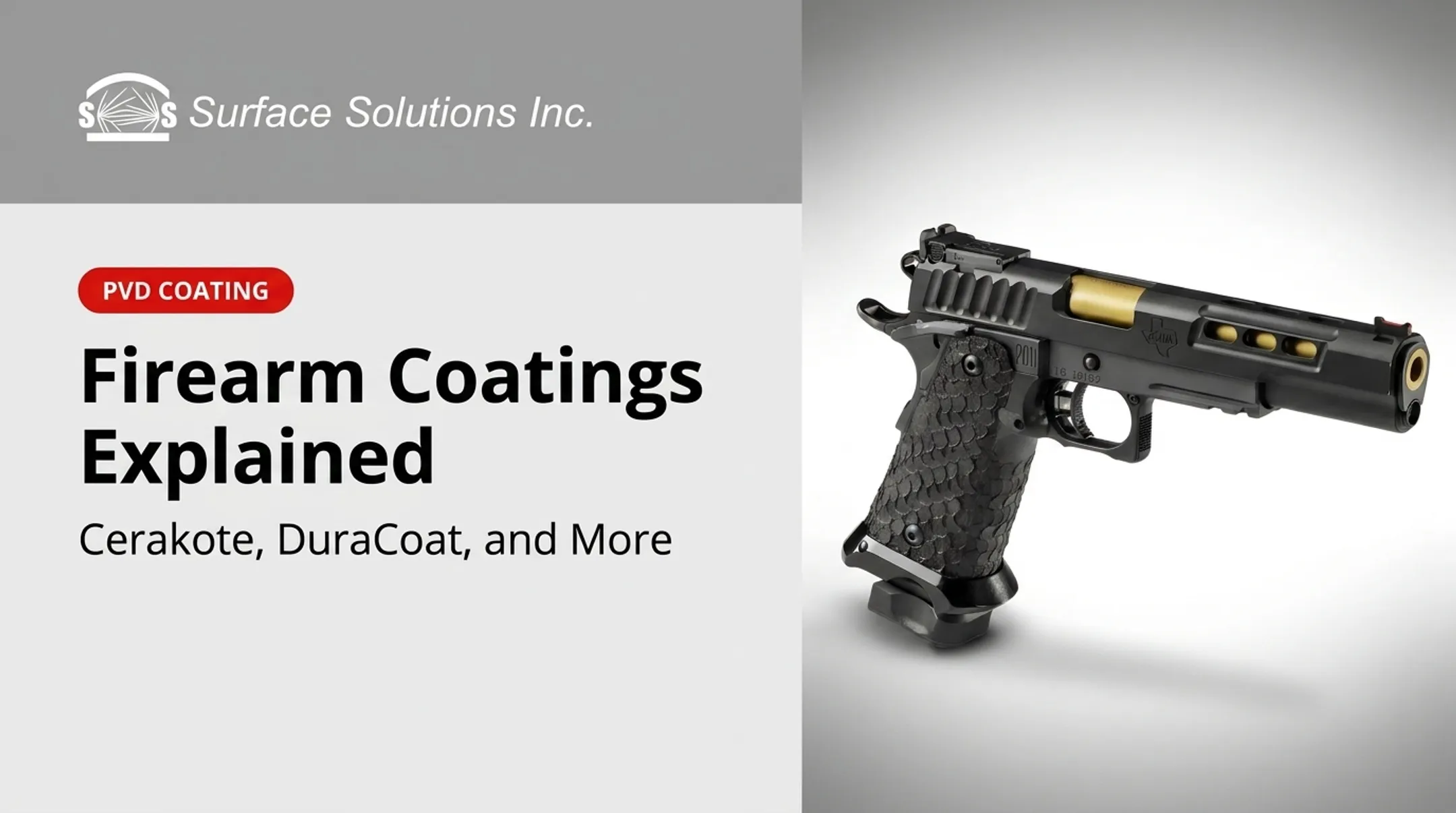
Cerakote is a ceramic-polymer composite coating applied as a thin film to metal, polymer, and composite surfaces. It's the most corrosion-resistant finish in common civilian use, and the data backs that up: Cerakote's H-Series achieves over 2,500 hours under ASTM B117 salt spray testing and a 9H pencil hardness rating under ASTM D3363.
For external components — slides, frames, barrels — Cerakote delivers:
- Superior resistance to sweat, salt spray, and chemical exposure
- Wide color customization options
- Compatibility with steel, aluminum, polymer, and composite surfaces
- Minimal ongoing maintenance compared to bluing or Parkerizing

Components that regularly exceed 500°F may require Cerakote's high-temperature formulations. For most civilian applications, standard H-Series handles the job. Professional application runs approximately $325–$400 for a complete firearm.
Nickel Boron (NiB)
Nickel boron is an electroless plating process — parts are submerged in a liquid bath, and the coating deposits uniformly across all surfaces including recesses and internal geometry. The result is a hard, silver-toned finish with standout lubricity.
UCT's EXO NiB formulation (used by manufacturers like FailZero on bolt carrier groups) reports hardness exceeding 1,300 Knoop — equivalent to HRC 82 or better — and a coefficient of friction of 0.08 to 0.2 depending on surface conditions. That low friction is what makes NiB particularly valuable for internal components: bolt carrier groups, trigger assemblies, and other parts where metal slides against metal repeatedly under heat and stress.
NiB still benefits from periodic light lubrication, but cleaning is noticeably easier because carbon and fouling don't bond as aggressively to the hard, smooth surface.
Black Nitride (Ferritic Nitrocarburizing / Melonite / QPQ)
Black nitride isn't a coating at all — it's a surface transformation. Nitrogen, carbon, and trace oxygen are diffused into the steel at the molecular level through a thermochemical process, creating a compound layer and diffusion zone that's integral to the metal rather than sitting on top of it.
For manufacturers, that distinction matters:
- Cannot peel, chip, or delaminate — no deposited layer to separate
- Preserves dimensional tolerances — the diffusion layer is extremely thin
- Achieves surface hardness of 600–1,200 HV (per HEF's firearm documentation), with certain post-treated variants reaching up to 1,000 hours under ASTM B117
- Well-suited for bores, barrels, and internal components — Ruger specifies black nitride barrels for accuracy, longevity, and easier maintenance
The limitation: black nitride is a steel-specific process and doesn't apply to aluminum or non-ferrous components.
PVD Coatings (Physical Vapor Deposition)
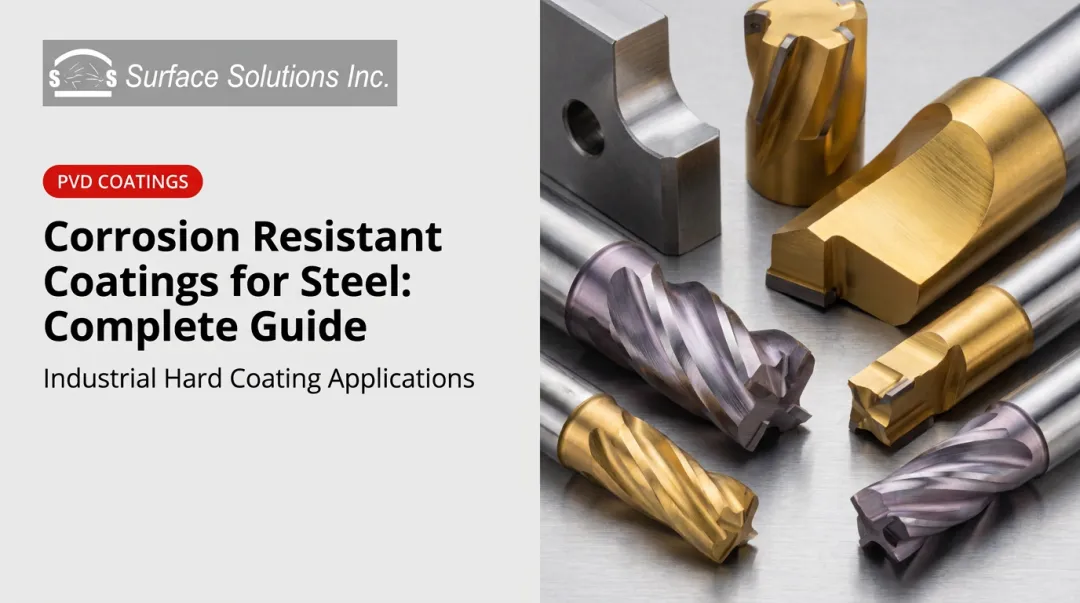
PVD coatings are vacuum-deposited thin films that bond to the surface at an atomic level. The two most common firearm-relevant chemistries — chromium nitride (CrN) and titanium nitride (TiN) — deliver exceptional hardness with minimal added thickness:
| PVD Chemistry | Hardness | Thickness | Max Service Temp |
|---|---|---|---|
| CrN (Ionbond 30) | 2,300 HV | 2–6 µm | 700°C |
| TiN (Ionbond 01) | 2,800 HV | 2–4 µm | 500°C |

That 2–6 micron thickness means PVD coatings don't meaningfully alter part dimensions — critical for barrels and slides where tolerances matter. Jarvis Inc. applies CrN and TiN PVD to custom pistol barrels for exactly this reason.
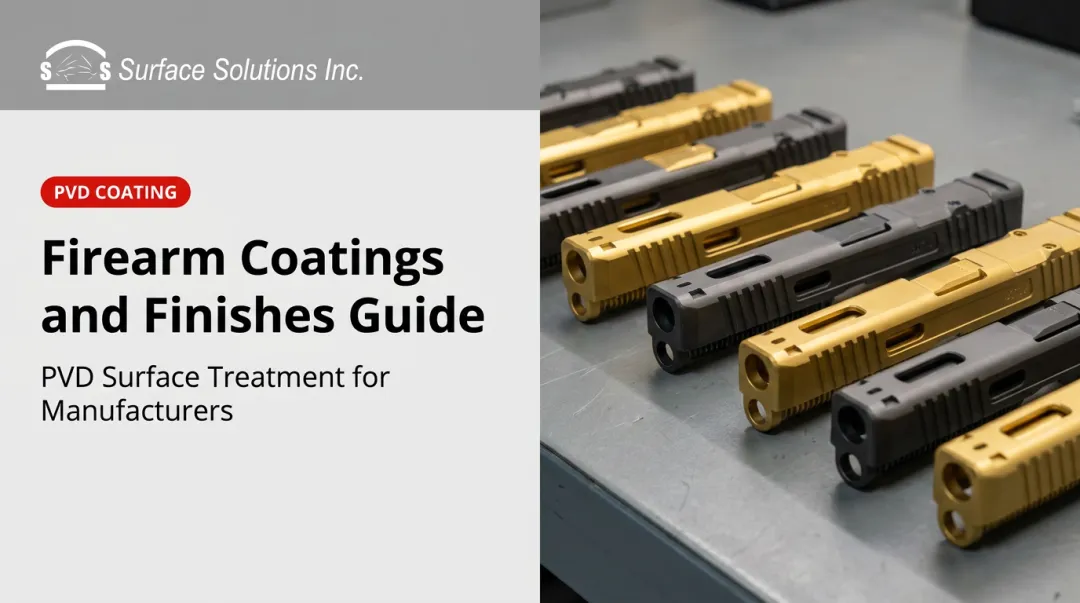
Surface Solutions (operating as Tincoat, based in Fridley, Minnesota) applies TiN, CrN, AlTiN, TiCN, and their proprietary Alpha™ coating to firearm components including barrels, slides, and receivers. Coatings are applied at 0.0001″–0.0002″ thickness — thin enough to preserve fit and function while delivering genuine wear and corrosion protection.
Surface Solutions serves firearm manufacturers and commercial customers (not individual consumers) across the US, Canada, and Mexico. Contact them at 763-785-9436 or info@tincoat.net to discuss batch coating requirements.
A note for firearm manufacturers: PVD deposition occurs at 700°–800°F. Components with heat treatments tempered below that range should be evaluated before submission, as the process temperature could affect hardness. Aluminum and zinc alloys cannot be coated.
Other Methods to Protect Your Gun from Corrosion
The best coating in the world doesn't replace smart storage and consistent cleaning habits. These non-coating practices are what keep a well-coated firearm in good condition between professional services.
Storage Environment
The National Firearms Museum recommends approximately 50% relative humidity for mixed metal-and-wood firearms. Too high and metal corrodes; too low and stocks crack.
Use a dehumidifier or silica gel desiccant packs in sealed storage — and monitor actual humidity rather than assuming the desiccant is handling it.
Post-Use Cleaning
Beretta's owner documentation is direct: clean and oil after each use, without exception. Disassemble, clean with an appropriate solvent, dry thoroughly, and apply a light coat of corrosion-inhibiting oil to all metal surfaces. Burned powder residue, sweat, and debris trap moisture against steel — leaving them in place accelerates corrosion.
Environmental precautions:
- Dry the firearm immediately if it gets wet — don't let moisture sit
- Avoid prolonged storage in leather, canvas, or fabric cases (Beretta specifically warns against this for long-term storage)
- For coastal or wet-environment firearms, a CLP (cleaner-lubricant-preservative) product meeting MIL-PRF-63460G standards provides a supplemental moisture barrier
- Fingerprints contain salt and acid — wipe exterior surfaces after handling
How to Tell If Your Gun Is Developing Corrosion
Catching corrosion early is the difference between a cleaning session and a gunsmith visit.
Visible indicators:
- Reddish-brown spots on exterior surfaces — even small ones
- Orange or black discoloration in crevices, around screws, or at the muzzle crown
- Dark pitting visible in the bore when inspected with a light
- Flaking, bubbling, or breakthrough in existing coatings
The NRA Museums' guidance notes that rust can transfer to a white cotton glove before it's clearly visible to the naked eye — a useful test for early detection on blued or Parkerized surfaces.
Functional warning signs:
- Increased resistance when cycling the slide
- Gritty or stiff trigger movement that wasn't there before
- Difficulty seating or ejecting magazines
- Unusual friction between any moving parts
What happens without intervention:
Surface rust that's caught early can be addressed with cleaning and re-oiling. Left alone, it converts to pitting — permanent material loss that no finish can reverse. Pitting in the bore reduces accuracy; pitting in load-bearing components affects structural integrity.
If any of the above signs appear, inspect thoroughly before the next use and consider professional evaluation if pitting is present. PVD and other coatings require clean, oxide-free surfaces — existing corrosion must be fully removed before recoating, or the new finish won't bond properly.
Gun Corrosion Protection Schedule
Maintenance frequency should reflect actual use patterns and environment. A daily-carry gun in a humid climate needs weekly attention; a rarely used firearm stored in a climate-controlled safe can go longer between inspections.
| Interval | Action |
|---|---|
| After each use | Wipe exterior surfaces, clean bore, apply light oil to all metal |
| Weekly (daily carry or frequent use) | Full disassembly clean, inspect for early rust or wear, reapply CLP |
| Monthly (stored/inactive firearms) | Inspect and re-oil all metal surfaces; USMC ordnance procedures require cleaning every 30 days for inactive weapons |
| Quarterly | Check coating condition, inspect storage humidity, replace desiccant if needed |
| Annually or condition-based | Professional touch-up or recoating may be needed for blued or Parkerized firearms in high-humidity environments; harder coatings like PVD and Cerakote typically extend this interval considerably |

No fixed recoating interval applies universally — renewal is condition-based. Inspect for rust breakthrough, finish loss, or wear that exposes bare metal, and when any of those signs appear, strip, treat, and recoat before rust spreads beneath the finish.
Conclusion
Corrosion protection is a system, not a single decision. The right coating for the firearm's material and environment forms the foundation, but it only works alongside regular cleaning, humidity-controlled storage, and early detection habits. A firearm that was Cerakoted five years ago and never cleaned since has a different finish — it isn't actually protected.
The most important step — whether you're maintaining a blued collector's piece, running a field rifle with a black nitride barrel, or coating firearm components at scale through a provider like Surface Solutions — is acting before corrosion progresses. Once pitting sets in, your options shrink considerably.
Frequently Asked Questions
What are the best protective coatings to prevent gun corrosion?
Cerakote, black nitride (ferritic nitrocarburizing), nickel boron, and PVD coatings (CrN, TiN) are the top-performing modern options. Cerakote suits external components best; black nitride excels for bores and barrels; NiB works well on internal BCG and trigger components; PVD is the strongest choice for precision parts where dimensional tolerances matter.
How often should I oil my gun to prevent rust?
Firearms in regular use should be cleaned and lightly oiled after each session. Stored firearms should be inspected and re-oiled monthly, with more frequent attention needed in humid or coastal environments where moisture accumulates quickly even on well-coated surfaces.
Is Cerakote better than bluing for corrosion resistance?
Yes, significantly. Cerakote H-Series exceeds 2,500 hours in ASTM B117 salt spray testing. Bluing requires frequent oiling to provide any meaningful corrosion resistance and performs poorly in humid or wet conditions. Cerakote is the preferred choice for firearms exposed to moisture, sweat, or regular outdoor use.
Can I apply gun coatings at home, or do I need a professional?
Cold bluing touch-ups and certain spray-on finishes can be DIY-applied with proper surface preparation. Cerakote, nickel boron, black nitride, and PVD coatings all require professional equipment and controlled environments — attempting them without proper facilities produces inconsistent results and poor adhesion.
What is the most durable gun coating for humid or coastal environments?
Cerakote, black nitride/QPQ, and PVD coatings (CrN or TiN) perform best in high-humidity and saltwater environments. All three resist moisture-driven corrosion more aggressively than bluing or Parkerizing and require far less maintenance to stay effective.
Does a PVD coating eliminate the need for regular gun maintenance?
No. PVD coatings reduce corrosion risk and extend protection intervals, but regular cleaning to remove carbon buildup, sweat, and debris remains necessary. Fouling traps moisture even on coated surfaces, and clean internals preserve both function and coating integrity over time.