Introduction
Cobalt and carbide end mills are two of the most widely used high-performance cutting tool materials in CNC machining and manufacturing. While standard high-speed steel (HSS) tools serve basic applications, cobalt-enhanced HSS and solid carbide end mills deliver the heat resistance, hardness, and wear characteristics needed for demanding materials and production environments.
Choosing between these substrates directly affects your shop's productivity, tooling costs, and part quality. The wrong choice can lead to premature tool failure, excessive downtime for tool changes, poor surface finishes, and higher cost per part.
Understanding the mechanical and economic trade-offs helps you match substrate to application, rather than defaulting to the most expensive option or settling for underperformance. Base that decision on your specific workpiece, machine capability, and production volume, not generic recommendations. This guide compares how cobalt and carbide differ on performance, cost, and best-fit uses so you can pick the right tool for the job.
Key Takeaways
- M42 cobalt (8% Co) hits 67 HRC with better hot hardness than HSS for tough materials at moderate speeds
- Solid carbide offers 2–3× steel rigidity and runs 2–3× faster than HSS for higher productivity
- Cobalt costs 20–40% more than HSS; carbide costs 2–3× cobalt but pays back via speed and tool life
- Pick cobalt for moderate speeds, interrupted cuts, or tight budgets; pick carbide for high-speed CNC and hardened steels
Cobalt vs Carbide End Mills: Quick Comparison
Side-by-side, cobalt HSS and solid carbide differ most on cost, hardness, speed, and how they fail in the cut.
| Attribute | Cobalt HSS | Solid Carbide |
|---|---|---|
| Initial Tool Cost | Moderate: 20-40% more than standard HSS | Premium: 2-3× more expensive than cobalt |
| Material Hardness | M35: ~65 HRC; M42: ~67 HRC | 91.8-93.0 HRA or 1590-1800 HV30 |
| Heat Resistance | Excellent hot hardness; holds an edge at elevated temperatures | Superior heat resistance at high cutting speeds |
| Cutting Speed Capability | About 10% faster than standard HSS in severe conditions | 2-3× faster than standard HSS |
| Tool Life & Durability | Good wear resistance; tougher than carbide, less tough than standard HSS | Longest tool life and wear resistance; chips more easily in unstable setups |
| Rigidity | Standard steel stiffness | 2-3× higher elastic modulus than steel; less deflection |

What are Cobalt End Mills?
Cobalt end mills are high-speed steel (HSS) cutting tools alloyed with 5–8% cobalt to improve hot hardness and wear resistance. The two most common grades are M35 (5% cobalt, ~65 HRC) and M42 (8% cobalt, ~67 HRC). They sit between standard HSS and solid carbide: more heat-resistant and tougher than plain HSS, without the speed demands or cost of carbide.
Typical compositions look like this:
| Element | M35 | M42 |
|---|---|---|
| Carbon | 0.93% | 1.08% |
| Chromium | 4.2% | 3.8% |
| Molybdenum | 5.0% | 9.4% |
| Tungsten | 6.4% | 1.5% |
| Cobalt | 4.8% | 8.0% |
| Vanadium | 1.8% | 1.2% |
Cobalt raises red hardness (the ability to hold cutting hardness at elevated temperatures). That makes these grades a fit for materials that throw a lot of heat during machining.
Core benefits of cobalt end mills include:
- Hot hardness above standard HSS, so edges hold up at higher cutting temperatures
- Longer wear life in abrasive materials versus plain HSS
- Stronger edge retention in stainless steel and titanium
- More toughness than carbide in interrupted cuts or less-rigid setups
- Shock resistance suited to manual mills and older machines that vibrate

Use Cases of Cobalt End Mills
Cobalt end mills fit shops where spindle speed is limited (typically 8,000–15,000 RPM). They also work when setup rigidity cannot handle carbide’s cutting forces, or when solid carbide is simply too expensive. For many teams, they are a practical step up from standard HSS once heat or abrasion starts killing tools early.
Primary industries and applications include:
- Stainless steel machining (300-series and 400-series grades)
- Titanium alloy cutting in aerospace and medical device manufacturing
- Cast iron milling in automotive and heavy equipment production
- Tool and die work on hardened steels up to about 45 HRC
- Manual mills and older CNCs that lack the speed or rigidity for carbide
Published head-to-head tool-life numbers for cobalt versus HSS are thin. If you are evaluating a switch, benchmark in-house: parts per tool, resharpening intervals, and cost per part.
What are Carbide End Mills?
Solid carbide end mills are cutting tools made from tungsten carbide (WC) particles bonded with a metallic cobalt binder. The tungsten carbide provides extreme hardness, while the cobalt binder holds the structure together and adds toughness.
That mix delivers hardness of 91.8–93.0 HRA (Rockwell A) or 1590–1800 HV30 (Vickers)—far above cobalt HSS.
Those properties make carbide the preferred choice for high-speed CNC work, hardened materials, and tight-tolerance jobs. Its elastic modulus is 2–3× that of steel, so the tool deflects less under load and holds dimensional accuracy and surface finish. The tradeoff is brittleness: carbide chips more easily from vibration, runout, or impact than cobalt HSS.
Core benefits of solid carbide end mills:
- Highest cutting speeds and longest tool life in demanding applications
- Exceptional wear resistance in abrasive materials and hardened steels (45-68 HRC)
- 2–3× steel's rigidity cuts deflection for better accuracy and finish
- Maintains sharp cutting edge at high temperatures, supporting aggressive metal removal rates
- Can be enhanced with PVD coatings (TiN, TiCN, AlTiN, CrN) to further extend performance

Key variations include:
- Uncoated carbide: Base substrate for general-purpose milling
- TiN-coated: Gold-colored coating offering improved lubricity and wear resistance
- TiCN-coated: Harder than TiN, suitable for more demanding applications
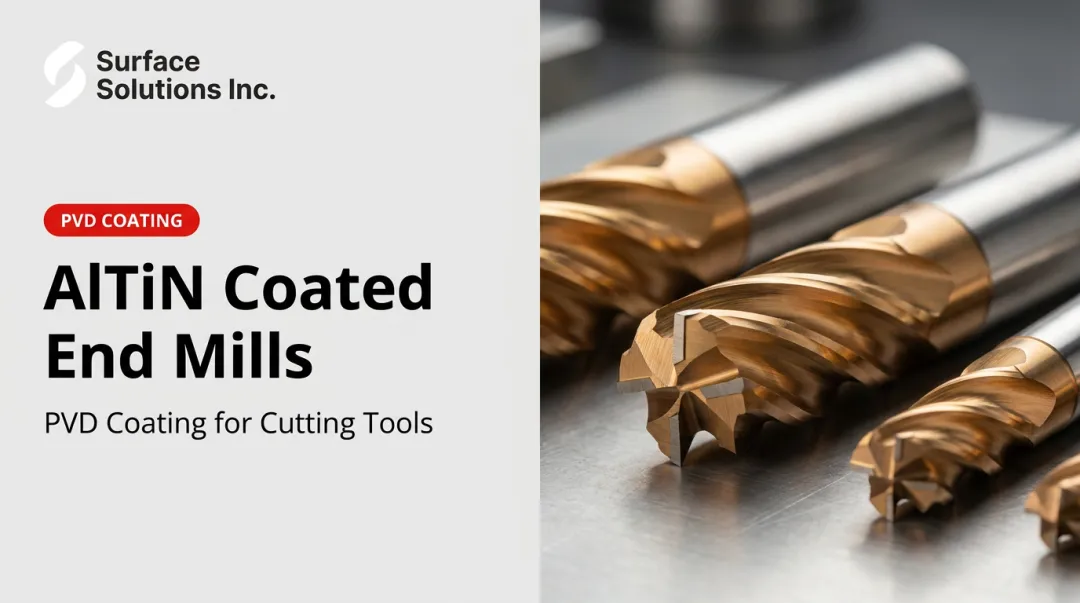
- AlTiN-coated: High heat resistance (up to 1470–1650°F / 800–900°C) for high-speed work on stainless and hardened steels
- CrN-coated: Corrosion-resistant coating for wet environments and stainless steel
Use Cases of Carbide End Mills
Carbide end mills fit high-production CNC shops where shorter cycle times justify the higher tool cost. They need spindles and setups rigid enough for 15,000+ RPM, plus jobs that demand tight tolerances or a fine surface finish. That profile makes them the default in aerospace, medical device, and mold-making work.
Dominant industries and materials:
- Hardened steels (45-68 HRC) in die and mold applications
- High-temperature alloys (Inconel, Hastelloy) in aerospace and energy sectors
- Cast iron in automotive and heavy equipment
- Non-ferrous metals (copper, brass, bronze)
- Abrasive materials including composites and glass-filled polymers
- Medical device manufacturing requiring biocompatible finishes
Documented hard-milling work shows carbide end mills cutting hardened steel at 54–70 HRC. Separate high-RPM case studies report 6–10× cycle-time cuts when shops move from 8,000 or 16,000 RPM spindles to true high-speed spindles. That gain tracks spindle capability as much as substrate.
Carbide’s speed advantage only shows up when the machine, holder, and setup are rigid enough to avoid chatter.
Cobalt vs Carbide: Which is Better?
Neither cobalt nor carbide is universally "better." The right choice depends on workpiece material hardness, machine spindle speed and rigidity, production volume, budget, required surface finish, and whether your setup can support high-speed cutting without vibration.
Machine Capability Considerations
Cobalt works well on:
- Older or less rigid machines with moderate spindle speeds (8,000-15,000 RPM)
- Manual mills and turret mills lacking high-speed capability
- Machines prone to vibration or with significant tool overhang
- Setups where toughness and shock resistance matter more than maximum speed
Carbide requires:
- Rigid, high-speed CNC machines (15,000+ RPM) to deliver speed benefits
- Low runout and stable toolholders to prevent chipping
- Minimal tool overhang to reduce deflection and chatter
- Consistent cutting parameters and controlled engagement
A modern CNC with 15,000+ RPM can use carbide's 2-3× speed advantage over standard HSS. If your machine cannot hold those speeds without chatter, or cannot control runout, carbide's brittleness becomes a liability.
In those cases, cobalt's toughness delivers better results at a lower cost.
Material-Specific Recommendations
Choose cobalt for:
- Stainless steel (300-series, 400-series) at moderate cutting parameters
- Tool steels up to about 45 HRC
- Titanium alloys when spindle speed is limited
- Cast iron when machine rigidity is marginal
- Interrupted cuts where shock resistance matters
Choose carbide for:
- Hardened steels above 45 HRC (up to 68 HRC documented)
- High-temperature alloys (Inconel, Hastelloy, other nickel-based superalloys)
- Maximum metal removal rates in production
- Tight-tolerance work that needs minimal deflection
- Superior surface finish requirements
Specific cutting speeds depend on workpiece grade, tool diameter, engagement, coolant, and coating. Calculate RPM with:
RPM = (12 × SFM) ÷ (π × diameter in inches)
Then verify that your machine can hit that RPM without vibration.
Cost-Per-Part Analysis
Machine and material fit decide what can run. Cost per part decides what should run. Purchase price is only one piece of tooling cost:
Cost per part = (Tool cost ÷ Tool life in parts) + (Change cost per cycle ÷ Parts per cycle) + (Machine rate × Cycle time) + Expected scrap cost
Variables:
- Tool cost: purchase price of the end mill
- Tool life in parts: parts produced before replacement or resharpening
- Change cost: labor rate × tool-change time (stop, swap, offsets, restart, inspection)
- Parts per cycle: parts between tool changes
- Machine rate: hourly cost to run the CNC
- Cycle time: time to machine one part
Example: a $50 carbide end mill makes 500 parts; a $20 cobalt end mill makes 200. Machine rate is $75/hour. Carbide cycle time is 3 minutes (0.05 hr); cobalt is 4 minutes (0.067 hr). A 5-minute tool change adds $6.25 in labor.
Carbide cost per part:
- Tool cost: $50 ÷ 500 = $0.10
- Change cost: $6.25 ÷ 500 = $0.0125
- Machine time: $75 × 0.05 = $3.75
- Total: $3.86 per part
Cobalt cost per part:
- Tool cost: $20 ÷ 200 = $0.10
- Change cost: $6.25 ÷ 200 = $0.0313
- Machine time: $75 × 0.067 = $5.03
- Total: $5.16 per part
Here, carbide's higher sticker price pays off through faster cycles and longer life. If the machine cannot run carbide at full speed—or cobalt lasts longer than assumed—the math flips.

Situational Decision Guide
Use cobalt when RPM tops out around 8,000-15,000, the setup is unstable (interrupted cuts, vibration, long overhang), or you need a lower upfront tool cost and can accept slower cycles. It is also the practical step up from standard HSS without replacing the machine.
Use carbide when the machine holds 15,000+ RPM with low runout, you need maximum throughput, or the job is hardened steel (45+ HRC), high-temperature alloy, tight tolerance, or fine surface finish. High production volume is what usually justifies the higher tool cost.
PVD coatings on either substrate
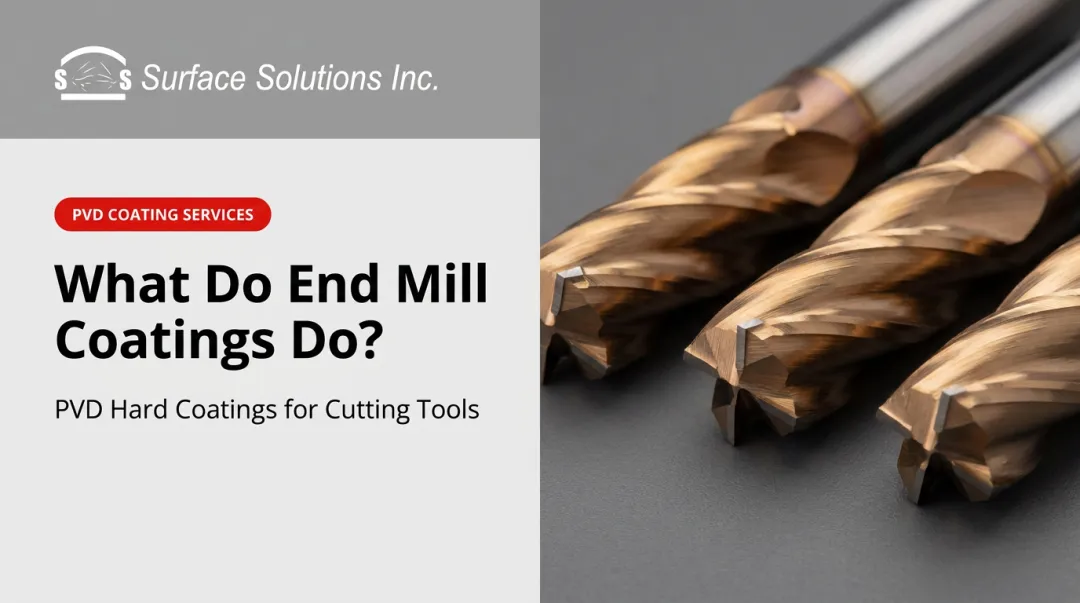
TiN, TiCN, AlTiN, and CrN coatings cut friction, raise heat resistance, and extend life on both cobalt and carbide. Longer life feeds directly into the cost-per-part formula above by spreading tool cost across more parts and fewer changeovers.
Surface Solutions applies PVD coatings to customer-supplied end mills (0.0001-0.0002 inches thick at 700-800°F deposition). For shops already choosing between cobalt and carbide, coating is often the lever that improves tool life without changing the base substrate.
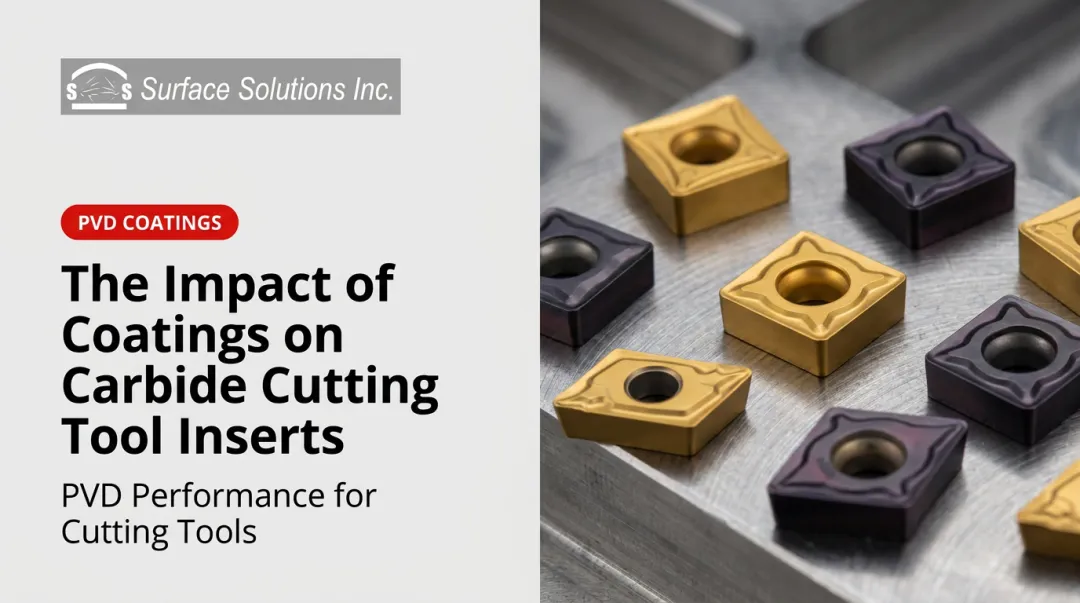
Real-World Case Study: PVD Coating Extends Carbide Insert Performance in Stainless Steel
A manufacturer machining 304 stainless steel with three-corner carbide inserts faced frequent tool changes, inconsistent surface finish, and rising tooling costs. Uncoated carbide inserts were wearing quickly, forcing production interruptions and secondary finishing operations. The shop needed a solution that would extend tool life without slowing cutting speeds or requiring new equipment.
The Decision: AlTiN PVD Coating
After evaluating coating options, the shop selected AlTiN (Aluminum Titanium Nitride) PVD coating. AlTiN offers hardness of 4,000-4,200 Hv, oxidation resistance up to 800-900°C, and a coating thickness of 0.0001-0.0002 inches. That profile suits the high-temperature, high-friction environment of stainless steel machining.
Surface Solutions applied AlTiN coating to the carbide inserts at a cost of $2.50-$4.00 per tool, depending on insert size. The coating process took place at 700-800°F, adding a thin, wear-resistant layer without altering tool geometry or requiring process changes.
Quantifiable Results
Results at the same speeds and feeds:
- AlTiN-coated inserts produced 6× more parts than TiN-coated inserts
- Alpha™-coated inserts (another PVD formulation) delivered 2× the life of TiN; AlTiN delivered 3× the life of Alpha™
- Surface finish improved versus Alpha™ or TiN, cutting or eliminating secondary finishing
- Speeds, feeds, and machine setup stayed the same; only the coating changed
ROI calculation:
At $4.00 per insert and 6× the life of the prior tools, coating cost was offset by fewer insert purchases and less downtime. The shop also cut labor previously spent swapping tools and running secondary finishing.
Practical Takeaway

If your shop faces short tool life, excessive heat, or poor surface finish when milling stainless steel, hardened steel, or other demanding materials, PVD coating can extend end mill performance without requiring new machines or process redesign. Coatings work on both cobalt HSS and solid carbide substrates, offering a cost-effective way to improve productivity.
If short tool life or excess heat is limiting your end mill work, contact Surface Solutions at 763-785-9436 or info@tincoat.net to discuss how AlTiN or CrN PVD coatings can extend tool life and lower total tooling cost.
Conclusion
Cobalt and carbide end mills each serve distinct roles in manufacturing. Cobalt is an economical upgrade for shops with moderate spindle speeds, tighter budgets, or work that needs toughness over raw speed. Carbide delivers higher productivity, longer tool life, and a better surface finish—but only when your machine has the rigidity and RPM to support it.
Substrate choice shows up in cost per part, cycle time, and finished quality. Skip defaulting to the priciest option—or settling for underperformance—and match the material to your setup:
- Workpiece material and toughness needs
- Machine rigidity and available spindle speed
- Production volume and cost-per-part targets
PVD coatings can enhance either substrate, so you can extend tool life and tune performance without changing your base material strategy.
Frequently Asked Questions
What are the key differences between cobalt and carbide end mills?
Cobalt end mills are HSS tools with 5-8% cobalt, reaching about 65-67 HRC for better hot hardness. Carbide uses tungsten carbide particles in a cobalt binder, hits 91.8-93.0 HRA, and can run 2-3× faster than standard HSS—at a higher cost, with longer life in high-speed work.
Which is better, cobalt (HSS) end mills or carbide end mills?
"Better" depends on the job. Choose carbide for high-speed CNC, hardened stock (45+ HRC), and machines that can hold 15,000+ RPM. Choose cobalt when spindle speed stays around 8,000-15,000 RPM, you need toughness for interrupted cuts or unstable setups, or you want a lower upfront cost.
How to tell if an end mill is carbide?
Carbide end mills are noticeably heavier than HSS or cobalt due to higher material density (14.2 g/cm³ for carbide vs. ~8 g/cm³ for M42 cobalt). They also appear darker gray in color. The most reliable identification method is traceable marking, certificate, or laboratory composition testing; visual appearance alone can be misleading, especially on coated tools.
Can you use carbide end mills on manual milling machines?
Possible, but often not ideal. Manual mills usually lack the 15,000+ RPM and rigidity carbide needs, so low-speed runs waste its advantage and vibration raises chipping risk. Cobalt is typically the better match for manual machines at moderate speeds.
How much faster can carbide end mills cut compared to cobalt?
Carbide end mills can run at cutting speeds 2-3× faster than standard HSS. However, this comparison is to standard HSS, not cobalt. Cobalt can run approximately 10% faster than standard HSS under severe cutting conditions. The exact speed advantage depends on workpiece material, tool diameter, engagement, coolant, and whether your machine can achieve the required RPM without chatter.
Do PVD coatings work on both cobalt and carbide end mills?
Yes. PVD coatings such as TiN, TiCN, AlTiN, and CrN work on both cobalt HSS and solid carbide. They cut friction, improve heat resistance, and extend tool life on either substrate—often by a large margin in demanding materials like stainless.