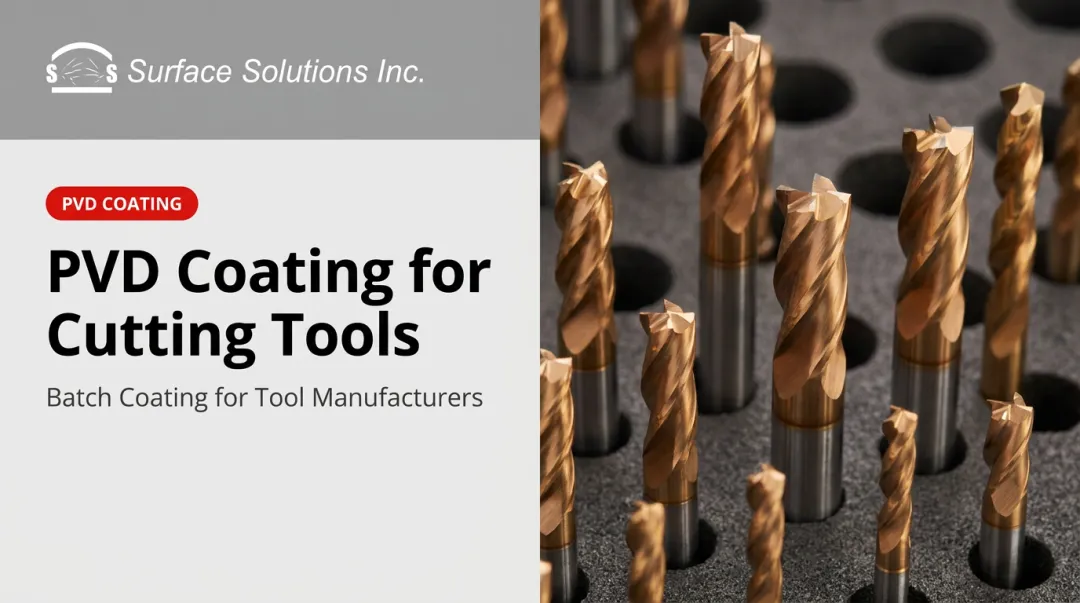
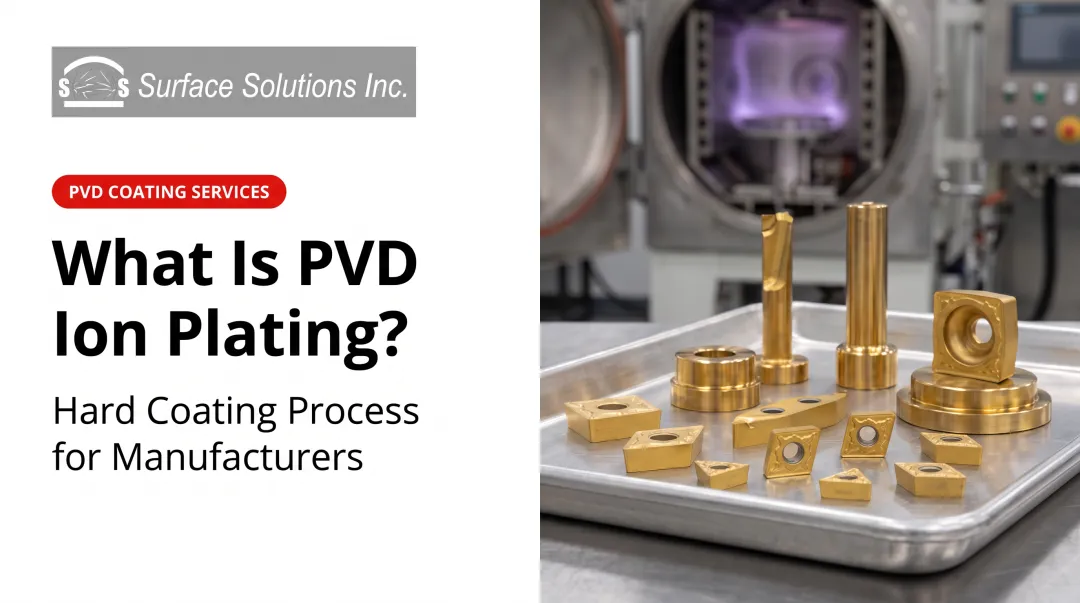
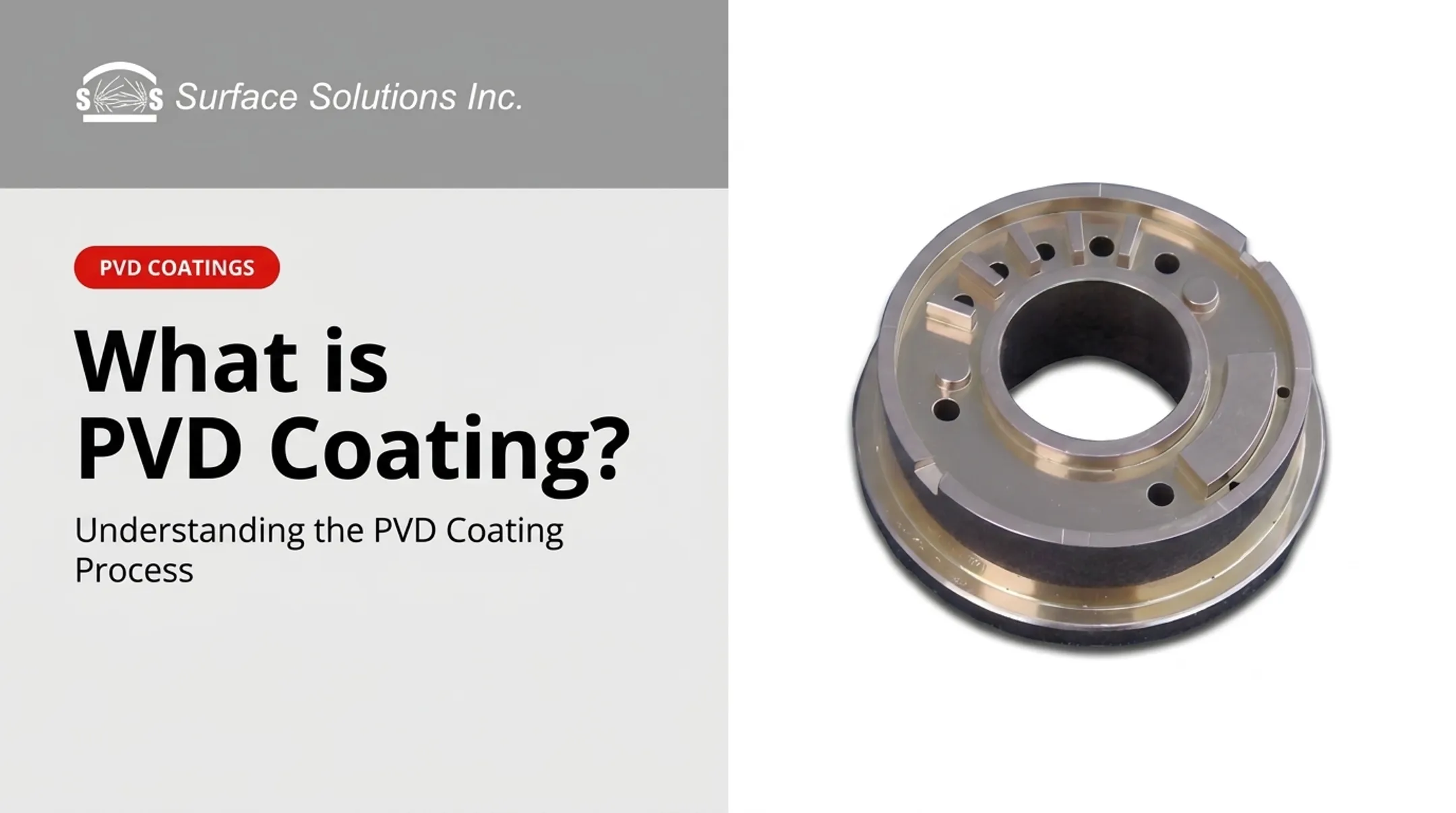
You've probably also seen PVD mentioned in jewelry and watch marketing. Consumer PVD is real, but it's a different animal. This guide focuses on industrial PVD: the process, the coating types, and the real benefits for tooling and manufacturing operations.
We'll walk through how the process works, break down the major coating types (TiN, CrN, AlTiN, TiCN, and proprietary options like Alpha™), and cover where PVD delivers the most value on the shop floor.
Key Takeaways
- PVD bonds an ultra-thin, durable film to metal parts using a vacuum-based vaporization process
- Coating types like TiN, CrN, AlTiN, and Alpha™ each solve different wear, heat, or build-up problems
- Tool life multiplies several times over with PVD, reducing sharpening frequency and downtime
- Unlike traditional plating, the process skips chemical baths and hazardous byproducts
What Is PVD Coating?
PVD stands for Physical Vapor Deposition — a vacuum coating process that turns a solid target material into vapor, then deposits it onto a part's surface as an ultra-thin, hard film. The film bonds at an atomic level, unlike electroplating.
PVD vs. electroplating:
- Electroplating uses a chemical bath and electrical current to deposit metal ions onto a surface
- PVD uses vaporization and ionization inside a vacuum chamber, with no wet chemistry involved
- PVD films bond more tightly to the substrate, which is why they last longer under mechanical stress
Industrial PVD is used on cutting tools, forming dies, stamping punches, and medical instruments. The same core process coats consumer goods like watches and jewelry, though target materials and performance requirements differ.
Common industrial target materials include:
- TiN (Titanium Nitride) — general-purpose wear resistance
- CrN (Chromium Nitride) — corrosion resistance, often used where moisture or food contact matters
- AlTiN (Aluminum Titanium Nitride) — higher heat tolerance for abrasive, high-speed cutting
- TiCN (Titanium Carbo-Nitride) — added hardness for abrasive materials
- Alpha™ — a proprietary formulation from Surface Solutions built for stamping and punching applications
That focus on wear and heat is also why PVD gets compared with other surface treatments.
Is PVD Coating Better Than Gold Plating?
They're built for different jobs. Gold plating (specified under standards like ASTM B488) is chosen for corrosion resistance, tarnish prevention, and electrical conductivity — not wear resistance. Hard PVD coatings like TiN or AlTiN are engineered specifically for friction, heat, and edge retention under mechanical load.
For a tool that needs to survive thousands of punching or cutting cycles, PVD is the better fit. Gold plating simply isn't designed for that kind of abrasive, high-cycle environment.
How Does the PVD Coating Process Work?
The industrial PVD process follows a consistent sequence, regardless of which coating material is used.
- Clean and prepare the substrate. Parts must be free of oils, oxides, and other contaminants. Surface finishing should happen before coating. PVD will not smooth rough surfaces or hide defects, since the film itself is only microns thick.
- Load parts into a vacuum chamber. An inert gas, typically argon, supports ionization inside the low-pressure chamber needed for vaporization.
- Vaporize the target material. Using sputtering or cathodic arc methods, the target (titanium, chromium, or similar) is converted to vapor and ionized into a plasma.
- Deposit the film. Ionized atoms travel through the chamber and bond to the substrate surface, building a uniform, thin film layer by layer.
- Control thickness precisely. Coating typically runs 0.0001–0.0002 inches (about 2–5 microns), thin enough to hold tight tolerances on precision tools without affecting fit.

Surface Solutions applies its coatings at approximately 800°F, within its standard deposition range. That heat level supports hard, wear-resistant films while helping protect tool-steel substrates and finished dimensions.
Types of Industrial PVD Coatings and Their Uses
Different coatings solve different problems. Choosing the wrong one for the application usually means leaving performance on the table.
TiN (Titanium Nitride)
The standard, general-purpose coating. Good hardness, solid wear resistance, and a track record across cutting, drilling, and general tooling applications. It's often the baseline other coatings get compared against.
TiCN (Titanium Carbo-Nitride)
Harder and more wear-resistant than TiN. A strong fit for abrasive materials and higher-wear cutting where standard TiN wears out too quickly.
AlTiN (Aluminum Titanium Nitride)
Built for heat. AlTiN holds up under high cutting temperatures, which makes it a go-to for high-speed machining and jobs where thermal load limits tool life.
CrN (Chromium Nitride)
Built primarily for corrosion resistance, which makes it a common choice for medical devices, food-processing equipment, and any application exposed to moisture. Surface Solutions' CrN coating is engineered to run cooler in demanding forming applications than standard options. That cooler running matters in high-cycle stamping, where heat build-up shortens tool life.
Specialty and Proprietary Coatings (Alpha™)
Alpha™ is Surface Solutions' proprietary formulation, developed specifically to address problems standard coatings don't solve well. In one documented case, an Alpha-coated punch processing 0.057-inch galvanized steel showed almost no galvanized build-up, while a comparable TiN-coated punch accumulated significantly more. The same application also showed reduced punch chipping.
Choosing the Right Coating
Match the coating to the job:
- Cutting → TiN, TiCN, or AlTiN depending on material abrasiveness and heat
- Forming/drawing → CrN for cooler running, longer cycles
- Punching/stamping galvanized material → Alpha™ to minimize build-up and chipping

Key Benefits of PVD Coating for Manufacturing and Tooling
The case for PVD comes down to fewer interruptions and lower total cost per part, not just a harder surface.
One Surface Solutions customer using Alpha™-coated tooling ran a full order of 60,000 parts without sharpening, versus a normal interval of 10,000 parts — six times the production between sharpenings. AlTiN coatings more broadly are documented to deliver 2–7 times the tool life of uncoated tools, depending on the application.
That same 60,000-part run eliminated six separate sharpening operations. At roughly 8 hours per sharpening cycle (removing tools from the press, resharpening, reinstalling), that's 48 hours of labor saved on a single order.

Longer intervals between maintenance also show up in day-to-day running conditions. Coated tools run smoother, which means:
- Less lubricant required during forming and cutting
- Cleaner parts and cleaner work areas
- Fewer lubricant-related quality issues downstream
Finish quality improves for the same reason. Alpha™ and CrN coatings in particular were engineered to address specific tooling headaches:
- Alpha™ nearly eliminates galvanized build-up on punches compared to TiN
- Reduced chipping extends punch life between maintenance cycles
- Smoother output reduces secondary finishing work
There is an environmental upside as well. PVD skips the chemical bath entirely. Traditional electroplating processes generate wastewater containing metals and, in some cases, cyanide — regulated under EPA effluent guidelines. PVD's vacuum-based approach avoids that wastewater stream, giving shops a cleaner alternative to wet-chemical plating.
Industries and Applications That Benefit from PVD Coating
PVD coating is used wherever tools face repetitive wear, heat, or corrosion:
- Metal forming and sheet metal punching — dies and punches that need to survive high-volume runs
- Drawing applications — where friction and heat management directly affect cycle life
- Medical device manufacturing — instruments needing corrosion resistance and biocompatibility
- Cutting tools — inserts, drills, and blades exposed to abrasive materials
- Firearm components — slides, barrels, and other parts needing wear and corrosion resistance

Tool resharpening services are a notable use case. Rather than replacing worn tooling, resharpening shops send sharpened tools out for PVD coating to extend service life. As Tony Deschenes of Special Tools, Inc. put it: "Nearly everything we resharpen gets sent out to Surface Solutions for coatings."
Surface Solutions provides PVD coating services to manufacturers across the United States, Canada, and Mexico, with turnaround times built around industrial production schedules.
Frequently Asked Questions
How much does PVD coating cost?
Cost depends on coating type, part size, and volume. Industrial pricing varies widely by application, so request a quote rather than relying on a general estimate.
How long does PVD coating last?
Industrial PVD coatings often multiply usable tool life several times over compared with uncoated tools. Results depend on the coating type and application.
Does PVD coating come off?
PVD is highly durable and resists wear far better than uncoated surfaces, but no coating lasts forever. Degradation can occur with extended use or incorrect application, so quality control during coating matters.
Can PVD coating be applied to stainless steel?
Yes. PVD adheres to stainless steel and a wide range of other metal substrates commonly used in tooling and manufacturing, though aluminum and zinc alloys fall outside the scope of most PVD services.
Is PVD coating worth it?
For manufacturing applications, the return comes from extended tool life, reduced downtime, and lower long-term maintenance costs. Documented cases show sharpening intervals stretching six times longer with the right coating.
Can you shower with PVD-coated jewelry?
Consumer PVD-coated jewelry is generally water-resistant and safe for everyday wear. This article focuses on industrial tooling applications rather than consumer products.