Pick the wrong one for your application and you're looking at premature part failure, higher maintenance costs, or paying for protection your parts don't even need. This article breaks down how each process works, what they cost, where they perform best, and how to choose with confidence.
Key Takeaways
- Process differs: PVD adds a hard vacuum-deposited layer; anodizing thickens the metal’s own oxide electrochemically.
- Hardness gap is large: TiCN and TiAlN reach 3,200–3,400 HV, well above Type II decorative anodize.
- Substrate range splits cleanly: steel and carbide suit PVD; anodizing stays largely limited to aluminum and titanium.
- Higher per-part PVD cost often pays back through longer tool life and fewer resharpening cycles.
- Hybrid stacks work too: anodize for corrosion resistance, then add PVD for wear performance.
PVD Coating vs Anodizing: Quick Comparison
Cost
- PVD: Higher cost per part, driven by batch size, geometry, masking, and thickness. Longer tool life and fewer resharpening cycles often offset the premium.
- Anodizing: Lower cost per piece; best for high-volume, low-stress aluminum parts where wear resistance isn't the main concern.
Composition & Process
- PVD: Vaporizes solid metal or ceramic in a vacuum chamber and deposits a thin film (typically 0.0001"–0.0002" / 2–5 microns) onto the tool surface.
- Anodizing: An electrochemical process that converts and thickens the aluminum substrate's own native oxide layer rather than adding new material.
Hardness & Durability
Hardness is the clearest gap between the two. PVD coatings typically reach:
- TiN: roughly 2,200 HV
- CrN: roughly 2,000 HV
- TiCN: roughly 3,400 HV
- TiAlN: roughly 3,200 HV Type III (hard) anodize, by comparison, ranges from 250 to 400 HV depending on the aluminum alloy and class, per ISO 10074 minimums cited by Anoplate. Type II anodize is a conventional, decorative-grade coating and isn't marketed for hard-wear service at all. These aren't directly comparable tests (coating microhardness versus alloy class requirements), but the gap is wide enough to guide most tooling decisions.

Material Compatibility
- PVD: Works across steel, tool steels, carbide, and most conductive metals. At Surface Solutions, coatings apply to nearly every metal type except aluminum and zinc-containing alloys.
- Anodizing: Primarily limited to aluminum, with titanium anodizing requiring a separate, non-standard process.
Appearance & Finish
- PVD: Wide color range (gold, black, bronze, blue) in reflective or matte finishes. Parts must be polished beforehand if you want shine.
- Anodizing: Natural metallic tones with dyes soaked into the oxide layer, for a more muted, architectural look.
What is PVD Coating?
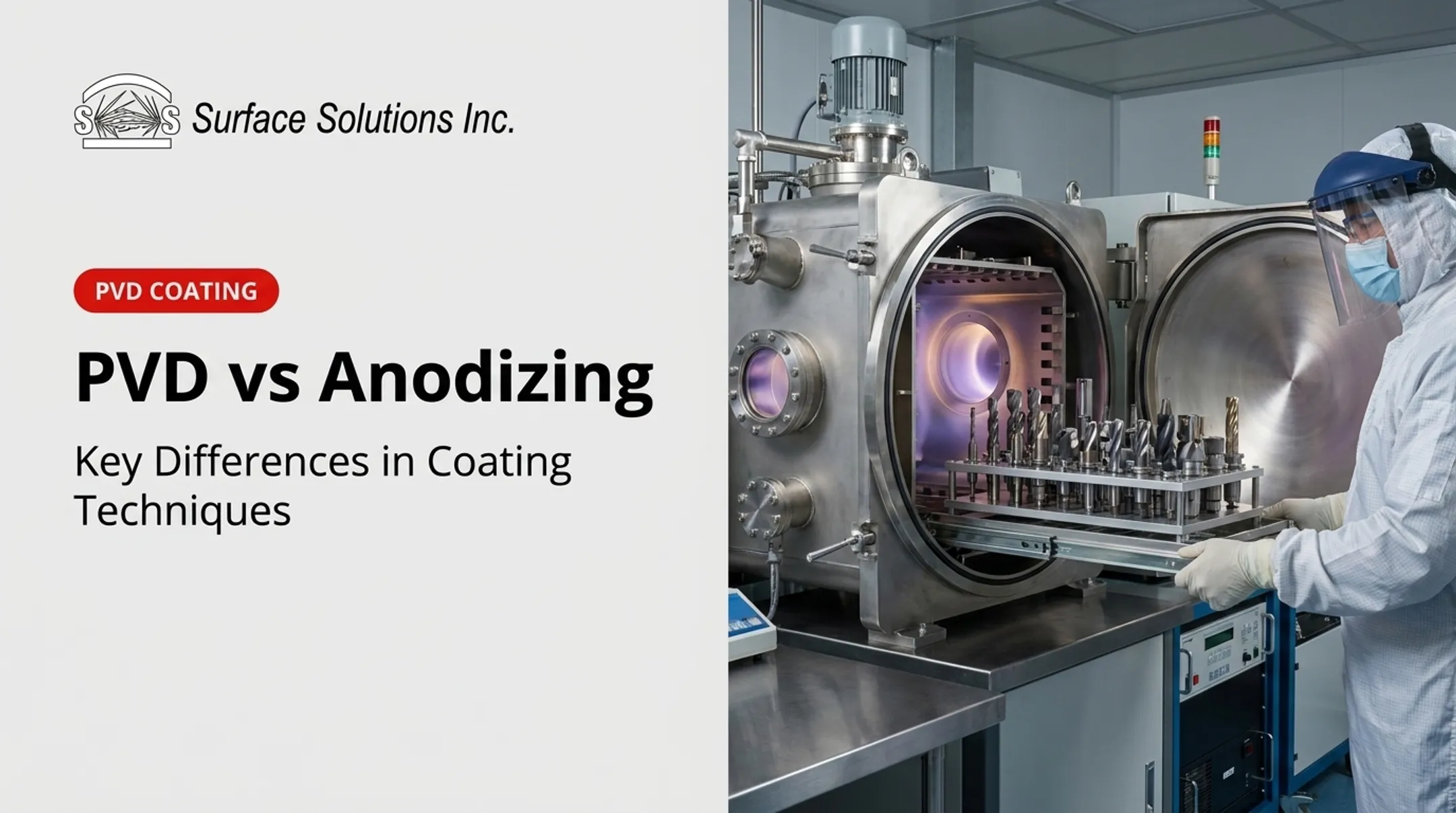
PVD (Physical Vapor Deposition) is a vacuum-based process. Solid coating material is vaporized, then deposited as a thin, dense film onto the tool or part surface. The result is a hard shell bonded to the substrate rather than a modification of the base metal.
Operational benefits include:
- Lower friction during cutting and forming
- Less lubricant needed in production
- Less galling and material build-up on punches and dies
- Longer intervals between resharpening or maintenance
Common PVD coating types target different wear challenges:
- TiN: Solid all-around hardness and wear resistance
- CrN: Strong corrosion resistance for medical and food-processing tools
- TiCN and AlTiN: Higher hardness for aggressive cutting
- Alpha™: Reduces galvanized build-up and extends sharpening intervals past standard coatings
Because PVD works across such a wide range of substrates — steel, carbide, hardened tool steels — it fits naturally into cutting tools, punches, dies, and molds without needing a substrate change.
Use Cases of PVD Coating
PVD typically gets applied to finished tools before they go back into service — punches, dies, and cutting inserts that have already been machined and hardened. It dominates in:
- Metal forming and sheet metal drawing
- Punching and stamping operations
- Cutting tool manufacturing
- Medical device tooling
One customer running M4 punches on 0.057-inch galvanized steel switched to Alpha™ PVD coating after uncoated D2 punches needed sharpening every three weeks.
The coated punches ran for over 15 months and produced an estimated 15 million parts with almost no galvanized build-up. TiN-coated punches in the same operation showed far more buildup.

What is Anodizing?
Anodizing is an electrochemical process. The metal (typically aluminum) is immersed in an acid electrolyte bath, and an applied current grows a durable oxide layer directly out of the base material.
Core benefits include:
- Improved corrosion resistance
- Better scratch resistance than bare aluminum
- Long-lasting color that's integrated into the oxide layer, not just applied on top
Type II and Type III anodizing differ in thickness and purpose:
- Type II: Conventional sulfuric-acid process for decorative and architectural finishes, typically 1.8-25.4 microns thick
- Type III (hard anodizing): Thicker ceramic-like layer at 12.7-115 microns, built for parts that need abrasion resistance rather than just a finish

Use Cases of Anodizing
Anodizing shows up most often in:
- Architectural aluminum framing and trim
- Consumer electronics housings
- Automotive trim components
- Lower-stress structural aerospace parts
It's a strong fit for high-volume production runs where the part needs consistent color and corrosion protection but isn't fighting constant abrasive contact. Think enclosures and trim, not cutting edges.
PVD Coating vs Anodizing: Which is Better?
Neither process wins across the board. The right call depends on:
- Expected wear and mechanical stress: is the part sliding, cutting, or just sitting in the weather?
- Substrate material: aluminum opens the door to anodizing; steel and carbide point toward PVD.
- Budget per part vs. total cost of ownership: lower unit cost isn't the same as lower lifetime cost.
- Production volume: high-volume aluminum runs often favor anodizing's economics.
- Desired finish: vibrant PVD colors versus anodizing's dyed, natural-metal look.
Choose PVD if you're maximizing tool life and wear resistance for cutting or forming applications.
Choose anodizing if you're working with aluminum components that need cost-effective corrosion protection and color options at scale.
Some manufacturers use both within the same assembly: anodizing on housings and trim, PVD on the wear components that actually see friction and impact.
Real-World Example: PVD Coating for Tooling Longevity
A high-volume stamping operation was running M4 punches and dies through 0.057-inch galvanized steel at one stroke per second, 8 to 16 hours a day. Under the old setup, tools needed sharpening every few weeks. Each cycle meant:
- 1 hour to remove the die
- 2 hours (best case) to separate, sharpen, and reassemble
- 1 hour to reinstall and get the press running again
That's four hours of press downtime per sharpening cycle — before counting scrap risk and lost output.
Shops facing that kind of cycle often move worn D2 components to M4 and add Alpha™ PVD coating. In a comparable high-volume run, Don Richardson's team reported 60,000 parts before resharpening, versus a typical 10,000: a 6x improvement. Skipping six sharpening cycles, at roughly 8 hours of labor each, saved 48 hours of labor on that single order alone.

On high-cycle tooling, that kind of life extension usually returns cost faster than anodizing, even when PVD costs more per part up front. If frequent resharpening is cutting into uptime, Surface Solutions can review your tooling and volume and recommend a fit.
Conclusion
Neither PVD coating nor anodizing is universally "better." The right choice depends on substrate, mechanical demands, budget, and volume.
Manufacturers fighting tool wear in cutting, forming, or punching should choose PVD coating. Shops running aluminum parts that mainly need corrosion resistance and color at scale will usually get what they need from anodizing.
Frequently Asked Questions
Can PVD coating be applied to aluminum?
Some providers can apply PVD to aluminum, but it is less common than coating steel or carbide. Surface Solutions excludes aluminum and zinc-containing alloys, so confirm substrate compatibility with your coating provider first.
Is PVD coating more durable than anodizing?
PVD offers higher hardness and wear resistance, making it the stronger choice for high-friction or high-wear applications. Anodizing still performs well for corrosion protection on aluminum parts.
How much does PVD coating cost compared to anodizing?
Anodizing is typically cheaper per piece. PVD carries a higher upfront cost but often lowers total cost of ownership by extending part life and reducing resharpening frequency.
Can anodizing and PVD coating be combined on the same part?
Yes, some manufacturers apply anodizing as a base treatment before or alongside PVD to get corrosion resistance and wear performance in one part.
Which process is better for cutting tools and dies?
PVD coating is preferred for cutting tools and dies. It offers superior hardness, reduces friction, and extends resharpening intervals compared to anodized or uncoated tooling.
Does PVD coating change the color of the part?
Yes. PVD offers finishes like gold, black, bronze, and blue, depending on the coating type. Anodizing colors come from dye absorbed into the oxide layer rather than the coating material itself.