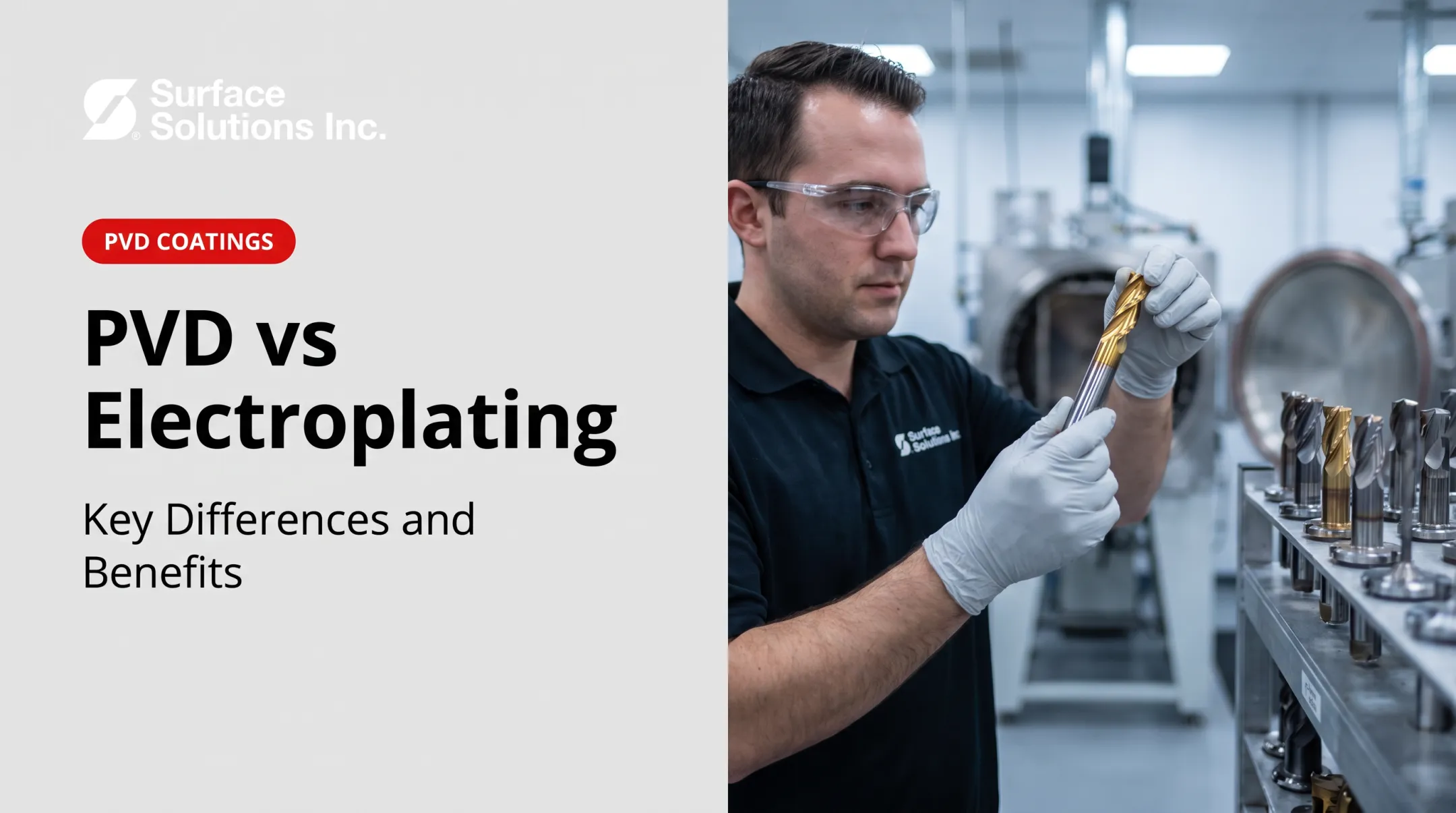
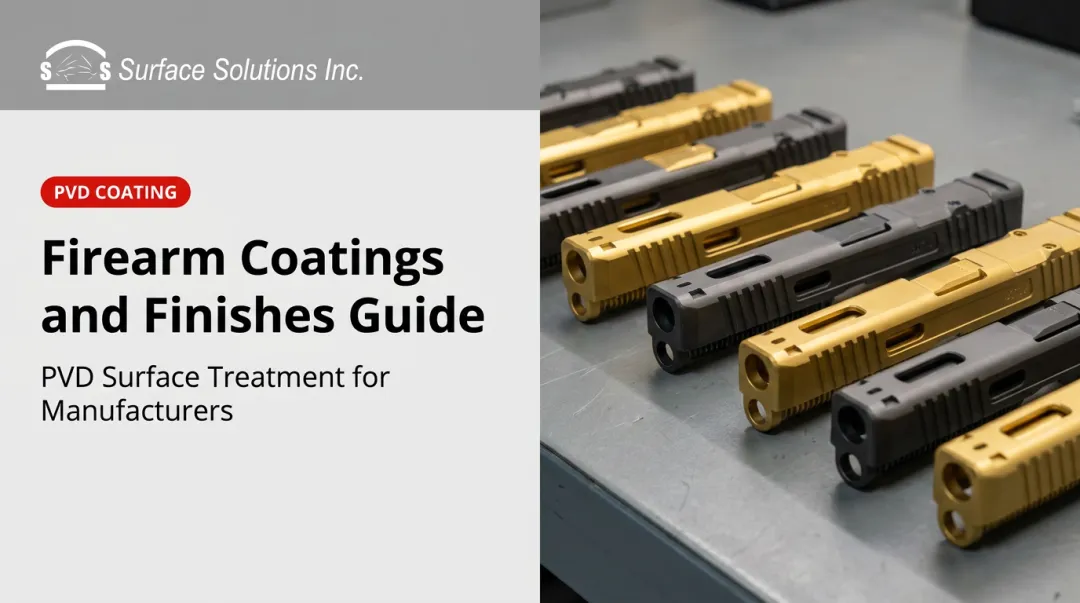
PVD (Physical Vapor Deposition) deposits an ultra-hard metallic film directly onto a tool's surface at a molecular level. Cerakote applies a ceramic-polymer blend by spray and oven-cure. Both protect surfaces. Neither is universally "better." But choosing between them without understanding what each actually does in operation is where costly mistakes happen.
This article breaks down how they compare on hardness, thickness, cost, and real-world performance — so manufacturers, engineers, and tooling managers can make the right call for their specific application.
Key Takeaways
- PVD coatings (TiN, CrN, AlTiN, TiCN) reach 2,000–3,500 HV hardness; Cerakote uses pencil hardness ratings (ASTM D3363), making direct comparison invalid
- Hardness scales differ between the two coatings — Vickers vs. pencil — so spec sheets can't be compared at face value
- PVD films run 1.5–8 microns thick; Cerakote H-Series runs 25–50 microns — a meaningful gap when precision tolerances matter
- For cutting tools, dies, and forming punches, PVD is the clear industrial choice
- Cerakote's real strengths are corrosion resistance (2,000+ ASTM B117 hours) and broad material compatibility for consumer or decorative applications
- Coating selection should be driven by what the tool actually endures in production — not by cost alone
PVD Coating vs. Cerakote: Quick Comparison
| Factor | PVD Coating | Cerakote H-Series |
|---|---|---|
| Process | Vacuum deposition, molecular bonding | Spray application, oven-cured at 250°F |
| Hardness metric | 2,000–3,500 HV (Vickers) | 9H scratch / 8H gouge (ASTM D3363) |
| Typical thickness | 1.5–8 microns (product-dependent) | 1–2 mil (25.4–50.8 microns) |
| Corrosion resistance | Moderate to good (coating-dependent) | 2,000–3,000+ ASTM B117 hours |
| Tolerance impact | Minimal — suitable for precision parts | Can affect tight tolerances |
| Best application | Cutting tools, dies, forming punches | Firearms exteriors, consumer products |
| Upfront cost | Higher | Lower |
| Color options | Limited (gold, silver, black, brown) | Hundreds of colors |

Cost Breakdown
The table above captures the technical differences — but cost often drives the final decision.
PVD carries a higher upfront cost due to specialized vacuum equipment and process complexity. Surface Solutions' AlTiN coating on carbide inserts, for example, runs $2.50–$4.00 per tool depending on size — but documented cases show tools lasting 6x longer before resharpening, which changes the per-part math entirely.
Cerakote is more accessible and less expensive to apply. For light-duty or decorative applications, that lower entry cost makes sense. In high-wear manufacturing environments, more frequent recoating cycles eat into those savings.
What Is PVD Coating?
PVD is a vacuum-based process where a solid metal target — titanium, chromium, or an alloy — is vaporized inside a high-vacuum chamber and deposited onto the tool surface as an ultra-hard film. The coating bonds at a molecular level — meaning it becomes part of the surface rather than sitting on top of it.
For manufacturing tooling, that bond translates into three measurable performance gains:
- Extreme hardness — resists abrasion under friction and load
- Low coefficient of friction — reduces heat buildup and material adhesion to the tool face
- Thermal stability — maintains performance at elevated operating temperatures (up to 850°C for AlTiN-based coatings per Ionbond's published specifications)

Surface Solutions applies PVD at a deposition temperature of 700°–800°F with a coating thickness of 0.0001"–0.0002" (2–5 microns). At that thickness, dimensional tolerances on precision components remain unaffected.
Common PVD Coating Types
| Coating | Hardness (HV) | Best For |
|---|---|---|
| TiN (Titanium Nitride) | 2,000–2,800 | General cutting tools, punches, firearms |
| CrN (Chromium Nitride) | ~2,300 | Medical instruments, food processing, stainless drawing |
| AlTiN (Aluminum Titanium Nitride) | 2,800–3,000+ | High-speed cutting, high-temperature applications |
| TiCN (Titanium Carbo-Nitride) | ~2,800 | Applications needing hardness + toughness balance |
| Alpha™ (Proprietary) | Among highest in lineup | Sheet metal forming, punching, galvanized steel stamping |
Hardness values from Ionbond and voestalpine published product data; values vary by deposition architecture and test conditions.
Where PVD Delivers the Most Value
PVD earns its place wherever tools face high friction, tight tolerances, and repetitive mechanical stress:
- Punching and stamping dies
- Thread-forming tools and cutting inserts
- Sheet metal forming tooling
- Injection molds
- Medical instruments requiring biocompatibility
In metal forming, precision machining, and medical device manufacturing, PVD routinely extends tool life well beyond what uncoated or mechanically applied finishes can achieve — which is the core difference when comparing it against a surface coating like Cerakote.
What Is Cerakote?
Cerakote is a ceramic-polymer composite coating. It's sprayed onto a prepared (typically bead-blasted) metal surface, flashed at ambient temperature for 15 minutes, then oven-cured at 250°F for 2 hours. The bond is mechanical — the coating adheres to the surface texture rather than integrating with it at a molecular level.
That mechanical bond makes Cerakote a surface-applied protective finish rather than a structural surface treatment — which matters when evaluating it against PVD for industrial applications.
Cerakote's Genuine Strengths
- Corrosion resistance — H-Series coatings achieve 2,000+ hours in ASTM B117 salt spray testing; Elite Series reaches 3,000+ hours
- Broad material compatibility — bonds to metals, polymers, and plastics
- Color variety — hundreds of options for consumer and decorative applications
- Accessibility — lower equipment requirements make application more widely available
Cerakote's Limitations in Industrial Contexts
The H-Series thickness of 1–2 mil (25.4–50.8 microns) adds measurable material on precision components where tolerance windows are tight. For cutting tools or stamping dies with tight dimensional specs, that buildup can push a part out of tolerance.
The hardness data is also worth scrutinizing. Cerakote's published rating uses ASTM D3363 pencil hardness (9H scratch / 8H gouge) — a test measuring resistance to a pencil stylus, not mechanical load. No Vickers or Rockwell values appear in official H-Series or Elite datasheets, and no independent cutting-tool or stamping-die wear study using Cerakote has been located in the published literature.
Where Cerakote Is Most Commonly Applied
- Firearm exteriors and accessories
- Hunting knives and sporting equipment
- Automotive trim and consumer components
- Parts where color customization and environmental corrosion protection are primary goals
PVD Coating vs. Cerakote: Which One Is Better?
The right choice depends on what your part actually does. Use this as your decision framework:
Choose PVD When:
- The tool undergoes repetitive mechanical stress (cutting, punching, forming, stamping)
- Dimensional precision is non-negotiable — tight tolerances can't absorb 25+ microns of coating
- Operating temperatures are high and thermal stability matters
- Total cost of ownership over the tool's lifecycle matters more than upfront spend
- The substrate is metal (tool steel or carbide) and the part is a single solid piece
Choose Cerakote When:
- The priority is corrosion protection or color customization
- The application is consumer-facing (firearms exteriors, sporting goods, automotive trim)
- The substrate is plastic, polymer, or a material PVD can't accommodate
- The part won't face high mechanical wear loads
- Lower upfront cost and simpler application logistics are the deciding factors
For manufacturing operations running cutting tools, dies, or forming punches, PVD's combination of hardness, thin profile, and friction reduction means fewer stoppages, less rework, and lower per-part costs. Research from CemeCon documents 30–50% tool life improvements from PVD coating across cutting tool applications — with individual case results frequently exceeding that range.

Real-World Results: Surface Solutions PVD in Production
The performance gap between coating types becomes concrete when you look at actual production data.
The 500+ Parts vs. 15 Parts Result
A sheet metal forming customer ran a direct head-to-head test on stainless steel drawing tooling:
- Alpha™ coating: 15 parts produced — parts were too hot to handle
- CrN coating: 500+ parts produced — parts were only warm to the touch
That's a 33x increase in parts before maintenance was required, along with a meaningful thermal management advantage that eliminated the safety and quality issues from heat buildup.
The 48 Hours of Labor Saved
Don Richardson, running a press-based stamping operation, documented what happened after switching to Surface Solutions' Alpha™ coating:
- Before: Resharpening required every 10,000 parts — each cycle takes 8 hours to pull tools, resharpen, and reinstall
- After: Completed a full 60,000-part order with zero resharpening required
- Result: 6 sharpening cycles avoided × 8 hours each = 48 hours of labor saved on a single production run

Additional Documented Outcomes with Alpha™ Coating
A high-volume galvanized steel stamping operation running M4 punches at one stroke per second, 8–16 hours per day, reported:
- Tools still performing after 15 months and an estimated 15 million parts
- Near-zero galvanized build-up compared to TiN-coated equivalents
- Reduced punch chipping, with less load transferred to the die
- Elimination of mid-run polishing and reduced lubricant consumption
For high-cycle manufacturing, these numbers show what separates a well-matched PVD coating from a generic one — and where Cerakote's wear performance simply doesn't compete.
If your operation is dealing with frequent resharpening cycles, heat-related wear, galvanized buildup, or excessive downtime, the right coating selection can change those numbers. Contact Surface Solutions at 763-785-9436 or info@tincoat.net to discuss whether TiN, CrN, AlTiN, TiCN, or Alpha™ fits your tooling application.
Conclusion
PVD and Cerakote solve different problems. For manufacturers where tool life, precision, and heat resistance determine whether a production run is profitable, PVD coating consistently outperforms. Its hardness, thin profile, and molecular-level bonding are purpose-built for industrial wear conditions.
For decorative, consumer, or corrosion-protection applications on non-precision parts, Cerakote remains a practical option with clear advantages in color variety and substrate flexibility.
The choice should be driven by what the tool actually endures in operation. In high-cycle, high-stress manufacturing environments, PVD delivers measurable ROI across three areas:
- Reduced downtime from longer intervals between tool changes
- Extended tool life that directly lowers per-part cost
- Fewer maintenance interruptions that keep production runs on schedule
Frequently Asked Questions
Is PVD the best coating?
For industrial cutting and forming tools, PVD is widely considered the top performer due to its extreme hardness, thin profile, and low friction characteristics. The answer depends on the application — Cerakote is the stronger choice for decorative finishes or corrosion protection on non-precision, consumer-facing parts.
How long will PVD coating last?
Longevity depends on the coating type, substrate, and application. In industrial settings, documented cases range from 30–50% tool life improvements on cutting tools to dramatically extended intervals in stamping and forming applications — one customer ran 60,000 parts before needing to resharpen, versus a previous baseline of 10,000.
What is the main difference between PVD coating and Cerakote?
PVD is a vacuum-deposited metallic film (1.5–8 microns thick, 2,000–3,500 HV) bonded at the molecular level — thinner, harder, and built for wear-heavy industrial parts. Cerakote is a sprayed ceramic-polymer coating cured in an oven; it's thicker, easier to apply, and better suited for corrosion resistance and aesthetics on non-precision parts. The two coatings are measured on different hardness scales and cannot be compared directly.
Can Cerakote be used on industrial cutting tools?
Cerakote is not established as suitable for high-wear cutting or forming tools. No independent cutting-tool or stamping-die wear study using Cerakote has been published, and its thicker film (25+ microns) can compromise edge sharpness and dimensional tolerances that precision tooling depends on. PVD is the documented choice for these applications.
Is PVD coating worth the higher upfront cost?
For manufacturing operations, yes. The higher initial cost is typically offset by longer tool life, fewer resharpening cycles, reduced lubricant consumption, and less downtime — making PVD the more economical choice in high-cycle environments when total cost of ownership is considered.
What PVD coating types are available for manufacturing tools?
The most common industrial options are TiN (general cutting and forming), CrN (corrosion resistance and stainless steel drawing), AlTiN (high-speed cutting up to 850°C), TiCN (hardness-toughness balance), and Surface Solutions' proprietary Alpha™ coating (sheet metal forming and galvanized stamping). The right choice depends on your material, operating temperatures, and whether friction reduction or hardness is the priority — contact Surface Solutions for application-specific guidance.