Pick the wrong coating, though, and the consequences show up fast. Premature wear, galling on aluminum or copper surfaces, corrosion in humid or sterile environments, poor surface finish on a visible part, all of it eats into margins and production schedules.
This guide breaks down what ZrN actually is, how it's applied, the properties that make it valuable, how it compares to titanium nitride (TiN), where it gets used across industries, and how to find the right coating partner, whether that ends up being ZrN or something else entirely.
Key Takeaways
- ZrN is a pale-gold ceramic coating with a cubic rock-salt crystal structure
- Hardness charts list about 2,500–2,700 HV, rivaling TiN with a smoother finish
- Excels on non-ferrous metals (aluminum, brass, copper, titanium) and on medical or decorative parts
- Costs more and stocks less widely than TiN—treat it as a specialty pick
- Match coating chemistry to the job; don’t default to the most exotic option
What Is Zirconium Nitride (ZrN) PVD Coating?
Chemical Composition and Appearance
Zirconium nitride is a ceramic compound with the chemical formula ZrN, one zirconium atom bonded to one nitrogen atom. It forms when vaporized zirconium metal reacts with nitrogen gas inside a vacuum chamber, similar chemistry to titanium nitride, just with a different base metal.
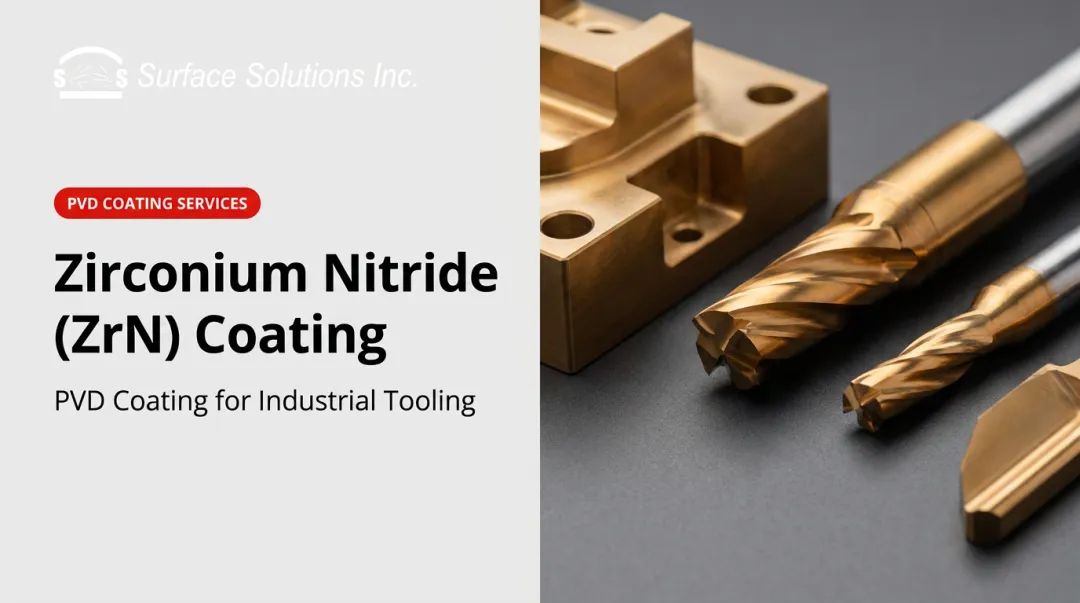
The result is a distinctive pale-gold to champagne color, sometimes described as running from nickel tones toward pale-gold brass depending on process settings. Manufacturers reach for ZrN when a part needs both a premium appearance and real wear resistance: plumbing fixtures, medical instruments, and cutting tools that customers actually see.
That durability starts at the atomic level. ZrN crystallizes in a cubic rock-salt structure, the same arrangement as ordinary table salt, just with zirconium and nitrogen atoms in place of sodium and chlorine. This tightly packed lattice is what gives the coating its hardness and thermal stability.
Where ZrN Fits Among PVD Coating Families
ZrN belongs to the same nitride-based hard-coating family as TiN, CrN, and TiCN, but it is less common and typically costs more. Fewer coating shops stock zirconium as a source material, and the deposition process itself runs less efficiently than titanium-based coating, so ZrN tends to show up as a specialty order rather than a default option.
A peer-reviewed materials study puts ZrN's melting point at roughly 3,253 K, or about 2,980°C, well above what most tool steels ever experience in service. Hardness depends heavily on how the film is deposited:
- Around 15 GPa in sputter-deposited films
- Up to 25 GPa or higher with other process setups
That spread matters. ZrN performance is not one fixed number. It changes with process and equipment.
How Is ZrN PVD Coating Applied?
ZrN coating uses the same core PVD process as other nitride coatings, just with zirconium as the source metal. Parts go into a vacuum chamber, where an energy source—typically a cathodic arc or magnetron sputtering—vaporizes solid zirconium into a plasma.
That vaporized metal reacts with nitrogen gas in the chamber. The resulting ZrN molecules condense on the part surface as a thin, uniform ceramic film.
Typical process parameters:
- Coating thickness: generally 1-5 microns (about 0.00004"-0.0002"), depending on vendor and application
- Deposition temperature: commonly 300-600°C, with some low-temperature processes below 100°C for heat-sensitive substrates
- Process environment: fully enclosed vacuum chamber—no open chemical baths

Compare that to electroplating, which relies on open chemical baths that can generate hazardous waste such as chromium runoff. PVD runs in a closed vacuum chamber instead: no wastewater treatment and no chemical disposal burden. For manufacturers under tighter environmental compliance rules, that is a concrete operational advantage.
Key Properties & Performance Benefits of ZrN Coating
Beyond its metallurgy, ZrN earns its keep on the shop floor through several practical advantages.
Wear Resistance and Lubricity
Industrial coating charts list PVD-deposited ZrN hardness at 2,500–2,700 HV, on par with many TiN formulations. That hardness means the coating—not the base steel—takes the brunt of abrasive contact, so cutting edges wear slower and forming dies score less.
ZrN’s low-friction surface also cuts galling and material buildup, a common failure mode when machining “gummy” metals like aluminum, copper, and brass. Lower friction generates less heat at the cutting interface, which extends tool life on its own.
Key shop-floor payoffs:
- Slower edge wear on cutting tools
- Less scoring on forming dies
- Reduced buildup when cutting aluminum, copper, and brass
- Lower heat at the tool–workpiece interface
Corrosion and Oxidation Resistance
Vendor testing rates ZrN’s maximum service temperature around 600°C (1,110°F). Arc-evaporated ZrN films also resist oxidation better than similarly deposited TiN, which matters for tooling that runs hot or parts exposed to humidity, cleaning chemicals, or sterilization cycles.
Surface Finish, Aesthetics, and Specialty Uses
Zirconium’s high boiling point during arc evaporation reduces the “droplet” spatter that shows up in some other arc-deposited coatings. Fewer droplets mean a smoother as-coated surface—useful for cutting performance and for cosmetic parts where texture is visible.
Unlike decorative gold plating, which thins and dulls with handling, ZrN holds its champagne-gold color because the color comes from the coating’s molecular structure, not a thin layer sitting on top of the base metal.
ZrN also carries low electrical resistivity. A 2018 peer-reviewed study on PVD-ZrN dental abutments found the coating nonhemolytic, non-mutagenic, and compatible with normal human cell growth—making it a fit for medical device work and specialized electronics where conductivity and biocompatibility both matter.
ZrN vs. TiN: Comparing PVD Coatings
Since ZrN and TiN often get considered for the same job, here's how they actually stack up against each other.
Cost and availability. TiN is the default nitride coating. Most PVD shops stock titanium as a standard source material and run TiN batches regularly. ZrN requires zirconium source material and, in many shops, dedicated setup, which pushes cost up and keeps it firmly in specialty-order territory.
Surface quality. Zirconium's higher boiling point during arc evaporation reduces droplet formation compared to some TiN processes. That typically leaves ZrN with a smoother as-deposited finish, which matters for parts where texture affects performance or appearance.
Oxidation resistance at elevated temperatures. Both coatings outperform uncoated steel, but ZrN has an edge at higher heat. Vendor data lists ZrN's maximum service temperature around 600°C (about 1,110°F). Industry sources describe arc-evaporated ZrN as more oxidation-resistant than comparably deposited TiN films.
Ideal use cases. TiN remains the general-purpose default. It works well across a broad range of ferrous cutting applications and is the most common gun-coating color for firearm components. ZrN is the better call for non-ferrous machining (aluminum, brass, copper, titanium), medical instruments, and premium finished parts where a smoother, longer-lasting gold finish justifies the extra cost.
| Property | ZrN | TiN |
|---|---|---|
| Hardness | ~2,500-2,700 HV | ~2,000-3,000 HV |
| Cost & availability | Higher cost, specialty order | Lower cost, widely stocked |
| Color | Pale gold / champagne | Dark gold |
| Oxidation resistance | Higher, ~600°C (~1,110°F) service rating | Good, generally lower ceiling |
| Best applications | Non-ferrous machining, medical, decorative parts | General-purpose ferrous cutting, firearms, everyday tooling |
Industries & Applications That Benefit from ZrN Coating
ZrN shows up wherever non-ferrous machining, biocompatibility, or a durable gold finish matter most.
- Cutting tools and machining: Drill bits, end mills, and punches cutting aluminum, brass, copper, and titanium gain lower friction and less galling than uncoated or TiN-coated tools on these "gummier" metals.
- Medical devices: Surgical instruments and implantables use ZrN for corrosion resistance and biocompatibility, including dental abutments tested to ISO 10993 and referenced in FDA filings.
- Decorative finishes: Plumbing fixtures, watches, and automotive trim get a gold-toned surface that holds up to daily handling better than standard gold plating.
Choose ZrN when the work centers on non-ferrous stock, validated biocompatibility, or a wear-resistant gold appearance—not when a general-purpose coating is enough.
Why Choose Surface Solutions for Your PVD Coating Needs
Choosing between ZrN and other PVD chemistries means matching coating properties to your tooling challenge, production volume, and budget—not whichever option looks best on a materials chart.
Surface Solutions, based in Fridley, Minnesota, has spent years coating tooling for punching, sheet metal forming, drawing, and medical device manufacturers across the Upper Midwest, California, New York, Florida, Canada, and Mexico.
The team works in TiN, AlTiN, CrN, TiCN, and its proprietary Alpha™ coating, and knows from direct customer results how each performs under real production loads.
Consider what that experience has shown:
- Alpha-coated M4 punches ran for more than 15 months and an estimated 15 million parts on 0.057-inch galvanized steel, with almost no galvanized buildup compared to standard TiN
- One customer produced 60,000 parts instead of 10,000 before resharpening was needed, a sixfold improvement that saved roughly 48 labor hours
- In a stainless-steel drawing application, CrN-coated tooling ran over 500 parts while staying just warm to the touch, versus 15 parts with Alpha before the tool overheated

Zirconium nitride isn't currently part of Surface Solutions' standard coating lineup. A quick conversation still helps: if you need ZrN's non-ferrous lubricity or gold-toned finish, they will say so plainly.
They can also tell you when Alpha, CrN, or another chemistry in their lineup will outperform it for your part, budget, and production volume.
Reach out at 763-785-9436 or info@tincoat.net to talk through your tooling challenge before committing to a coating.
Frequently Asked Questions
Is zirconium toxic to humans?
Elemental zirconium and its nitride form are non-toxic and biocompatible, which is why ZrN coatings appear on dental and surgical components. Raw zirconium metal dust and powders still require standard handling precautions.
What is the chemical formula for zirconium nitride?
The formula is ZrN, one zirconium atom bonded to one nitrogen atom in a cubic rock-salt crystal structure, the same lattice found in ordinary table salt.
How hard is zirconium nitride PVD coating compared to other coatings?
PVD ZrN hardness typically runs 2,500-2,700 HV, well above uncoated tool steel. That puts it roughly in line with TiN coatings, which range from about 2,000-3,000 HV depending on the deposition process.
What is the difference between ZrN and TiN coatings?
ZrN generally offers a smoother finish, better high-temperature oxidation resistance, and superior lubricity on non-ferrous metals. TiN costs less and remains more widely available for general-purpose ferrous cutting.
How long does a ZrN PVD coating last on tools?
Lifespan depends on the application, load, and material being processed—there's no universal number. A coating provider can estimate durability from your tooling and production conditions.
Can zirconium nitride coating be applied to any type of metal tool?
ZrN works on most tool steels and carbide substrates. It delivers the most value on tools used for non-ferrous metal machining or forming rather than general-purpose ferrous work.