Introduction
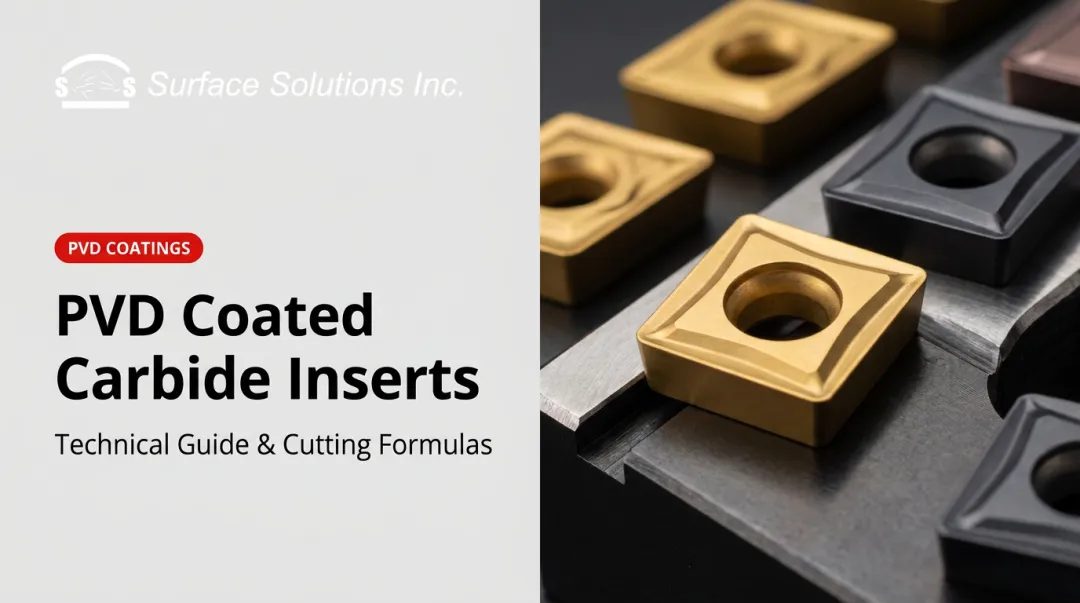
According to Sandvik Coromant, coated cemented carbide represents 80–90% of all cutting tool inserts in use today. This isn't a niche material category — it's the default.
The coating isn't just a protective layer applied as an afterthought. It fundamentally defines how a tool wears, how much heat it can withstand, and whether it survives interrupted cuts or continuous high-speed turning.
Treat grades as interchangeable — or choose the wrong coating for the application — and you'll see premature edge failure, thermal degradation, or substrate fracture that no cutting parameter adjustment will fix.
This guide covers the substrate-coating system as a whole:
- What coated cemented carbide is and how the substrate and coating interact
- Which properties matter and why they vary by application
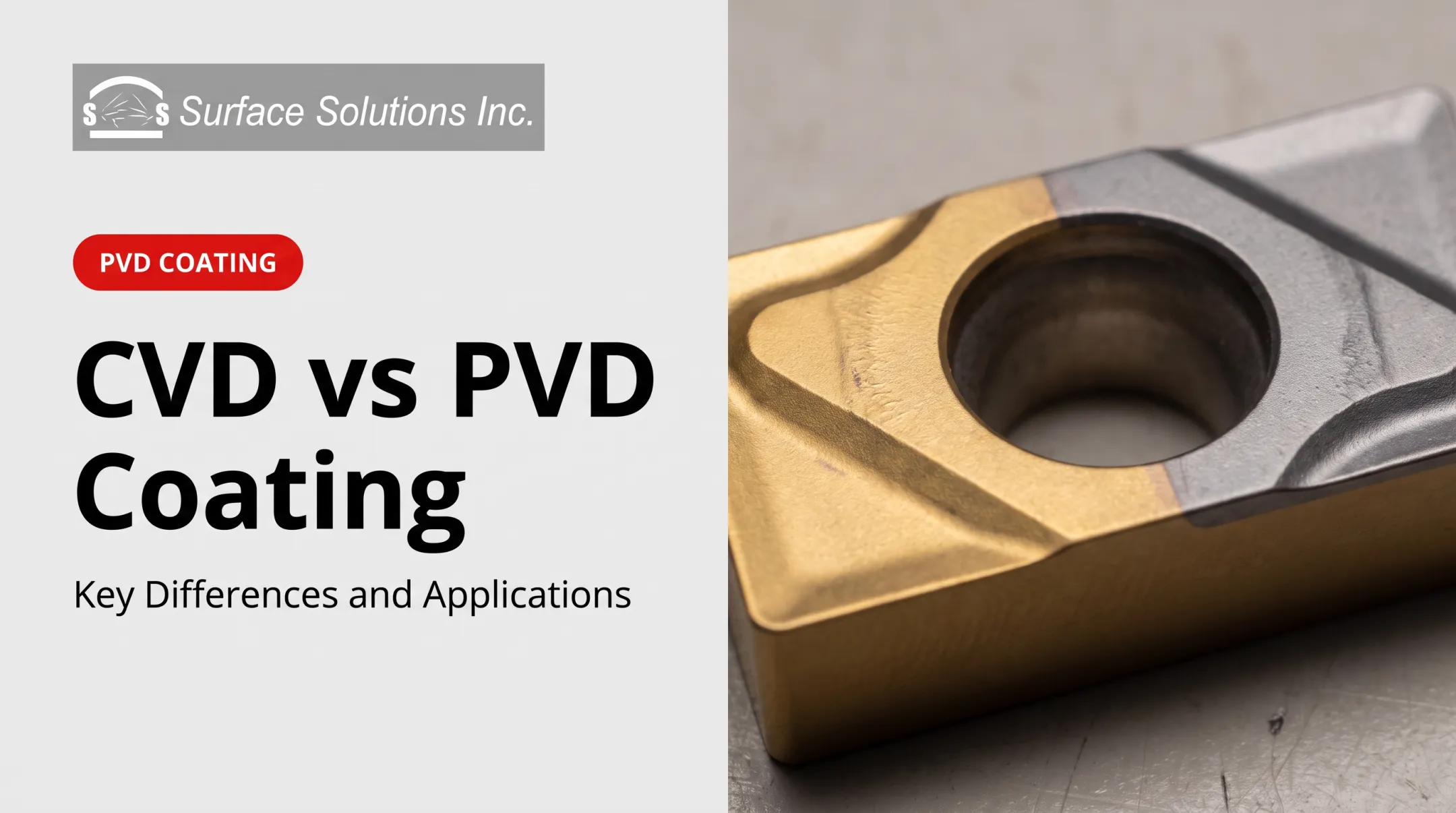
- How CVD and PVD coatings differ in practice
- How to select grades for specific operations and what failure modes to watch for
Key Takeaways
- Coated cemented carbide combines a WC-Co substrate with CVD or PVD coatings to achieve wear resistance and toughness simultaneously
- CVD coatings (700–1,050°C) suit continuous cutting operations; PVD coatings (400–600°C) preserve edge sharpness for interrupted cuts and finishing work
- Coating chemistry, thickness, and deposition method must match the workpiece material and operation—no universal "best" coating exists
- Substrate grain size and cobalt content are as important as coating choice; a mismatched substrate fails regardless of coating quality
- PVD re-coating after resharpening restores—and often exceeds—original performance, extending tool life across multiple cycles
What Is Coated Cemented Carbide?
The Substrate: WC-Co Structure
Cemented carbide is a metal matrix composite. Tungsten carbide (WC) particles—comprising 70–97% by weight, with average grain sizes of 0.4–10 μm—are bonded by a metallic cobalt (Co) binder. WC grains act as aggregate; cobalt acts as the binding matrix.
Sintering at 1,400–1,600°C for around 24 hours produces a dense body, with the green compact shrinking by up to 50% by volume during densification. The process yields hardness and toughness that neither WC nor cobalt achieves on its own.
Binder content varies systematically by grain size:
- Submicron grades (<1 μm): 3–15 wt% Co — high hardness, high compressive strength
- Medium grades (1–5 μm): 10–20 wt% Co — greater toughness and fracture resistance
What the Coating Adds
That substrate is capable on its own — but it's the coating that targets a specific wear environment. CVD and PVD surface layers each contribute independently:
- Hardness — exceeding the substrate's surface hardness
- Chemical inertness — reducing diffusion wear against steel and stainless
- Thermal insulation — limiting heat transfer into the carbide body
- Lubricity — reducing friction and adhesive wear
Where Coated Carbide Fits in the Tooling Hierarchy
| Material | Hard Phase | Binder | Key Limitation |
|---|---|---|---|
| Coated WC-Co | WC | Metallic Co | Application-specific; coating must match operation |
| Uncoated WC-Co | WC | Metallic Co | Used only in niche HRSA/titanium machining |
| Cermet | Ti(C,N) | W-rich Co | Lower toughness and thermal shock resistance |
| Ceramic/CBN | Al₂O₃ or cBN | None | Brittle; limited to specific high-speed or hardened-steel applications |

Coated WC-Co sits in the practical middle ground — it handles the thermal and mechanical demands that ceramics can't absorb and covers the broad material range that cermets and uncoated grades cannot.
Key Technical Properties of Coated Cemented Carbide
Performance is governed by four interacting properties. No single one fully determines grade suitability—the coating and substrate each contribute, and their interaction matters.
Hardness and Wear Resistance
Coating hardness varies significantly by chemistry and deposition method:
| Coating | Hardness | Source |
|---|---|---|
| CVD κ-Al₂O₃ (single layer) | 2,000 HV0.5 | Peer-reviewed study |
| PVD TiN (Ionbond 01) | 2,800 HV | Product data |
| PVD TiCN (Ionbond 10) | 2,800 HV | Product data |
| PVD AlTiN (Ionbond 22) | 3,200 HV | Product data |
These hardness values translate directly to wear behavior. CVD Al₂O₃ resists both abrasive flank wear and crater wear through its thermal barrier effect. PVD AlTiN combines high hardness with oxidation resistance, with aluminum-rich formulations (>50 atomic percent aluminum) pushing performance toward the upper end of the range.
Toughness and Edge Integrity
The cobalt binder offsets WC's inherent brittleness, providing the ductility that makes cemented carbide tougher than ceramic alternatives. The coating's residual stress state then determines how well that toughness holds under cutting loads:
- CVD coatings carry tensile residual stress—measured at up to 662 ± 8 MPa in TiCN deposited at 800°C. This makes edges more susceptible to micro-chipping under impact or thermal cycling.
- PVD coatings carry compressive residual stress, adding comb-crack resistance. A foundational CIRP milling study confirmed that irregular thermal cracks appeared in CVD-coated carbide but were absent from PVD-coated tools, directly attributing the difference to PVD's compressive stress state.
Thermal Stability and Hot Hardness
Documented service temperature limits by coating type:
- PVD TiN: ~500°C service limit; friction vs. steel = 0.5
- PVD TiCN: ~300°C service limit; friction vs. steel = 0.2
- PVD TiAlN (BALINIT FUTURA NANO): ~900°C maximum service
- PVD AlTiN: ~850°C service limit
For CVD Al₂O₃, thermal conductivity of 7.5 W/(m·K) versus 55 W/(m·K) for WC-Co shifts heat toward the chip rather than into the substrate—critical for sustained high-speed continuous turning of steel and stainless.
One TiAlN oxidation study found significant hardness loss above 700°C and complete delamination at 1,000°C. That's a useful boundary condition, though product-specific limits from manufacturers remain the better reference for production specification.
Chemical Stability and Lubricity
- CVD Al₂O₃: Chemically resistant to crater wear in steel and stainless machining; low thermal conductivity limits diffusion wear
- PVD TiN: Friction coefficient of 0.5 vs. steel; reduces adhesive wear and built-up edge formation
- PVD TiCN: Friction coefficient of 0.2 vs. steel—considerably lower and effective against adhesive wear in interrupted cuts
- PVD CrN: Superior corrosion resistance; preferred in wet, medical, or food-processing environments where chemical attack is a concern
CVD vs. PVD Coatings: Types, Ranges, and Performance Limits
The CVD vs. PVD decision is the primary branch point in specifying coated cemented carbide. Application conditions drive the choice — not personal preference or convention.
CVD Coatings
CVD (Chemical Vapor Deposition) is applied at 700–1,050°C, producing films typically 5–20 μm thick. The modern CVD stack is a multilayer system:
- MT-Ti(C,N) base layer — abrasive wear resistance
- Al₂O₃ middle layer — chemical stability, thermal barrier, crater wear resistance
- TiN outer layer — wear detection (color change indicates coating loss)
This architecture makes CVD the standard choice for:
- Continuous turning and boring of steel and stainless
- ISO P and M grade applications
- Semi-finishing to roughing operations where abrasive and crater wear dominate
The trade-off is tensile residual stress — thicker coatings increase cutting edge radius. That stress accumulation has consequences: in hard turning studies, CVD thicknesses of 12–18 μm directly affected edge microgeometry and made these grades more prone to thermal crack propagation under interrupted conditions.
PVD Coatings
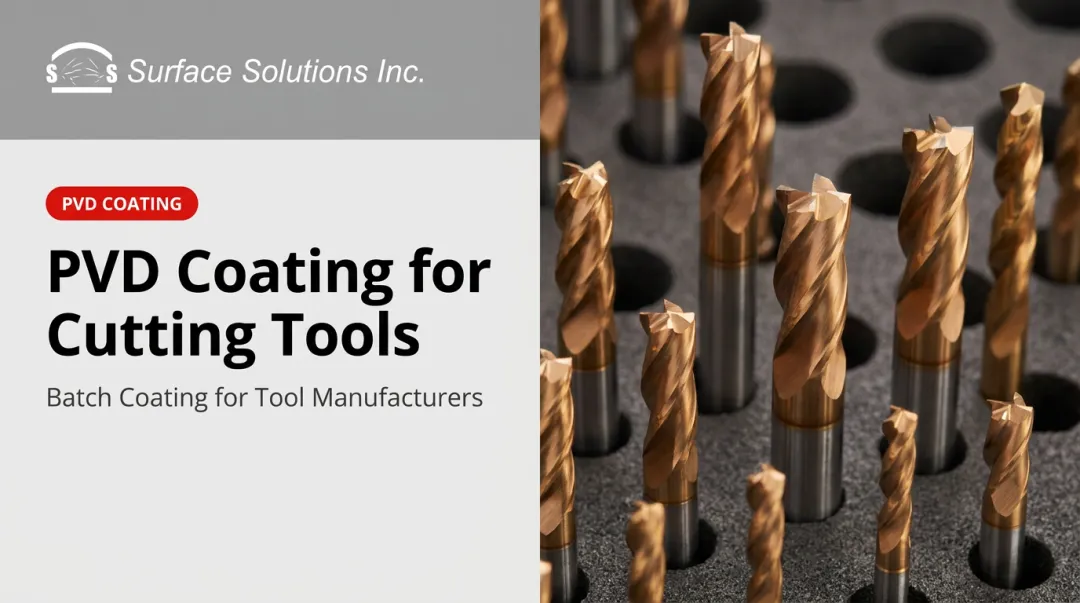
PVD (Physical Vapor Deposition) is applied at 400–600°C — Surface Solutions operates at approximately 370–427°C — producing films 0.5–5 μm thick. PVD coating types in order of increasing hardness and oxidation resistance:
| Coating | Hardness | Max Service Temp | Best Application |
|---|---|---|---|
| TiN | ~2,800 HV | ~500°C | General-purpose; baseline performance |
| TiCN | ~2,800 HV | ~300°C | Interrupted cuts; adhesive materials |
| TiAlN | ~3,000 HV | ~900°C | High-speed; demanding machining |
| AlTiN | ~3,200 HV | ~850°C | Dry cutting; hardened steels |

PVD coatings preserve sharp edge geometries — essential for solid end mills, drills, grooving and threading tools, and finishing grades. The compressive stress state provides comb-crack and micro-chipping resistance that CVD coatings cannot match under cyclic thermal loading.
That edge-retention advantage is exactly what makes PVD the method of choice for re-coating carbide tools after resharpening. Surface Solutions applies TiN, TiCN, AlTiN, CrN, and their proprietary Alpha™ to customer-supplied tools — with tools performing better than new after re-coating cycles, per Tony Deschenes of Special Tools, Inc.
Industrial Applications of Coated Cemented Carbide
Metal Cutting
The right coating depends on which wear mechanism dominates in the application:
CVD-coated grades:
- General turning and boring of steel and stainless (crater and abrasive wear dominate at sustained temperatures)
- ISO P/M roughing to semi-finishing grades
- Sandvik's GC2220 CVD grade, for example, is the manufacturer's first-choice recommendation for austenitic and duplex stainless steel turning
PVD-coated grades:
- All solid end mills and drills (edge geometry preservation is critical)
- Grooving, threading, and finishing inserts
- Interrupted cutting where thermal cycling and impact load cycling occur
Forming and Wear Applications
Forming applications call for a different set of priorities than cutting. Where cutting favors crater wear resistance, forming demands lubricity, adhesive wear resistance, and resistance to galling.
Applications include:
- Rolling mill rolls (hot and cold rolling)
- Stamping punches and deep drawing dies
- Pump pistons, nozzles, and wire drawing dies
- Mining drill button bits
The performance difference between coatings is measurable in real production data. In one stainless steel drawing application tracked by Surface Solutions, switching from Alpha™ to CrN coating increased output from 15 parts to over 500 parts per cycle — a 33x improvement tied directly to CrN's superior thermal management and lubricity in that application.
In high-volume galvanized steel stamping, Alpha™-coated M4 punches ran for over 15 months and approximately 15 million parts, compared to uncoated D2 punches requiring resharpening every three weeks.

Selecting and Specifying the Right Coated Carbide Grade
Primary Specification Logic
Follow this decision sequence:
- ISO workpiece group → determines coating chemistry
- P (steel), M (stainless), K (cast iron), N (non-ferrous), S (HRSA/titanium), H (hardened)
- Operation type → determines CVD vs. PVD
- Continuous, high-temperature roughing → CVD
- Interrupted, finishing, or precision geometry → PVD
- WC grain size and cobalt content → tuned for toughness/hardness balance
- High impact: higher Co content, coarser grain
- High hardness priority: lower Co, finer grain

Validating Performance in the Field
Once you've selected a grade using the sequence above, real-world conditions will tell you whether it holds. Datasheet values are idealized — actual validation follows ISO 3685 flank wear criteria:
- VBB = 0.3 mm for uniform wear (average flank wear land)
- VBmax = 0.6 mm for irregular wear (maximum width)
Measure flank wear (VB) progression over initial trials, inspect coating adhesion visually and by cross-section, and adjust cutting parameters until wear falls within the acceptable range. Published cutting speed recommendations are starting points—not guaranteed outcomes across all workpiece conditions.
Re-Coating as a Cost Reduction Strategy
When wear reaches those thresholds and a tool goes in for resharpening, there's a cost recovery step that most operations overlook. After resharpening, a coated carbide tool loses its coating on the reworked face. That surface reverts to uncoated substrate. Re-coating via PVD after each sharpening cycle restores the protective layer and in documented cases delivers performance exceeding the original factory coating.
Surface Solutions handles this workflow routinely for cutting tool manufacturers and resharpening services. In a documented case study on 3-corner carbide inserts machining 304 stainless steel:
- AlTiN re-coating produced 6x the tool life of TiN-coated tools
- Coating cost: $2.50–$4.00 per tool
For high-volume shops running carbide inserts regularly, building re-coating into the resharpening cycle is worth running the numbers on — the per-tool cost is low enough that even modest life extensions tend to pay off quickly.
Common Misinterpretations and Failure Modes
Three mistakes account for most preventable coated carbide failures:
1. Treating Grades as Interchangeable Across Operations
Using a CVD-coated turning insert in heavy interrupted milling causes thermal cracking from tensile stress under cyclic loading. Using a PVD finishing grade in continuous high-temperature roughing results in coating thermal degradation well below the tool's theoretical rating. Both are predictable failures when coating type doesn't match the operation.
2. Assuming Thicker Coatings Are Always Better
CVD coatings at 12–18 μm add significant edge radius and reduce toughness under impact. Applying a forming-optimized PVD coating to high-speed continuous cutting leads to premature thermal degradation. Thickness is a design parameter — it reflects what the application requires, not how good the coating is.
3. Focusing on Coating While Neglecting the Substrate
An inappropriate substrate will fail by plastic deformation or brittle fracture regardless of coating quality. Excessive cobalt binder content causes the carbide body to deform under the coating at high loads. A substrate that's too brittle for the application fractures beneath an intact coating.
Eta-phase formation (W₄Co₂C or W₆Co₆C) at the WC-Co interface, caused by uncontrolled CVD parameters, creates a brittle interfacial layer above 2 μm that promotes spalling and edge strength loss.
Specify the substrate and coating as a system, not as independent variables.
Frequently Asked Questions
What are cemented carbides?
Cemented carbides are metal matrix composites of hard tungsten carbide (WC) particles bonded by a metallic cobalt binder, produced via sintering at 1,400–1,600°C. They combine high hardness with fracture toughness that neither WC nor cobalt achieves independently.
What is cemented carbide used for?
Primary applications include cutting tool inserts for turning, milling, and drilling; metal forming dies and punches; mining drill bits; rolling mill rolls; and wear parts such as nozzles, pump pistons, and wire drawing dies.
Is cemented carbide a ceramic?
No. It's a metal matrix composite. The WC phase is ceramic-like in hardness, but the metallic cobalt binder provides ductility and fracture toughness that true ceramics lack. This places cemented carbide in a distinct performance category between ceramics and tool steels.
What is the difference between CVD and PVD coating on cemented carbide?
CVD is applied at 700–1,050°C and produces thicker coatings (5–20 μm) with tensile residual stress, suited for continuous cutting. PVD is applied at 400–600°C and produces thinner coatings (0.5–5 μm) with compressive residual stress, preferred for interrupted cuts, finishing, and tools requiring precise edge geometry.
How does coating thickness affect coated cemented carbide performance?
Thicker CVD coatings maximize abrasive and crater wear resistance but round cutting edges and introduce tensile stress. Thinner PVD coatings preserve edge sharpness and add toughness through compressive stress. Choosing the right thickness depends on the application — not on which coating is inherently superior.
Can coated cemented carbide tools be recoated after resharpening?
Yes. After resharpening removes the original coating from reworked faces, tools can be recoated via PVD to restore — and in many cases exceed — original performance. Re-coating after each resharpening cycle is a straightforward way to reduce tool costs over time.