Uncoated tools wear out fast. That means frequent resharpening, more lubricant on the shop floor, and downtime that eats into production schedules. PVD ion plating tackles this problem right at the surface, bonding a thin, extremely hard coating onto the tool before it ever sees a press or a lathe.
This guide breaks down what PVD ion plating actually is, how the process works step by step, the real benefits manufacturers see on the shop floor, and how it stacks up against other coating methods.
Key Takeaways
- PVD ion plating bonds a thin, hard metallic coating to a substrate using ionized particles for superior adhesion
- Manufacturers use it on cutting tools, punches, dies, and forming tools to reduce wear and extend part life
- Ion bombardment before and during deposition is what separates ion plating from standard PVD coating methods
- TiN, CrN, and specialty coatings like Alpha™ each serve different tooling applications and performance needs
What Is PVD Ion Plating?
Physical Vapor Deposition, or PVD, is the umbrella term for vacuum-based coating technologies that turn a solid coating material into vapor and deposit it onto a part. Ion plating is a specific method within that umbrella, distinguished by one key detail: continuous ion bombardment before and during the coating process.
Energetic ions (atomic-sized charged particles) do two jobs at once during plating:
- Scrub the substrate surface clean at a microscopic level
- Control the density and structure of the coating as it forms
The result is a film that bonds more tightly and grows more uniformly than it would without bombardment.
Ion Plating vs. General PVD Terminology
Terms like sputtering, evaporation, and arc vaporization describe how the coating material becomes vapor. Ion plating, by contrast, describes the bombardment step that can be paired with any of those vaporization methods. You can have arc-vaporized ion plating or sputtered ion plating; they are not competing categories.
The technique isn't new. Donald M. Mattox first documented ion plating in the 1960s while working at Sandia National Laboratories, and his research remains a foundational reference in ion plating literature. Six decades later, it's a standard industrial coating technique.
Ion plating is used in jewelry and watch finishing for cosmetic durability, but its primary industrial role is on tools and machine components where mechanical performance matters more than appearance.
How Does the PVD Ion Plating Process Work?
PVD ion plating follows a sequence that turns a bare tool into one with a hard, bonded surface layer. Every step matters, and skipping cleaning or ionization compromises the final result.
- Clean and load — The substrate, whether it's a punch, die, or cutting tool, is thoroughly cleaned and loaded into a sealed vacuum chamber. This eliminates surface contamination before coating begins.
- Sputter/ion clean — Inside the chamber, the surface is bombarded with ions (often argon) to strip away microscopic impurities. This creates an atomically clean bonding surface.
- Vaporize the coating material — A metal like titanium or chromium is vaporized using arc vaporization or sputtering.
- Ionize and bombard — An electrical bias attracts the vaporized metal ions toward the substrate, driving denser, more uniform film growth with a stronger bond to the surface.

What you end up with: a coating that typically runs 2 to 5 microns per layer, roughly 0.0001 to 0.0002 inches. Layers can be stacked for added protection.
The process preserves whatever surface finish the part had going in, polished or matte. PVD coatings don't fix a rough surface—they protect the finish that's already there.
Benefits of PVD Ion Plating for Industrial Tools and Parts
The dense, hard coating produced by ion plating directly increases wear resistance. That translates into more parts produced before a tool needs resharpening, which is where the real business case shows up.
Real-World Tool Life Gains
After coating punches with Surface Solutions' Alpha™ coating, Don Richardson ran a full order of 60,000 parts without needing to sharpen. His previous tools required resharpening after roughly 10,000 parts—six times more output before maintenance.
Removing and resharpening tools takes about 8 hours. Avoiding five extra sharpening cycles saved 48 labor hours on that one order alone.
Independent data backs up this pattern. Kyocera reports that PVD-coated tools typically last 1.5 to 3 times longer than uncoated tools in most applications, citing lower friction and better heat management.
A separate stamping case study documented a maintenance interval jump from 10-15 panels to 40 panels after switching to coated punch steel—a 3x to 4x tool life improvement.

Beyond raw wear resistance, ion-plated coatings deliver:
- Lower friction and less galling — reduces the amount of lubricant needed during forming and cutting operations
- Better heat dissipation — CrN-coated tooling ran 500+ stainless parts warm to the touch, versus 15 parts before another coating ran too hot to handle
- Reduced buildup — Alpha-coated M4 punches ran ~15 million galvanized parts over 15 months with almost no buildup, far less than TiN in the same run
- Fewer secondary finishing steps — some manufacturers skip polishing when coated tools resist wear and buildup
The net result is more productive press time, less maintenance labor, and longer die runs between upkeep.
PVD Ion Plating vs. Other Coating Methods
Manufacturers weighing coating options usually compare durability, adhesion, cost, and environmental impact. Here's how ion plating stacks up.
| Factor | PVD Ion Plating | Electroplating | Standard PVD (no ion assist) |
|---|---|---|---|
| Durability | Dense, hard, high wear resistance | More ductile, but softer overall | Good, but less dense bonding |
| Environmental impact | No wastewater treatment needed | Can generate cyanide-based wastewater requiring treatment | No wastewater, similar to ion plating |
| Cost at scale | Higher upfront equipment cost | Often lower per-unit cost | Comparable to ion plating |
| Adhesion strength | Superior, due to ion bombardment | Weaker mechanical bond | Adequate, but more prone to defects |
Electroplating can produce hazardous wastewater with cyanide compounds and metal ions that must be treated before disposal. PVD processes, including ion plating, avoid that wastewater stream entirely—though they are not completely waste-free.
Standard PVD without ion assist still yields a usable coating, but it lacks the same bombardment-driven density and defect control. Ion plating needs specialized vacuum equipment and more process expertise. For high-wear tools and precision parts, that extra demand is usually worth the performance gain.
Common Ion-Plated Coating Types and Industrial Applications
Not every ion-plated coating performs the same way. Choosing the right one depends on the application, the material being formed or cut, and how much heat and friction the tool will see.
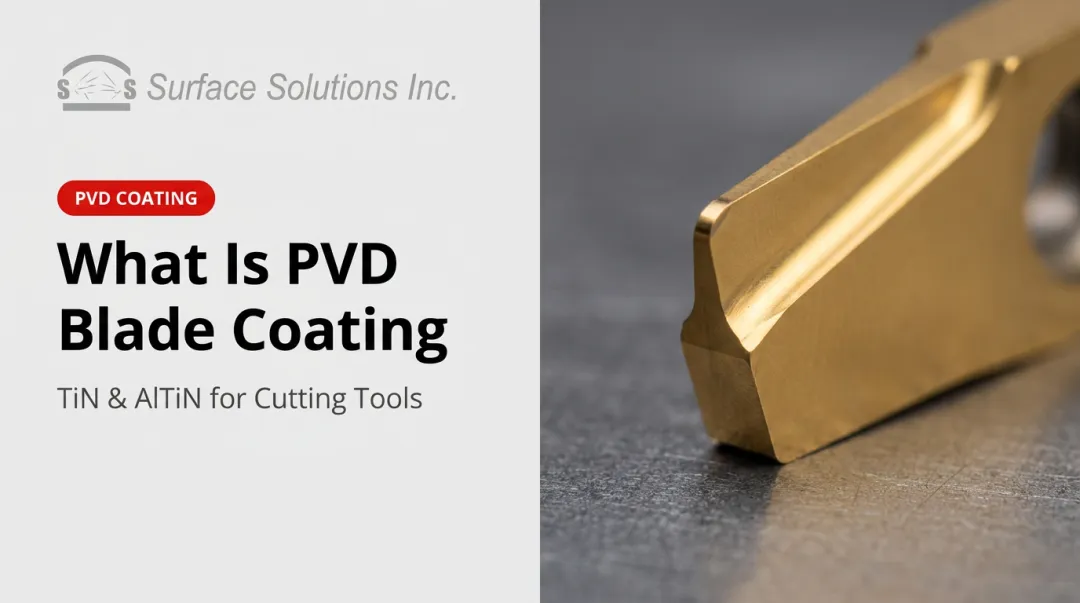
- Titanium Nitride (TiN): General-purpose workhorse known for hardness and a gold-toned finish. Common on cutting tools, stamping dies, and injection molds.
- Chromium Nitride (CrN): Low-friction, high-release coating that cuts galling and heat buildup in high-volume stamping of stainless and galvanized materials.
- Alpha™: Surface Solutions' proprietary coating that extends sharpening intervals well beyond standard TiN. In field use, Alpha-coated punches ran over 15 months on galvanized steel with almost no buildup.
Other common options include AlTiN for high-heat cutting and TiCN for abrasive wear. Typical industrial applications include:
- Metal forming and sheet metal drawing
- Punching and stamping dies
- Cutting tools and carbide components
- Medical device manufacturing, where tight tolerances and long tool life matter most
Choosing a PVD Ion Plating Provider
Not all coating providers deliver the same consistency or support. Before committing to a partner, manufacturers should look for:
- Turnaround time that fits production schedules without creating bottlenecks
- Coating consistency across batches, not just on a single sample part
- Technical support for selecting the right coating chemistry for the application
- Proven performance data from real production environments, not just lab conditions
Surface Solutions checks these boxes for manufacturers in Minnesota, Wisconsin, and the Upper Midwest, plus customers in California, New York, Florida, Canada, and Mexico. Its Fridley, Minnesota facility ships parts to and from most of the country within one to three days.

Manufacturers like Special Tools, Inc. and K&C Manufacturing rely on Surface Solutions for coating work.
Special Tools' owner Tony Deschenes said tools sent for coating came back "working better than new." K&C Manufacturing's CFO Angela Naasz reported that Alpha™ cutters may have eliminated an entire manufacturing step, saving substantial processing time.
If you're weighing PVD ion plating for your tooling, call Surface Solutions at 763-785-9436 to discuss your specific application.
Frequently Asked Questions
What does ion plating mean?
Ion plating is a PVD process that uses ionized particles to clean a substrate surface and control coating growth as it forms. The result is a thin, extremely durable metallic layer bonded tightly to the part.
Is ion plating better than gold plating?
Ion-plated coatings are generally harder and more wear-resistant than traditional gold electroplating, particularly for high-wear industrial or consumer applications. Gold electroplating, however, can offer more ductility in low-stress decorative uses.
Will ion plated stainless steel tarnish?
Ion-plated stainless steel resists tarnishing well because the dense, tightly bonded coating layer limits the defects that lead to corrosion. Actual performance still depends on the specific coating type and how the part is maintained.
How long does PVD ion plating last on industrial tools?
Lifespan varies by application and coating type, but manufacturer data shows tool life increases of 1.5x to 3x are common, with some documented cases reaching 4x to 6x over uncoated tools. Real-world results depend on the material being processed and operating conditions.
Is PVD ion plating the same as PVD coating in general?
No. PVD is the broader umbrella of vacuum coating technologies, while ion plating is a specific technique within it, distinguished by ion bombardment that improves adhesion and coating density.
How much does PVD ion plating cost for tooling?
Cost depends on part size, coating type selected, and production volume. Most manufacturers offset the expense quickly through reduced resharpening, lower labor hours, and fewer replacement parts. Contact Surface Solutions at 763-785-9436 for a quote specific to your tooling.