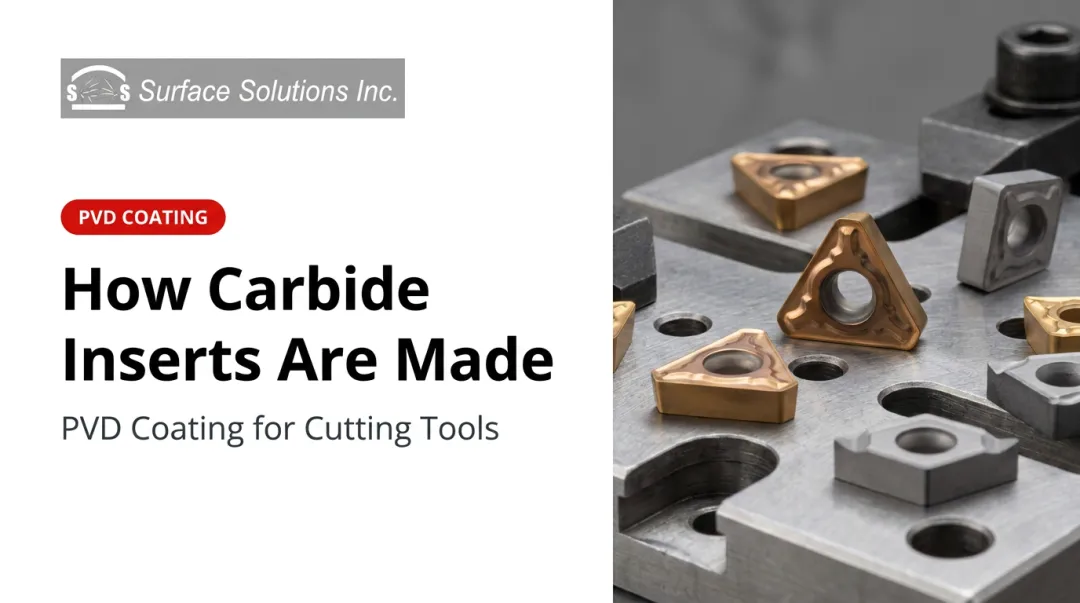
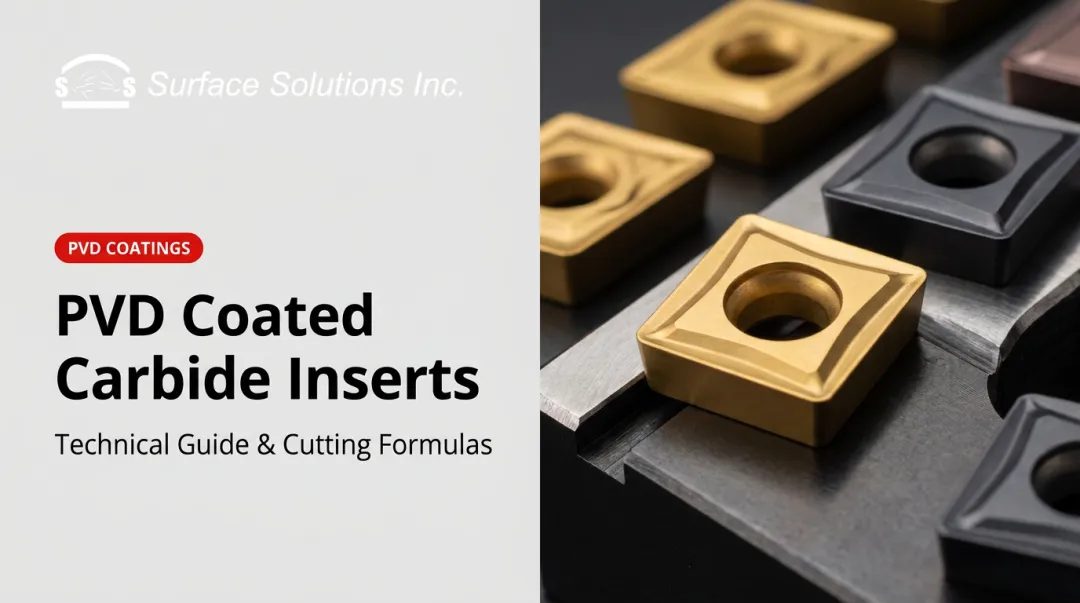
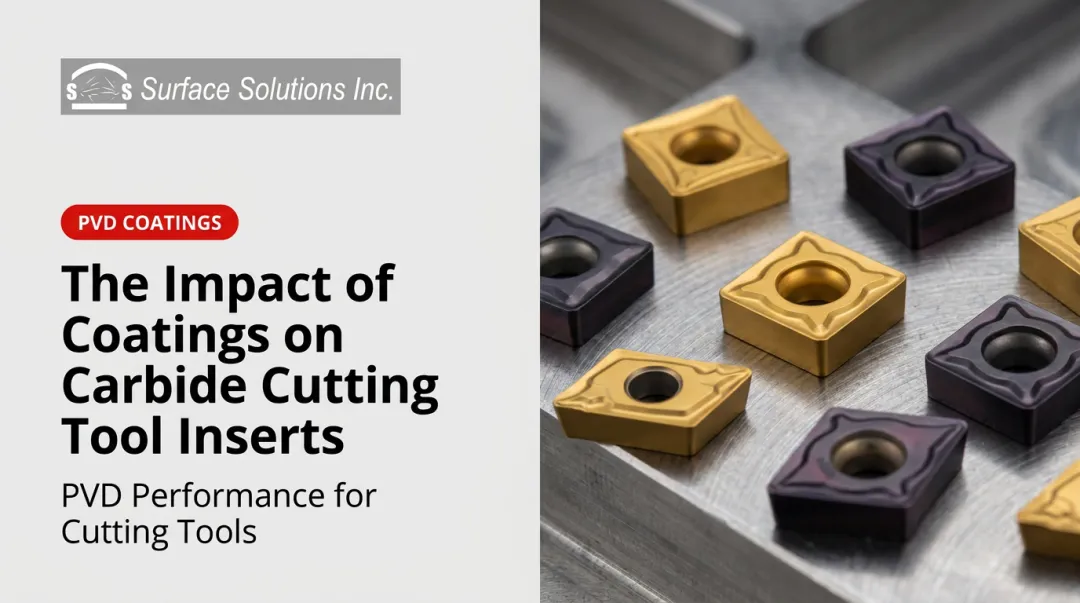
The trouble is that coating benefits often get discussed in vague terms: "extends tool life," "reduces friction." Real value shows up somewhere else entirely: parts-per-edge, cycle time, and cost-per-part on the shop floor. This article breaks down the practical advantages of coated carbide inserts and how to pick the right coating for measurable gains.
TL;DR
- Coatings cut wear, friction, and heat at the cutting edge, extending usable tool life
- Match TiN, TiCN, AlTiN, or PVD/CVD process to workpiece material and cutting speed
- Coated inserts reduce downtime, lower cost-per-part, and improve surface finish
- Wrong coating choice erases these gains; material and application drive the pick
What Are Carbide Insert Coatings?
A carbide insert coating is a thin, hard layer, typically applied through PVD or CVD deposition, bonded to the insert's surface to boost wear, heat, and friction resistance. The coating acts as a functional barrier between the cutting edge and everything trying to destroy it.
These coatings show up across turning, milling, drilling, threading, and forming operations, spanning automotive, aerospace, medical, and general manufacturing. The goal is straightforward: extend usable tool life and push more parts through each edge before it needs attention.
Key Advantages of Carbide Insert Coatings
Hardness ratings on a spec sheet only go so far. Parts-per-edge, downtime, and rework rate show what a coating actually delivers once it starts cutting metal in production.
Extended Tool Life and Reduced Resharpening Frequency
Coatings form a hard barrier that resists abrasive and adhesive wear at the cutting edge. That barrier translates directly into more parts produced before an insert needs replacing or resharpening.
Published tool-life multipliers vary widely by coating and application. According to a Canadian Metalworking comparison of coating types, TiN can deliver 3-4x longer life versus uncoated carbide, TiCN roughly 5x, and AlTiN up to 14x in favorable applications.
These are application-specific claims, not guarantees. Results depend heavily on workpiece material, speed, and wear criteria.
Surface Solutions has documented similar patterns with its own Alpha™ coating. One customer running press tooling reported 60,000 parts produced without resharpening, compared to a normal resharpening point of 10,000 parts — a sixfold improvement.
Avoiding six sharpening cycles saved 48 labor hours, since each removal-and-resharpening cycle took roughly 8 hours.

KPIs impacted:
- Tool life and cost-per-part
- Labor hours spent on resharpening
- Machine utilization and uptime
This advantage matters most in high-volume runs or when machining abrasive materials like cast iron or hardened steel, where uncoated edges degrade fast.
Reduced Friction and Heat for Better Process Stability
Coatings lower the coefficient of friction between insert and workpiece. Less friction means less heat buildup, which prevents plastic deformation and built-up edge (BUE), two of the fastest ways to ruin a cutting edge mid-run.
A peer-reviewed study on dry orthogonal cutting of hardened H13 steel found that a PVD TiAlN-coated carbide tool ran significantly cooler than an identical uncoated tool. At cutting speeds of 50, 100, and 150 m/min, temperature differences reached as high as 168°C at the higher speed.
At 800°C friction-test conditions, the coefficient of friction measured 0.63 for TiAlN versus 0.75 for uncoated tooling.
Lower heat allows higher cutting speeds and feeds without sacrificing tool integrity. That stability shows up directly in part quality:
- Fewer thermal-damage rejects
- More consistent dimensional accuracy across long runs
- Higher achievable cutting speeds without edge failure
This matters most in continuous operations such as turning, dry machining, or high-speed milling of superalloys and titanium, where heat has nowhere to escape.

Improved Surface Finish and Reduced Secondary Operations
A smoother, harder coated surface reduces material adhesion and chip smearing. That means cleaner cuts and more consistent part dimensions across a full production run.
A 2025 dry-milling study published in Scientific Reports found that TiAlN-coated carbide produced Ra values of 0.3-0.55 micrometers, compared to 0.7-7.8 micrometers for uncoated carbide on a hybrid aluminum composite. That's a substantial jump in finish consistency from the coating alone.
Surface Solutions has seen the same pattern qualitatively. One metal-forming customer, machining thick Grade 80 hot-rolled material, reported that operators used to polish tooling several times per run.
After switching to Alpha™ coating, they never had to polish again, while also using less lubricant and producing better-looking parts.
KPIs impacted:
- Surface finish consistency (Ra)
- Secondary operation costs and rework rate
- Customer returns tied to finish quality

Common Coating Types and Where They Perform Best
Not every coating fits every job. Matching coating chemistry to material and operating conditions is where the real savings happen.
- TiN: General-purpose and cost-effective for mild steels at moderate speeds. A solid starting point when heat and wear demands are not extreme.
- TiCN and AlTiN: Tougher choices for stainless, abrasive materials, or high-heat work where TiN wears through too fast.
- PVD coatings: Thinner layers deposited at lower temperatures that protect sharp edges and tight-tolerance geometry.
CVD layers run thicker and can round over precision edges, so PVD is usually the better fit for finishing and tight-tolerance inserts.
Surface Solutions applies PVD coatings, including TiN, AlTiN, TiCN, and its proprietary Alpha™ formulation, at about 2-5 microns on carbide inserts. That thin film helps keep original insert geometry intact.
The result is longer tool life, less maintenance, and more consistent output quality in cutting and forming work.

What Happens When Coating Selection Is Ignored or Mismatched
Choosing a coating without matching it to material and operation carries real consequences:
- Premature tool failure and inconsistent part quality
- Increased unplanned downtime for resharpening or replacement
- Higher scrap rates from heat damage or built-up edge
- Rising per-part costs that erode margins over time
A stainless-steel drawing job makes the point. Alpha™-coated tooling produced only 15 parts before running too hot to touch. The same application with CrN produced more than 500 parts and stayed just warm.
Same operation, different coating, wildly different outcome.
How to Get the Most Value from Coated Carbide Inserts
Coating investment pays off when it's treated as an ongoing decision, not a one-time purchase.
- Match the coating to the material and operation. Skip a generic default just because it worked on a prior job.
- Track performance over time. Log parts-per-edge and wear patterns so you can prove the coating is earning its cost.
- Revisit the choice when conditions change. New materials, higher speeds, or tighter tolerances can turn a solid coating pick into a weak one.
Conclusion
Coating selection directly drives tool life, cost control, and part quality. Treat it as a core production choice, not a minor line on a purchase order. Gains compound over time: fewer changeouts and less downtime free capacity for higher throughput. Review coating strategy on a regular cycle instead of locking it in once and moving on.
Frequently Asked Questions
What is the best coating for carbide tools?
It depends on the workpiece material and operation. AlTiN and TiAlN suit high-heat, high-speed jobs, while TiN or TiCN work well for general-purpose and abrasive material applications.
What is the difference between PVD and CVD coatings?
PVD is thinner and applied at lower temperatures, preserving sharp edges and tight tolerances. CVD runs thicker and is better suited to heavy-duty roughing inserts where edge sharpness matters less.
How much longer do coated carbide inserts last compared to uncoated ones?
Published multipliers range from roughly 3-5x for TiN or TiCN in some applications. AlTiN can reach 10x or more in favorable conditions. Actual results vary by material, speed, and coating type.
Can carbide inserts be recoated after resharpening?
Many inserts can be stripped, resharpened, and recoated to extend service life cost-effectively. Check with your coating provider on specific limitations for your insert geometry and coating type.
Does coating affect insert sharpness or geometry?
Thin PVD coatings, typically 2-5 microns, preserve edge sharpness and original geometry. This makes PVD the preferred choice for precision applications requiring tight tolerances.
How do I know if my current coating is a poor match for my application?
Watch for inconsistent tool life, built-up edge, excessive heat at the cutting edge, or variation in surface finish. Any of these is a sign it's time to reevaluate your coating choice.